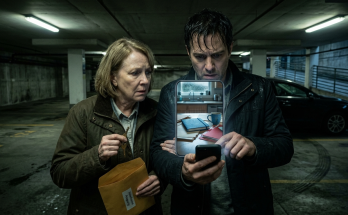
At sixty, I had learned that financial trouble rarely arrived with drama. It came quietly, disguised as ordinary inconveniences: a pharmacy receipt I folded twice before putting back in my purse, an electric bill left unopened until payday, a grocery cart containing everything except the things I actually wanted. That Tuesday morning, trouble arrived in the passenger seat of my daughter Paula’s car, inside a thick yellow folder she refused to let me touch.
“You brought enough paperwork to buy a house,” I said as she pulled away from my curb.
Paula gave a quick laugh, but she kept both hands on the steering wheel. “Government offices love paperwork.”
I watched the folder balanced against her purse. My name was written across one corner in black marker: SUSAN MILLER. Beneath it were several numbers I couldn’t read from where I sat.
“What exactly are we fixing today?”
“Your Social Security situation.”
“I didn’t know I had a Social Security situation.”
She sighed in the patient way adult children sometimes sigh when they have decided their parents are becoming difficult. “Mom, we talked about this. You should be receiving more than you are. Jared thinks something may be wrong with your record.”
The mention of my son-in-law tightened something in me.
Jared Thompson always had opinions about my money. He had opinions about my house, too, particularly the fact that I owned it outright. Once, during Thanksgiving dinner, he had called the place “a surprisingly valuable little asset.” I remembered looking around at the scratched dining table, the faded curtains, and the radiator that clanked every winter and wondering when my home had become an asset instead of the place where I lived.
“I can speak for myself,” I told Paula.
“I know.”
“Then why is Jared involved?”
“He isn’t involved. He just helped me figure out what documents you needed.”
Her answer came too quickly.
I turned toward the window. Pontiac slid past in familiar pieces: laundromats, gas stations, small brick houses, a church with a hand-painted sign promising a fish dinner on Friday. I had lived long enough to know the difference between suspicion and evidence, and I had no evidence that my daughter was doing anything except helping me.
Paula had been helping more often lately.
Three years earlier, she had begun taking over little administrative tasks. Online bills. Insurance forms. Password resets. She had even asked to borrow my Social Security card once, saying she needed the number while helping with a health insurance application. I had handed it over without hesitation.
She was my daughter.
That had seemed like reason enough.
My trust in her had roots deeper than paperwork. When Paula was nine, her father disappeared.
Sam Miller left for work one morning and never came home.
For years, I searched. I called hospitals. I filed reports. I checked names in newspapers and missing-person databases. I followed rumors that led nowhere. At first I believed something terrible must have happened to him. Later, after enough birthdays and Christmases passed without a word, I allowed myself to consider the possibility that he had simply chosen another life.
Paula hated that possibility.
“Dad wouldn’t leave me,” she once said when she was fourteen.
I had been standing at the kitchen sink. I remembered gripping a wet plate and saying nothing because there was no answer that wouldn’t hurt her.
Eventually, we began referring to Sam in the past tense.
Not because anyone had proved he was dead.
Because waiting forever had become another form of grief.
Paula pulled into the Social Security office parking lot shortly after nine. Before turning off the engine, she reached for the yellow folder.
“I’ll handle most of the talking.”
I looked at her. “Why?”
“You get frustrated with these offices.”
“I get frustrated when people don’t answer questions.”
“That’s exactly what I mean.”
I smiled slightly. “Then they should answer my questions.”
She didn’t smile back.
Inside, the air-conditioning was so cold that I rubbed my forearms. Plastic chairs formed neat rows beneath fluorescent lights. A television mounted near the ceiling displayed numbers while people waited with folders, envelopes, canes, strollers, and tired expressions.
Paula checked us in.
“What did you put as the reason for the appointment?” I asked.
“Benefits review.”
She sat beside me and opened the folder just enough to look inside.
I caught sight of photocopies.
My driver’s license.
A bank statement.
Something bearing my signature.
“Paula.”
She closed the folder.
“What?”
“Why do you have a copy of my bank statement?”
“It was on the list.”
“What list?”
“The documents they might need.”
“Let me see it.”
She hesitated.
It lasted perhaps one second.
But mothers become experts at reading their children in seconds.
Then she handed me the folder.
Before I could open it, the electronic board changed.
MILLER, SUSAN.
WINDOW 6.
“That’s us,” Paula said, immediately taking the folder back.
The woman behind Window 6 wore glasses on a chain and a name badge that read BRENDA. She looked somewhere in her fifties, with the expression of someone who had spent years explaining complicated rules to impatient strangers.
“Good morning,” she said. “Susan Miller?”
“That’s me.”
Paula pushed the folder through the opening.
Brenda looked at it, then at me.
“And you are?”
“Her daughter. Paula Thompson.”
“Are you an authorized representative?”
Paula paused.
“No. I’m just helping my mother.”
Brenda returned her attention to me. “Mrs. Miller, what can we do for you?”
I opened my mouth.
Paula answered first.
“We believe there’s a problem with her retirement benefits.”
Brenda’s eyes shifted between us.
“What kind of problem?”
“She hasn’t been receiving the amount she should.”
Brenda asked for my identification.
I gave her my driver’s license.
She typed my name.
Then my date of birth.
Then my Social Security number.
Her fingers stopped.
She looked at the monitor.
Then at my license.
Then at me.
“Could you confirm your date of birth again?”
I did.
She typed something else.
“Current address?”
I gave it.
Paula leaned closer to the counter.
“Is something wrong?”
Brenda ignored her.
“Mrs. Miller, have you recently had any problems with your Social Security number?”
“No.”
“Banking issues?”
“No.”
“Identity theft?”
“Not that I know of.”
Her expression changed.
Not dramatically.
That made it worse.
She stood.
“I need to speak with my supervisor.”
Paula immediately asked, “Why?”
“I’ll be right back.”
She walked away.
I looked at my daughter.
“What is going on?”
“Probably nothing.”
“You don’t look like you think it’s nothing.”
“I’m fine.”
She wasn’t.
Her right foot had begun bouncing beneath the chair.
I remembered that habit from childhood. Paula had done it before school performances, before dental appointments, before telling me she had broken a neighbor’s window.
“What aren’t you telling me?”
“Nothing.”
“Paula.”
“Mom, please.”
That word stopped me.
Please.
Not Mom, relax.
Not You’re imagining things.
Please.
As though she wanted me to stop asking because she feared the answer.
Brenda returned with a man wearing a supervisor badge. They spoke quietly several feet from us while looking toward the computer.
The supervisor typed.
Brenda pointed at something.
He frowned.
Then he looked directly at me.
I felt suddenly aware of my own body: my breathing, the ache in my left knee, the pulse beating in my neck.
Whatever that computer said, I knew one thing it apparently did not.
I was sitting there.
The supervisor approached.
“Mrs. Miller, could I see another form of identification?”
“I have my Medicare card.”
“That would help.”
I handed it over.
He compared the cards.
“Do you have a passport?”
“No.”
“Birth certificate?”
“At home.”
Paula stood.
“We can get it.”
The supervisor raised one hand.
“Please remain here for the moment.”
Her face drained of color.
That frightened me more than anything he had said.
“Why can’t we leave?”
“No one is preventing you from leaving,” he said carefully. “We’re trying to understand an inconsistency.”
“What inconsistency?”
He glanced toward Brenda.
She returned to her chair.
“Mrs. Miller,” she said, “have you ever used another last name?”
“My maiden name was Parker.”
“Anything else?”
“No.”
“Have you ever lived outside Michigan?”
“No.”
“Have you ever reported your Social Security card stolen?”
“No.”
“Have you requested a replacement card recently?”
“No.”
Brenda studied the monitor again.
Paula gripped the back of my chair.
I could feel her fingers trembling through the plastic.
“Paula,” I said quietly.
She withdrew her hand.
Brenda asked another question.
“Do you receive any payments through another bank account?”
“No.”
“Are you certain?”
“I think I’d know if someone was sending me money.”
Her expression told me that was precisely the problem.
I leaned forward.
“Brenda, I’m sitting right here. Whatever you see on that computer, tell me.”
The supervisor whispered something to her.
She nodded.
“Mrs. Miller, the system isn’t recognizing you as currently eligible for the benefits your daughter asked us to review.”
“Why?”
Another pause.
Behind me, someone coughed. A baby began fussing. The electronic board chimed and called another number.
Ordinary sounds.
Yet the space around Window 6 seemed to have gone still.
Brenda looked at me.
“According to the record we’re seeing, your status changed approximately three years ago.”
“To what?”
She didn’t answer immediately.
Paula stepped between us.
“We should go get Mom’s birth certificate.”
“No,” I said.
“Mom.”
I turned toward her.
She looked frightened.
That was when I understood that whatever Brenda was about to say, my daughter wanted me outside before I heard it.
I faced the counter again.
“What does your record say happened to me three years ago?”
Brenda took a slow breath.
Then she turned the monitor slightly away from the waiting room.
“Mrs. Miller,” she said, “our system says you died.”