The following Christmas Eve began with noise.
Not the frightening kind.
The good kind.
My grandson was arguing that whipped cream counted as a dairy serving.
My granddaughter was sitting cross-legged beneath the tree, inspecting every gift tag despite repeated instructions not to.
Caleb stood in the kitchen wearing an apron that said ASK GRANDMA.
I had not bought it.
Mara had.
“I hate all of you,” I told them.
My grandson shouted from the dining room, “Grandma said hate!”
“Context matters.”
He did not know what that meant.
He repeated it anyway.
A year earlier, I had stood in the same kitchen surrounded by groceries meant for people who had secretly left town.
Now the refrigerator held less food.
That was deliberate.
I no longer cooked for fourteen when six people were coming.
I no longer bought three desserts in case someone changed plans.
I no longer treated abundance as insurance against disappointment.
Caleb had brought the ham.
Mara brought wine and potatoes.
I made vegetables, bread and dessert.
The children were responsible for setting the table.
My grandson placed every fork on the wrong side.
I left them there.
Growth.
There was no resort reservation.
No secret itinerary.
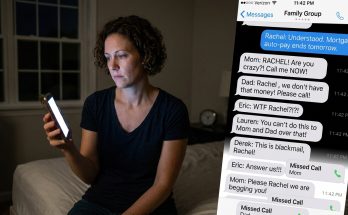
No deleted family chat.
No assumptions.
We had planned Christmas in November.
Caleb asked whether I wanted to host.
I said yes.
He asked what he should bring.
I told him.
Mara asked whether she could stay two nights.
I said yes.
Everyone knew where they were sleeping.
Everyone knew when they were arriving.
Nobody’s place at the table depended on who paid.
It was almost embarrassingly ordinary.
That was exactly what I wanted.
Sloan was not there.
Her marriage to Caleb had legally ended months earlier.
I had no direct relationship with her beyond what remained necessary through legal processes and the children’s family structure.
I did not ask Caleb for updates about her life.
If something affected the grandchildren, he told me.
Otherwise, I did not need to know.
Her parents were no longer part of our lives.
The criminal case and related proceedings had produced consequences for the fraud and forgery established through the investigation.
I learned that accountability was rarely as cinematic as people imagined.
There was paperwork.
Negotiation.
Hearings.
Lawyers.
Admissions.
Disputed details.
Financial recovery.
Restrictions.
Sentencing consequences.
No single dramatic gavel strike made the year disappear.
The important part for me was simpler.
They had failed to take my house.
They had failed to take control of my finances.
They had failed to turn forged consent into reality.
And they could no longer enter my life merely because they once belonged inside it.
At four, the children went outside to see whether the thin layer of snow was sufficient for sledding.
It was not.
They attempted anyway.
Caleb stood beside the window.
“My son is going to hit that bush.”
“He gets his athletic ability from you.”
“He absolutely does not.”
The sled turned sideways.
My grandson disappeared into the bush.
Three seconds later, one mitten rose triumphantly.
Caleb sighed.
“See?”
I laughed.
He went outside.
I watched him help both children drag the sled back uphill.
He looked different from the man who had called me from the mountain resort a year earlier.
Not dramatically.
He had not become taller, richer, wiser in every situation, or magically free of bad judgment.
He had become accountable.
That was less glamorous.
More useful.
His apartment remained small.
His debt remained substantial, though lower.
His job was going well.
He had not asked me to pay his attorney.
He had not asked me to replace his car.
He had not asked me for a down payment.
He did not know exactly what my estate plan contained.
Most importantly, he no longer acted as though not knowing was an injury.
Mara came beside me.
“You’re staring.”
“I’m allowed.”
“At what?”
“My family.”
She looked outside.
“You mean the one that survived?”
I glanced at her.
“That sounded darker than necessary.”
“I drove seven hours last Christmas. I earned dramatic language.”
“You remind me constantly.”
“I’ll stop when I’m dead.”
“Put that in your estate plan.”
She laughed.
The children returned wet.
The bush had won.
We ate at six.
No speeches.
I had considered making one.
Then decided families did not need to convert every meal into a lesson.
My granddaughter told us about school.
My grandson explained a video game I did not understand.
Mara complained about a neighbor.
Caleb admitted he had forgotten to buy batteries for one of the children’s gifts.
Ordinary problems.
Wonderful problems.
After dinner, we opened presents.
My granddaughter gave me a framed drawing of the house.
This one was more detailed than the chalk version from summer.
There was the front porch.
The upstairs window.
The maple tree.
Five people stood outside.
Me.
Caleb.
The children.
Mara.
Above us she had written:
CHRISTMAS AT GRANDMA’S.
I hugged her.
“Do you like it?”
“I love it.”
“I made the roof too big.”
“The roof is perfect.”
My grandson gave me a coupon book.
One coupon promised FREE HUG.
Another promised CLEAN KITCHEN.
I asked whether the second one had legal enforceability.
Caleb said absolutely not.
The children went to watch a movie.
Mara fell asleep halfway through it.
At ten, I found Caleb alone in the kitchen washing glasses.
“You don’t have to do those.”
“I know.”
That answer pleased me.
He kept washing.
I dried.
After a while, he said, “Can I tell you something without ruining Christmas?”
“That depends entirely on what it is.”
“I’ve been thinking about last year.”
“That was predictable.”
“I know.”
He rinsed a glass.
“I’m glad you canceled the trip.”
My hands stopped.
“That is new.”
“I hated you for it that night.”
“I know.”
“I thought you were punishing us.”
“Partly I was protecting myself.”
“I understand.”
He set the glass in the rack.
“If you hadn’t canceled, I don’t think I would have looked at Sloan’s laptop.”
I said nothing.
“We would have checked in.”
“Yes.”
“Victor wouldn’t have panicked about the hotel cost.”
“Probably.”
“Sloan wouldn’t have blamed me for not controlling you.”
I looked at him.
“She blamed you?”
“Immediately.”
“I didn’t know.”
“She said I should have known you might cancel.”
“That sounds like her.”
“She started calling Victor. They argued. She took my phone because she said I was making things worse. That’s when I realized something was off.”
I remembered the borrowed phone.
Caleb outside.
His fear.
“I went looking for information because I thought she was hiding money from me.”
“And she was.”
“Yes.”
“Among other things.”
He nodded.
“If the reservation had stayed active, everyone might have been happy enough to keep pretending.”
The sentence settled between us.
“They would have come back after Christmas,” I said.
“Victor would have talked to you.”
“I would have said no.”
“Would you?”
I looked at him.
He immediately raised a hand.
“Sorry. That sounded wrong.”
“No.”
I considered the question honestly.
Would I?
Before Christmas Eve, if Caleb had sat across from me with the children nearby and said they needed their own life—
If Sloan had said my stairs were becoming unsafe—
If Victor had presented polished numbers—
If forged documents suggested Daniel had reviewed everything—
If a doctor’s statement suggested my illness had affected my judgment—
If Caleb threatened to move farther away—
Would I have refused?
“I don’t know.”
Caleb looked surprised.
“I want to say yes.”
“But?”
“I had spent years making decisions based on keeping everyone close.”
He looked down.
“I’m sorry.”
“I know.”
“I think that’s why Sloan was so sure.”
“Yes.”
“She knew you loved us.”
“She mistook love for control.”
“So did I.”
That was the difference.
He could say it now.
I picked up another glass.
“Canceling the trip saved the house.”
Caleb shook his head.
“More than that.”
“What?”
“It saved us.”
I looked at him.
He leaned against the counter.
“If the plan had worked, maybe I would have found out later.”
“Yes.”
“Maybe after the house sold.”
“Yes.”
“Maybe after your money moved.”
“Yes.”
“Maybe after Sloan left.”
The overseas account.
The draft email.
The children.
“Yes.”
He rubbed his forehead.
“I would have lost you anyway.”
“Probably.”
“And maybe the kids.”
“Possibly.”
“And I would have deserved a lot of it.”
I did not answer.
He looked toward the living room.
“I used to think the worst thing that could happen was our family breaking apart.”
“And now?”
“The worst thing was what we were willing to do to keep pretending it wasn’t already broken.”
That was painfully accurate.
I put the towel down.
“You’ve become annoyingly thoughtful.”
“Therapy.”
“Expensive?”
“Very.”
“Worth it?”
He smiled.
“Yes.”
“Then keep paying for it.”
“Of course that’s your takeaway.”
We finished the dishes.
At midnight, the children insisted everyone stand near the tree for a photograph.
Mara complained about her hair.
I told her history would survive.
Caleb set the timer.
He ran into position.
The camera flashed.
For one instant, all of us were caught together.
Not perfect.
Not restored to what we had been.
Something newer.
After the children went to bed, I stood alone in the living room.
The wooden house ornament Caleb had made hung near the center of the tree.
HOME IS WHERE YOU ARE LOVED.
I had added nothing to it.
No correction.
No footnote.
I understood the missing part without words now.
Love needed respect.
Love needed consent.
Love needed room for no.
Otherwise, it could become possession wearing a kinder face.
The next morning, I woke before everyone else.
Christmas Day.
I walked downstairs.
The house was quiet.
For half a second, the silence carried me backward.
Empty driveway.
Missing luggage.
Deleted chat.
Canceled reservation.
Then I heard my grandson snore from the sofa.
A small foot stuck out from beneath a blanket.
Mara’s suitcase sat beside the stairs.
Caleb’s coat hung by the door.
My granddaughter’s drawing rested against the fireplace.
This silence was different.
Nobody had disappeared.
Nobody had excluded me from my own family while spending my money.
Nobody was planning my future in another room.
They were simply asleep.
I made coffee.
Then I sat beside the tree and waited for them to wake.
Click here to continue reading: PART 20: Caleb Finally Thanked Me for Canceling Christmas, and I Understood Why Saving My House Had Required Saving My Right to Say No
On Christmas Eve I Found an Empty House, a Missing Family Chat, and a Vacation Nobody Had Mentioned
Part 19 of 20