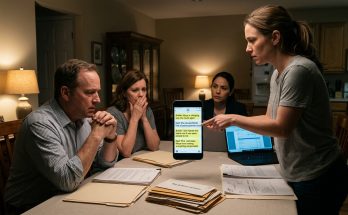
I knew exactly where Robert’s laptop had once been kept.
The desk was built into the wall of the small downstairs room we called the den, though it had gradually become a storage space for fishing licenses, instruction manuals, old photographs and whatever else nobody wanted to throw away.
Robert used the laptop there during our final summers together.
After he died, I stopped opening it.
Not deliberately at first.
There was simply no reason.
My own computer contained the household records I needed. Marisol had the important estate documents. Robert’s machine held tax spreadsheets, scanned receipts, photographs and the thousand little files accumulated by a man who believed deleting anything might someday prove regrettable.
Eventually the laptop became part of the cabin itself.
Something I expected to see when I opened the desk drawer.
Until I stopped noticing it.
Now I could not remember the last time I had actually seen it.
Claire and I drove to Cedar Lake that afternoon with Marisol following behind us.
The temporary court order remained in effect. Derek had no permission to enter, rent, manage or modify the property.
I had also hired a locksmith to replace the remaining physical cylinders rather than relying only on electronic codes.
For the first time since the ordeal began, I knew exactly who could open my doors.
That should have made me feel secure.
Instead, I spent the drive thinking about all the years when Derek could.
We entered through the kitchen.
Nothing looked disturbed.
The rental materials remained boxed near the dining room wall.
Robert’s leather folder sat in my bag.
I carried it into the den.
The desk smelled faintly of cedar and dust when I opened it.
The laptop was gone.
I stared at the empty space.
Claire looked over my shoulder.
“You’re sure it was here?”
“Yes.”
“When did you last see it?”
“I don’t know.”
“That could mean years.”
“Yes.”
She opened the lower drawers.
Charging cables.
An old wireless mouse.
Two flash drives.
Printer paper.
No laptop.
Marisol stood in the doorway.
“Do you know the make and model?”
“Dell. Dark gray.”
“Serial number?”
“Maybe in Robert’s records.”
We searched.
The original receipt was still in an envelope.
Robert had purchased the computer six years before his death.
The serial number was printed near the bottom.
Marisol photographed it.
Then Claire found the first useful clue.
The charger.
It wasn’t in the desk.
“That doesn’t prove anything,” I said.
“No.”
“But if someone took the laptop to use it—”
“They probably took the charger.”
We searched the entire cabin.
Closets.
Storage room.
Bedroom cabinets.
The shelf above the washing machine.
Nothing.
Then I remembered something.
“Derek borrowed a computer once.”
Claire turned.
“When?”
“I don’t remember.”
The memory came slowly.
A rainy weekend.
Robert had already died.
Derek needed to finish some work but had left his laptop at home.
I told him there was an old computer in the den.
“Did he take it?”
“I thought he used it here.”
Claire’s face tightened.
“What year?”
“Maybe two years ago.”
That widened the timeline dramatically.
Marisol asked whether Robert’s computer had a password.
“Yes.”
“Did Derek know it?”
“I doubt it.”
“What was it?”
I almost smiled.
“Claire’s birthday followed by an exclamation point.”
Claire closed her eyes.
“Dad.”
“He wasn’t good at passwords.”
“So Derek could have guessed it.”
“Anyone who knew Robert could.”
The more troubling question was whether Derek had guessed it accidentally while borrowing the laptop or deliberately while searching for information.
We could not answer that yet.
Then Marisol asked, “Did Robert back up his files anywhere?”
I pointed toward the two flash drives.
One contained photographs.
The other was mostly tax records.
No trust amendment.
No estate scan matching the file used for my signature.
Then I remembered Robert’s external drive.
It was small, black and usually lived inside a blue zippered case.
We found the case in the hall closet.
Empty.
Claire looked at me.
“Was the drive always in this?”
“Yes.”
“So both are gone.”
“Yes.”
The coincidence no longer felt innocent.
Marisol told us not to search Derek’s belongings ourselves.
Claire’s family-law attorney could address property in the marital home. If the laptop or drive was there, it needed to be recovered properly.
We documented the empty desk and case.
Then Claire walked toward the window.
“Mom.”
Something in her voice made me look up.
“What?”
“Did Dad have cloud backup?”
“I don’t know.”
“He might have.”
She remembered Robert helping her recover photographs after her old phone failed. He had bragged about keeping copies “in three places because computers were untrustworthy.”
That sounded exactly like him.
We searched his old email account from my phone.
I still had legal access because it had been transferred to me after his death.
Buried among old receipts was a subscription renewal for an online backup service.
The account had remained active for almost two years after Robert died because I had forgotten to cancel the automatic charge.
Marisol asked me to stop.
“Don’t log in from here.”
“Why?”
“If there are access records, I want them preserved before we accidentally complicate them.”
Back at her office, her technology consultant helped us contact the provider.
The account had been closed years earlier.
But limited historical records remained.
Not the backup files themselves.
Login history.
Device information.
Recovery requests.
My heart began beating harder.
There had been multiple logins after Robert’s death.
Some came from my home.
Those were probably mine.
Several came from Cedar Lake.
That could have been me too.
Then there were logins from an IP address associated with Claire and Derek’s home.
Claire stared at the report.
“When?”
The consultant enlarged the dates.
The earliest was twenty-two months earlier.
Another seventeen months earlier.
Then several during the previous winter.
January.
February.
March.
Derek had been accessing Robert’s backup account before Cedar Lake Ventures existed.
Before the known rentals.
Before Elaine gave him Robert’s letter.
Marisol asked Claire whether she had ever logged into her father’s backup account from home.
“No.”
“Could Derek have done it for you?”
“No.”
“Did you know the account existed?”
“Not until today.”
That removed the simplest explanation.
The provider’s records showed a password-reset request from Claire and Derek’s internet connection.
Recovery had been completed using Robert’s email account.
Derek could have opened Robert’s email on the laptop.
Then used it to reset the backup password.
A closed circle.
“He didn’t stumble onto one file,” Claire whispered.
“No.”
“He went looking.”
We still needed the laptop itself.
Claire’s attorney arranged a supervised retrieval of additional personal items from her marital home the next morning.
A neutral officer accompanied her.
Derek was present.
I waited at Marisol’s office.
Claire called forty minutes later.
“I found it.”
My stomach tightened.
“Where?”
“His office closet.”
“Robert’s laptop?”
“Yes.”
“And the drive?”
“Not yet.”
She sounded furious.
“Mom, he labeled the laptop ‘OLD WORK COMPUTER.’”
I closed my eyes.
“Don’t argue with him.”
“I’m not.”
“Photograph it where it is.”
“I already did.”
The officer documented the machine.
Derek claimed I had given it to him years earlier.
That was false.
But ownership could be sorted out separately.
More importantly, the serial number matched Robert’s receipt.
Claire’s attorney requested that it be preserved because it potentially contained records relevant to ongoing litigation.
Derek’s lawyer objected to Claire removing it.
So the laptop stayed temporarily where it was under written preservation notice.
That frustrated me.
Marisol considered it good.
“Nobody can now credibly say they didn’t know it mattered.”
The external drive remained missing.
Then Claire called again.
“I found something else.”
“What?”
“A folder.”
She sent a photograph.
The label was handwritten.
CEDAR.
Inside were printed copies of Robert’s letter to Elaine.
Old appraisal pages.
Estate notes.
My unsigned property confirmation form.
And a photograph.
I enlarged it on my phone.
It showed Robert and me standing beside the original cabin foundation almost thirty years earlier.
I knew the photograph.
It had lived in one of Robert’s digital folders.
Not framed.
Not printed.
Derek had printed it.
Why?
Claire found the answer on the back.
Derek had written:
Legacy presentation opening image.
My grief had been scheduled into his sales pitch.
I sat very still.
Marisol looked at the photograph.
“He planned to use Robert.”
“Yes.”
Not merely his property.
His memory.
The family presentation Derek intended for July would apparently have begun with Robert and me building Cedar Lake.
Then it would move through Claire’s childhood.
Then the grandchildren.
Then rental revenue.
Then the future.
By the time he reached the purchase proposal, saying no would be framed as rejecting Robert’s legacy, Claire’s security and my grandchildren’s future all at once.
I almost admired the architecture of the manipulation.
Almost.
Claire returned to Marisol’s office two hours later.
She carried copies of the documents but not the originals, which remained preserved at the house.
Her hands shook as she placed them on the table.
“I asked him one question.”
“What?”
“Why he had Dad’s laptop.”
“What did he say?”
“That you gave it to him.”
“I didn’t.”
“I told him that.”
“And?”
“He said you forgot.”
I laughed once.
Of course.
Every inconvenient fact became evidence of my age, grief or forgetfulness.
I had been elderly to the lender.
Emotionally stuck to Elaine.
Financially struggling to Richard.
Uncomfortable with technology to Northwoods.
Now forgetful to Claire.
Derek had created a different weakened version of me for every audience.
Marisol examined the Cedar folder.
One document was especially important.
A printed email from Derek to himself.
Subject: JULY FAMILY MEETING.
It contained an outline.
Start with Robert / legacy.
Show annual carrying cost.
Show revenue proof.
Show expansion.
Claire explains benefit to kids.
Parents explain investment.
Present transfer options.
Preferred: family sale to CLV.
Fallback: management agreement + future transfer commitment.
Avoid lawyers until signed.
I read the final line twice.
Avoid lawyers until signed.
“He knew exactly what he was doing,” Claire said.
Marisol nodded.
“He certainly knew independent advice could interfere with his plan.”
The outline also explained why Claire had been told to keep me away from the cabin.
Derek needed uninterrupted rental dates.
He needed Northwoods to inspect.
He needed improvements visible before the July meeting.
Most importantly, he needed me not to discover the business before he could present it as an accomplished success.
My unexpected June visit would have ruined the sequence.
So Claire had called.
Stay away next week.
A simple request.
The first visible piece of a much larger strategy.
Claire covered her face.
“I made that call.”
“Yes.”
“I helped him.”
“Yes.”
“I keep thinking there should be some version where I didn’t.”
“There isn’t.”
She lowered her hands.
I continued gently.
“But there is a version where you stopped.”
Her eyes filled.
“When?”
“When the truth became more important to you than protecting yourself.”
She looked down.
That was the beginning of forgiveness.
Not the end.
Later that afternoon, the technology consultant called.
He had received additional login metadata from the backup provider.
One January session lasted almost four hours.
During that session, hundreds of files had been accessed.
Estate documents.
Property photographs.
Tax files.
Insurance.
Old appraisals.
Scanned signatures.
Derek had not searched only Cedar Lake.
He had searched everything.
My stomach tightened.
“Everything?”
“Based on file categories, yes.”
“What else did Robert keep there?”
Bank statements.
Investment summaries.
Insurance policies.
Copies of identification.
Our wills.
The consultant could not determine exactly which files had been downloaded.
Only accessed.
Claire whispered, “He knows all of Mom’s finances.”
Possibly.
That created an entirely new problem.
Marisol immediately recommended credit monitoring and security changes for me.
I followed every instruction.
Then the consultant mentioned one final detail.
A file had been accessed repeatedly.
Not Cedar Lake.
Not the trust amendment.
A PDF titled MERCER_PERSONAL_UMBRELLA_2019.
My insurance policy.
“Why would he care about that?” Claire asked.
Marisol’s expression changed.
“Liability coverage.”
The policy included Cedar Lake.
Derek had been renting my property to strangers while studying the insurance that might respond if someone was injured.
The implication made me cold.
He had understood there was risk.
He simply expected my policy to carry it.
Then Marisol asked the consultant whether any insurance correspondence had been found in Derek’s preserved Cedar folder.
Claire suddenly looked up.
“There was something.”
She searched photographs from the house.
Then stopped.
An envelope.
Insurance.
Not mine.
A commercial broker.
Inside, according to the photograph, was a quote for short-term rental liability coverage.
Applicant: Cedar Lake Ventures.
Property owner: Diane Mercer.
Consent status: pending.
Coverage status: not bound.
Not bound.
Derek knew he lacked commercial insurance.
He rented anyway.
Six times.
Families had swum from my dock.
Children had used my canoe.
Guests had lit fires.
If something serious had happened, my personal policy might have denied coverage because the property was being used commercially without disclosure.
For the first time, the money stopped being the worst thing he had risked.
He had exposed everything Robert and I spent our lives building to liabilities I never agreed to assume.
And Derek had known enough to ask an insurance broker about it.
He simply decided to keep renting while he waited.