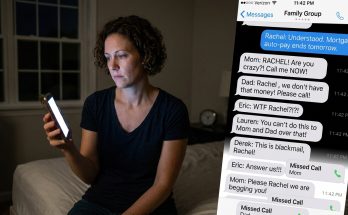
I didn't sleep.
At 2:14 in the morning, Ethan called from the bedroom.
"Brenda."
I was sitting at the kitchen table with my phone in my hand.
"Brenda!"
I went in.
He had kicked off part of his blanket.
"My leg is uncomfortable."
The leg he could barely feel.
I repositioned the cushion beneath it, checked his skin and pulled the blanket back into place.
"Water."
I brought it.
He drank half the glass.
"What's wrong with you?"
"Nothing."
"You've been weird."
"I'm tired."
He gave a short, irritated laugh.
"You're always tired."
I almost smiled.
He had no idea that the woman standing beside his bed had spent the previous hour examining transfers he apparently believed she would never find.
"Go back to sleep," I said.
The next morning, Ms. Paredes called.
The transfers associated with Laura were only part of the problem. Ethan had also moved money into an account I had never seen. Some deposits were small enough to disappear among ordinary household spending. Others were not.
"How much?" I asked.
"We're still determining that."
"Give me what you have."
She did.
I sat down.
For years, I had postponed dental work, bought generic groceries, worn shoes until the soles thinned and told myself we were surviving an expensive medical catastrophe together.
Meanwhile, Ethan had been diverting money.
"Can I confront him?"
"No."
The answer came so quickly that I almost laughed.
Ms. Paredes continued, "Not yet."
"I need to know who Laura is."
"We're working on that."
"I can ask him."
"And give him time to move assets, delete messages or coordinate stories."
I hated how sensible she sounded.
"What am I supposed to do? Make breakfast?"
"For the moment? Yes."
So I made breakfast.
That became the strangest phase of my marriage.
Every ordinary task acquired a second meaning.
When I prepared Ethan's medication organizer, I wondered what else he had hidden.
When I drove him to therapy, I wondered whether Laura had walked those same corridors.
When he asked me to retrieve his phone, I noticed how quickly he turned the screen downward.
Before, I had interpreted secrecy as his desire for independence.
Now secrecy looked like secrecy.
Three days later, my lawyer called me into her office.
"We found Laura."
My mouth went dry.
"Who is she?"
"She had a connection to the rehabilitation center."
"Worked there?"
"Not exactly."
Ms. Paredes slid a page toward me.
"Her father was receiving treatment there."
I read Laura's surname and address.
"Did Ethan know her?"
"That appears likely."
"Likely?"
"I don't want to tell you more than we can establish."
I pushed the paper away.
"Was he having an affair?"
"I don't know yet."
"Those transfers—"
"Could mean several things."
"Such as?"
She held my gaze.
"That's precisely why we're not guessing."
I left angry.
Not at her.
At uncertainty.
Five years of caregiving had trained me to solve problems immediately. Fever meant thermometer. Pressure sore meant repositioning. Prescription running low meant pharmacy. Ethan had needed something, and I had responded.
But betrayal offered no simple procedure.
I had to wait.
That evening, Tomás called while I was washing dishes.
"How's Dad?"
"Fine."
"He said you've been acting strange."
I stopped scrubbing.
"Did he?"
"He thinks you're getting overwhelmed."
"Interesting."
"What does that mean?"
"Nothing."
Tomás lowered his voice.
"Look, Brenda, I know taking care of him isn't easy."
I waited.
"But he's been through hell."
There it was.
The family equation.
Ethan suffered visibly, therefore everyone around him owed him invisibly.
"I know what he's been through."
"Then be patient."
My wet hand tightened around the phone.
"Tomás, when was the last time you stayed with your father for an entire day?"
Silence.
"What?"
"Twenty-four hours. When?"
"I work."
"So do I."
"My situation is different."
"Of course."
He heard something in my voice.
"Are you thinking about leaving him?"
I looked toward the living room.
Ethan was watching television.
"No."
It was my first deliberate lie.
And it felt remarkably clean.
The next development came from Ethan himself.
He left his phone unlocked on the kitchen counter while I was helping him shower.
I did not search it.
Ms. Paredes had specifically warned me against accessing accounts or devices I wasn't legally entitled to enter.
But when I carried the phone back afterward, a notification appeared across the screen.
L: You promised you would handle it before her birthday.
Ethan saw me holding the phone.
His face changed.
Only for a second.
Then he snatched it.
"Why are you reading my messages?"
"I wasn't."
"You were staring at it."
"A notification appeared."
"Give me privacy, Brenda."
The absurdity nearly made me laugh.
Privacy.
I had washed him, dressed him, cleaned him after accidents, changed wound dressings and slept beside hospital machines.
But the glowing rectangle in his hand was sacred territory.
"Fine."
I left the room.
That night, I told Ms. Paredes exactly what I had seen.
"Birthday," she repeated.
"Whose?"
"We don't know."
She was quiet.
Then she said, "I think it's time we formally begin protecting your finances."
We changed the deposit instructions for my wages.
We documented every household expense.
I removed Ethan as an authorized user from one card that belonged solely to me.
I changed passwords to my personal email and financial accounts.
Nothing that belonged to him was touched.
Nothing was hidden.
For once, the rules protected me too.
Ethan noticed the credit card within forty-eight hours.
"Why doesn't this work?"
He was holding my card.
I looked at it.
"Because you're no longer an authorized user."
His face hardened.
"What?"
"It's my personal account."
"We're married."
"Yes."
"Then why are you separating money?"
"I've decided I need clearer records."
"Who put that idea in your head?"
"No one."
He stared at me for several seconds.
"Your sister."
I said nothing.
"I knew it. She's always hated me."
"She doesn't control my bank account."
"Neither should you."
The sentence escaped before he could stop it.
We both heard it.
His expression shifted.
"I didn't mean—"
"I know exactly what you meant."
For the first time, he looked uncertain.
That uncertainty sustained me for days.
Then he changed tactics.
Flowers arrived.
Ethan had not bought me flowers since before his accident.
"What's this?"
"Can't a husband appreciate his wife?"
He smiled.
I touched one of the roses.
"Apparently."
He began saying please.
He complimented dinner.
He apologized for waking me at night.
Had he behaved that way five years earlier, I might have thought my marriage was healing.
Instead, every kindness felt like someone testing a lock.
Then Ms. Paredes called.
"Can you come immediately?"
I arrived twenty-five minutes later.
She closed the office door.
"We have confirmation about Laura."
My heart began pounding.
"Tell me."
"She and Ethan communicated extensively."
"How extensively?"
"Years."
I stared at her.
"While I was taking care of him?"
"Yes."
"Was it an affair?"
"We have enough information to believe the relationship was intimate."
I expected rage.
What came instead was humiliation.
I thought of myself lifting Ethan from bed while another woman received messages from him.
Cooking his dinner.
Driving him to rehabilitation.
Changing his clothes.
Saving money on groceries.
"How long?"
"At least four years."
Four.
Almost the entire period after the accident.
I stood and walked toward the window.
"There's something else, isn't there?"
Ms. Paredes didn't answer quickly enough.
I turned.
"What?"
"Laura has a child."
I felt cold.
"How old?"
"Four."
I understood before she continued.
"No."
"Brenda—"
"No."
"We haven't verified paternity."
"Does Ethan send money for the child?"
"Some transfers appear consistent with that possibility."
I pressed both palms against the edge of her desk.
The room tilted.
For five years, Ethan had told me we couldn't afford professional help.
For four of those years, he may have been supporting another household.
"Does Laura know about me?"
"We don't know what Ethan told her."
I laughed once.
It sounded awful.
"I know."
Ms. Paredes watched me carefully.
"What did he tell you?"
"Nothing. But I know Ethan."
And suddenly I did.
I knew how he would explain me.
Controlling.
Cold.
Unstable.
A wife who refused to let a disabled man live.
Every cruelty required a story that made the cruel person innocent.
"What now?" I asked.
"Now we proceed."
"With the separation?"
"With everything."
When I returned home, Ethan was cheerful.
"Tomás might visit Sunday."
"Fine."
"I thought we could have dinner."
"Fine."
He frowned.
"Are you even listening?"
I looked at him.
Four years.
A child.
A woman named Laura.
"More than I ever have."
That night, I began packing a small bag.
Not to leave.
Not yet.
I placed copies of documents inside and took them to my sister's house the following morning.
Then I photographed the house room by room.
Furniture.
Medical equipment.
Electronics.
Jewelry.
Everything.
Ms. Paredes had told me to establish what was present before Ethan understood the legal process had begun.
On Sunday, Tomás arrived carrying expensive wine.
He barely greeted me before wheeling his father toward the patio.
I was setting the table when I heard them talking through the open window.
"She'll get over it," Tomás said.
Ethan replied, "She always does."
My hands stopped.
"What if she actually leaves?"
Ethan laughed.
"Where would she go?"
The certainty in his voice was almost impressive.
Then he said something that finally explained the architecture of my marriage.
"She has nothing without this house."
I looked around my mother's kitchen.
My mother's cabinets.
My mother's windows.
My mother's house.
Ethan genuinely believed it belonged to him.
And apparently he had convinced Tomás of the same thing.
I walked upstairs, opened the folder where I kept the certified deed and ran my finger across my own name.
For five years, I had behaved like a guest in property I owned.
The following morning, I gave Ms. Paredes permission to proceed.
"You're certain?"
"Yes."
"Once Ethan is served, the quiet stage ends."
"I know."
"He may become hostile."
"I know."
"He may use his disability publicly and privately to make you appear cruel."
"I know."
She studied me.
"Then I'll file."
I signed.
When I returned home, Ethan was asleep in the living room.
His phone rested on his chest.
For several minutes I watched him.
I didn't hate the wheelchair.
I didn't hate his broken body.
I hated the man who had turned his suffering into permission to consume mine.
The next morning, a process server arrived.
Ethan read the first page.
Then the second.
His face drained of color.
"What did you do?"
I stood across the room.
"What you never believed I would."
He threw the papers onto the table.
"You're divorcing me?"
"Yes."
"You can't."
"I already started."
His breathing accelerated.
"You ungrateful—"
He stopped.
The doorbell rang again.
I thought perhaps the process server had forgotten something.
Instead, Ms. Paredes stood outside.
Beside her was a woman I had never met.
A little girl held the woman's hand.
Ms. Paredes looked at me.
"Brenda, this is Laura."
Behind me, I heard Ethan whisper one word.
"No."
Click Here to continue read next: PART3: Laura Came to My Door With a Four-Year-Old Girl, and Ethan’s Carefully Built Story Began Collapsing in Front of Us
I Walked Into the Rehabilitation Center Carrying His Favorite Pastries and Heard My Husband Explain Exactly What I Was Worth to Him
Part 2 of 12