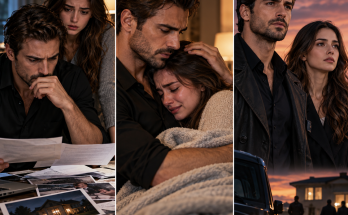
My mother slapped my son over a toy, and the whole family pretended not to see the blood. I said nothing. I carried him to the hospital… and when I came back with the report in my hand, even the favorite grandson stopped smiling. Mateo was only six years old. Damián ripped his little red car out of his hands during a family dinner. And when my son tried to get it back, my mother screamed, “Don’t hit my boy!” and slapped him so hard his face turned to the side.
My mother slapped my son over a toy, and the whole family pretended not to see the blood.
That was the moment something inside me finally broke.
Not loudly. Not with screaming. Not with the kind of dramatic explosion people imagine when a mother reaches the end of her patience. It broke quietly, in the dining room of my mother’s house, while a pot of mole cooled on the table and my 6-year-old son stood trembling beside my chair with one hand pressed to his ear.
His name was Mateo.
But in that house, they rarely called him by his name.
To my mother, Teresa Robles, he was “that boy.”
To my sister Valeria, he was “your son,” spoken with the same tone other people used for inconvenience or stain.
To my brother-in-law, he was “the kid,” something tolerated as long as he stayed quiet, stayed small, stayed out of the way.
Only to me was he Mateo.
Only to me was he the child who still slept with one hand under his cheek, the child who whispered good morning to his father’s photograph, the child who believed a little red toy car from a street market was worth more than anything in the world because Julián, his father, had given it to him before he died.
It was a cheap toy. Red plastic. One wheel a little loose. The paint already chipped along the roof from years of being carried in small hands and tucked beneath pillows. But to Mateo, it was treasure. It was memory. It was the last gift from the man whose voice he barely remembered but whose absence shaped every room of our lives.
Everyone knew that.
My mother knew it.
Valeria knew it.
Even Damián knew it.
Damián was Valeria’s son. He was 8, though my mother always treated him like a fragile little prince who needed protection from the cruelty of anyone saying no. In my mother’s house, Damián could knock over a glass and someone else would apologize for putting it too close to his elbow. He could interrupt adults, push other children, take what was not his, and the family would smile indulgently, as if selfishness were charm when it belonged to the favorite child.
That night, we had gathered for Sunday dinner because my mother insisted family dinners were important. What she meant was that obedience was important. Attendance was important. Performance was important. Sitting at her table and pretending the family was loving mattered more than whether anyone at that table felt loved.
I had worked a double shift that day at the beauty salon. My feet ached inside my flats. My lower back throbbed from standing behind clients for 10 hours, washing hair, sweeping floors, applying color, smiling through gossip and complaints because tips depended on pleasantness. Mateo had spent the afternoon quietly drawing in the corner of the salon, never asking for much, never making trouble. By the time we arrived at my mother’s house, he was tired but happy because he had brought his red car.
He rolled it carefully along the edge of the dining room rug while the adults ate.
I remember watching him from my chair and feeling, for a brief second, something like peace. He was humming under his breath, the way he did when he felt safe. His dark hair fell across his forehead. His little fingers guided the car over imaginary roads, around chair legs, beneath the table, past the polished shoes of people who barely saw him.
Then Damián noticed.
“I want that car,” he said.
Mateo pulled it closer to his chest. “It’s mine.”
Damián looked at Valeria, already offended.
Valeria barely glanced up from her plate. “Mateo, let him play with it.”
Mateo shook his head.
“It was from my dad.”
The sentence landed quietly, but I felt it in my ribs.
Damián frowned. He was not used to refusal. In his world, wanting something was the first half of receiving it. So he stood, crossed the dining room, and ripped the car out of Mateo’s hands.
Mateo gasped.
“Give it back.”
Damián held it above his head. “No.”
“Please,” Mateo said, his voice breaking. “It’s mine.”
He reached for it.
That was all.
A 6-year-old boy reaching for the last gift his dead father had left him.
My mother’s chair scraped against the floor.
“Don’t hit my boy!”
Before I could stand, before I could speak, before I could even understand how she had twisted the moment so quickly, my mother struck Mateo across the face.
The sound cracked through the room.
Mateo’s head snapped to the side.
The dining room went silent.
For one second.
Nothing more.
Then Valeria pulled Damián into her arms as if he were the one who had been hurt.
“Oh, my love,” she murmured, stroking his hair. “Did that boy scare you?”
That boy.
The words echoed louder than the slap.
Mateo stood beside the table, stunned. His cheek was already turning red. His eyes filled with tears, but he did not cry loudly. He never did. He had learned, even at 6, that loud pain was punished in that house. So he stood there with his breath trembling and one hand lifted slowly toward his ear.
“Mom…” I said.
My voice sounded far away.
My mother did not even look at me.
“Teach your son some manners, Clara.”
“He didn’t hit Damián.”
“He was about to.”
“He was trying to get his car back.”
“Damián is younger.”
It was a lie.
Damián was 8.
Mateo was 6.
But truth had never mattered much at my mother’s table. Not when it stood in the way of protecting Valeria or her son.
Valeria had always been the perfect daughter.
The daughter who married correctly.
The daughter who wore the right dresses, attended the right events, chose a husband with clean shoes and a family business.
The daughter who did not get pregnant by a mechanic.
The daughter who did not become a widow young.
The daughter who did not return to her mother’s house with a suitcase, a child, and shame hanging around her neck like a sign everyone could read.
That was me.
Clara.
The mistake.
The burden.
The daughter who should be grateful for any corner she was allowed to occupy.
Mateo touched his ear again.
When his fingers came away, there was blood.
A tiny drop.
Bright red.
Small enough that someone else might have dismissed it.
Large enough to end my silence forever.
In that instant, the room went soundless for me.
I saw my brother-in-law’s mouth move, but I did not hear him say it “wasn’t that serious.”
I saw Valeria roll her eyes, but I did not hear her mutter that Mateo always made a drama out of everything.
I saw my mother point toward my chair, but I did not hear her order me to sit down because the mole was getting cold.
All I saw was my son.
His cheek marked by my mother’s hand.
His ear bleeding.
His red car clutched now in Damián’s fist.
And his eyes searching my face for the answer children always seek from their mothers after pain.
Was this my fault?
Did I deserve it?
Will you protect me?
I stood.
No one expected that.
For years, I had survived in that house by swallowing words. I swallowed insults because I had nowhere else to go. I swallowed humiliation because Mateo needed a roof. I swallowed my mother’s cruelty because I had convinced myself I could absorb it as long as it did not reach him.
But it had reached him.
It had marked his face.
I picked Mateo up.
He was too big to be carried comfortably now, all knees and elbows, but he folded into me like a much smaller child. His body shook against mine.
“Where are you going?” my mother demanded.
“To the hospital.”
She laughed.
A dry, ugly sound.
“Over a slap?”
I turned toward the door.
“Don’t be ridiculous,” she said.
I did not answer.
Because if I spoke, I was going to scream.
And if I screamed, maybe they would pull me back into the old pattern. Maybe the fight would become about my tone, my disrespect, my exaggeration. Maybe I would be forced to defend reality in a room full of people committed to denying it.
So I said nothing.
I walked out with Mateo in my arms.
No purse.
No jacket.
No phone charger.
No explanation.
Just my son pressed against my chest and one thought repeating inside me with every step.
No more.
The night air hit us cold.
I had just enough cash in my pocket for a taxi. Mateo rested his head against my shoulder, one hand still holding the side of his face.
In the back seat, he did not sob. He did not scream.
That broke me more than if he had.
He only whispered, “Mom?”
“Yes, my love?”
“Did I do something bad?”
I felt my heart split.
I kissed his forehead.
“No.”
“But Grandma was mad.”
“Grandma was wrong.”
He was quiet for a few seconds.
Then he said, “I just wanted Daddy’s car.”
I held him tighter.
“I know.”
His small fingers curled in my blouse.
“The bad one is never the child who receives the blow,” I whispered.
I do not know if he understood me then.
But I needed him to hear it.
I needed myself to hear it too.
Part 2
The emergency room smelled of disinfectant, old coffee, and fear.
I carried Mateo through the sliding doors with his cheek swollen and his eyes half-closed from exhaustion. By then, the blood at his ear had dried into a thin dark line. The nurse at the reception desk looked up, saw his face, and immediately straightened.
“What happened?”
I opened my mouth.
For one second, the old instinct rose in me.
Minimize it.
Protect the family.
Say he fell.
Say children fight.
Say it was an accident.
That instinct had been trained into me over years. In my mother’s house, truth was not welcomed if it made her look bad. Truth had to be softened, reshaped, apologized for. Pain had to be private. Bruises had to become clumsiness. Cruelty had to become misunderstanding.
But Mateo’s fingers were clutching my sleeve.
“My mother hit him,” I said.
The nurse’s expression changed.
Not dramatically. Professionally. Carefully.
She took us back quickly.
A young doctor examined Mateo. She had kind eyes, but her voice became very serious when she saw the mark on his cheek and the swelling near his ear.
“Who hit him?” she asked.
I swallowed.
“His grandmother.”
Her pen paused against the form.
“Is this the first time?”
“Yes,” I started to say.
The lie came automatically. A reflex. A shield held up for a woman who had just struck my child.
But Mateo spoke before I could finish.
“No.”
The room went still.
I looked down at him.
“What?”
The doctor crouched so she was level with him.
“What do you mean, champ?”
Mateo looked at me.
That look destroyed me.
He was asking permission.
Not permission to lie.
Permission to tell the truth.
In that moment, I understood something so clearly it felt like a knife sliding between my ribs.
My silence had never been peace.
It had been a cage.
I had thought I was protecting Mateo by enduring my mother’s insults. I had thought if I kept my head down, paid what I could, worked harder, caused no trouble, stayed grateful, then he would be safe.
But children do not only inherit houses and last names.
They inherit silence.
They learn who must apologize.
They learn whose pain matters.
They learn what kind of treatment adults call normal.
I crouched beside the bed and took Mateo’s hand.
“Tell her the truth,” I whispered.
His lower lip trembled.
“Grandma locks me in the laundry room when my cousin comes over.”
The words entered the room softly.
But they hit me like a collapse.
“What?” I breathed.
Mateo looked down at his shoes.
“She says if I come out, I’ll ruin his afternoon.”
The doctor’s face hardened.
I covered my mouth.
“Mateo…”
“And Aunt Valeria took my new sneakers because Damián wanted them.”
I remembered those sneakers.
Blue with white stripes.
I had saved tips for 3 weeks to buy them. When they disappeared, my mother told me Mateo must have lost them. Valeria had shrugged and said children were careless. I had scolded Mateo for leaving his things around.
He had cried.
And I had believed the wrong people.
My son continued, smaller now.
“Grandma said I shouldn’t complain because we live there as charity cases.”
Charity cases.
My vision blurred.
I worked double shifts at the salon. I bought groceries. I paid for Mateo’s medicine. I gave my mother cash every month toward electricity, water, and part of the property tax. On days when clients canceled, I cleaned stations and folded towels for extra hours. I came home with my feet blistered and still cooked dinner if my mother said she was tired.
But to them, I was a charity case.
The inconvenient widow.
The daughter whose need could be used as a weapon.
The young woman who should bow forever because she had once come back with nowhere else to go.
The doctor stood.
“I’m going to call social services,” she said.
I nodded.
My body felt numb.
Another physician came. Then a social worker. They ordered an X-ray. They photographed the mark on Mateo’s cheek and examined his ear. They asked questions gently, slowly, giving him time.
With every answer, the world I had forced myself to live inside cracked further.
Mateo told them how my mother sent him to the laundry room when Damián visited because “guests should not be bothered.”
He told them Valeria called him dramatic when he cried.
He told them my brother-in-law once grabbed him by the arm hard enough to leave fingerprints because he had touched Damián’s tablet.
He told them Grandma said boys without fathers needed discipline.
I sat beside him and listened.
Every word felt like an accusation.
Not only against them.
Against me.
How had I not seen all of it?
How many times had Mateo gone quiet because he knew I was too tired, too frightened, too desperate to hear what he was trying to tell me?
The X-ray did not show a fracture. His ear had swelling, and the doctor warned me to watch his hearing carefully over the next few days. The cheek mark was documented. Then the physician turned him gently and found bruises on his back.
Old bruises.
Bruises I had thought came from playground falls, rough games, childhood clumsiness.
The social worker looked at me.
“Ma’am,” she said, “this is no longer a family matter.”
I nodded.
I did not cry.
Not then.
Crying would have to wait.
First, I had to stop being a coward.
By 9:00 p.m., Mateo had fallen asleep against me in a hospital chair, his face turned into my coat. I had a medical report in my bag, a copy of the complaint folded inside my bra, and a list of instructions from the social worker. She had offered to help us find emergency shelter immediately.
I almost accepted.
Then I remembered something.
The blue folder.
It had belonged to Julián.
After he died, I had packed his documents into an old box and carried them to my mother’s house with the rest of our broken life. I had never reviewed everything inside. Grief had made paperwork feel impossible. Every signature, every receipt, every insurance form had his name on it. For months after his death, I could not even touch the box without feeling as if the floor was falling away.
I had thought the folder contained only insurance papers.
But that night, I remembered something else.
Julián had been careful.
Too careful, sometimes. He saved receipts for everything. He made copies of documents. He said poor people could not afford to be careless because nobody believed them without proof.
I had laughed at him then.
I was not laughing now.
I told the social worker I needed to retrieve documents from the house before we went anywhere else. She hesitated, then made calls. By the time I left the hospital, arrangements had changed. I would not go back alone. But first, I needed the folder.
I carried Mateo into a taxi. He slept the whole way, his cheek still red, one hand curled near his chest as if the red car should have been there.
At my mother’s house, the windows glowed with warm yellow light.
For one insane second, it looked like home.
Then I saw shadows moving through the living room, heard laughter through the walls, and remembered that my son had left that house bleeding while the rest of them continued dinner.
I entered through the side door with the spare key I still had.
No one heard me at first.
The family was in the living room.
Eating cake.
Cake.
My son’s face had been marked by my mother’s hand, and they were eating cake.
I did not go to them.
I went straight to the small back room my mother had given us after Julián died. She called it generous. It had once been a storage room. The window stuck in summer. In winter, cold slipped beneath the door. Mateo’s bed was against one wall, mine against the other. Our clothes fit into one dresser because there was no space for more.
I laid Mateo gently on my bed without waking him and pulled the old cardboard box from beneath it.
Julián’s name was written on the side in black marker.
For a moment, I could not move.
I remembered his hands.
Grease under the nails from the garage. Warm palms. The way he used to rub Mateo’s tiny back when he was a baby. The way he had smiled the day he bought the red toy car from a street vendor, pretending it was a luxury vehicle.
“For my boy,” he had said, kneeling in front of Mateo. “Every driver needs his first car.”
Mateo had been 3 then.
Julián died 7 months later.
An accident at the workshop. A machine. A phone call. A sentence no young wife is ready to hear.
I opened the box.
Click Here to continuous Read Full Ending Story Part2: My mother slapped my son over a toy, and the whole…
My mother slapped my son over a toy, and the whole…
Part 1 of 2