The first night Lily stayed with me, I barely slept.
Every small sound brought me out of bed.
I checked on her repeatedly, following the instructions the hospital had given me.
Sometimes she was awake.
Sometimes she was sleeping peacefully.
I was still learning how to distinguish an ordinary cry from one that required closer attention.
I had become frightened of overlooking something.
That fear didn't disappear simply because she was home with me.
The diaper bag sat beside the changing table.
I had emptied it, cleaned it, and replaced the supplies.
Fresh diapers.
Clean clothes.
Baby wipes.
Ordinary things.
I wanted them to become ordinary again.
During the following weeks, my days began revolving around Lily's appointments, feeding times, and recovery.
There were forms to complete.
People to speak with.
Questions to answer.
There were also wonderful moments that had nothing to do with the investigation.
The way Lily looked at me when I entered the room.
The little sounds she made when she was content.
The way her fingers reached toward anything interesting.
I began remembering that she was more than the injury that had brought her into my care.
She was a baby discovering the world.
She deserved to discover it without being frightened.
Her medical appointments gradually brought encouraging news.
The doctors were satisfied with how her fracture was healing.
They continued monitoring her progress.
I followed their instructions carefully.
When I felt uncertain about something, I asked.
I wasn't embarrassed about needing help.
I would rather ask an unnecessary question than ignore an important one.
Sarah visited under the arrangements established by the authorities.
She never arrived without permission.
She never tried to persuade me to make exceptions.
The first few visits were difficult for both of us.
She would sit near Lily and become emotional over the smallest things.
Sometimes, Lily smiled at her.
Sometimes, she became distracted by something else.
Sarah had to accept whatever happened.
She couldn't demand reassurance from a six-month-old child.
One afternoon, she brought a small package of baby clothes.
She asked whether she could give them to Lily.
I checked that everything was appropriate under the arrangements.
Inside was a little yellow outfit.
Sarah held it up.
“I thought this might look nice on her.”
“It will.”
She folded it carefully.
Then she looked at me.
“I couldn't buy another green one.”
I understood.
Neither of us needed to explain why.
She placed the yellow outfit beside the diaper bag.
For a while, we watched Lily playing with her fingers.
Then Sarah spoke.
“I've started counseling.”
I nodded.
She had agreed to participate in the services recommended to her as part of the protective process.
That included addressing the circumstances in her marriage and her failure to respond appropriately to Lily's injury.
She didn't tell me that counseling would fix everything.
She said she was beginning to understand how often she had surrendered her judgment to someone else's anger.
“I kept thinking keeping him happy would keep everything peaceful.”
I looked at her.
“Was it peaceful?”
She shook her head.
“No.”
She looked toward Lily.
“It just meant I was the one pretending.”
I thought about those words for a long time after she left.
Sarah had spent months, perhaps longer, confusing silence with peace.
But silence had protected nobody that Friday evening.
It had allowed Lily's suffering to continue.
I hoped Sarah was beginning to understand that.
As the investigation progressed, additional medical findings and statements were examined.
Her husband's changing account became part of the evidence.
Eventually, he admitted responsibility for the rough handling that had caused Lily's injury.
He also acknowledged that he had discouraged Sarah from seeking medical attention because he feared the consequences.
Those admissions did not undo what had happened.
The case proceeded through the legal system.
He ultimately accepted legal responsibility for injuring Lily, and the court imposed consequences and restrictions intended to protect her.
I didn't experience the satisfaction I had imagined someone might feel when the truth was finally established.
There was no celebration.
No feeling that our family had won something.
I thought about Lily's little fists.
The sweat around her forehead.
The scream that had stopped me in the middle of my living room.
Knowing who was responsible didn't erase those memories.
But it ended the uncertainty surrounding the central question.
We no longer had to wonder whether someone had hurt her.
Someone had.
And he had tried to keep the injury from being discovered.
Sarah's conduct was addressed separately through the child protection process.
Her admission about the concealer remained significant.
So did her delay in seeking medical care.
She understood that separating from her husband wasn't enough by itself.
She needed to demonstrate that she could recognize danger and respond appropriately.
Not occasionally.
Not only when somebody else was watching.
Consistently.
Her progress was assessed over time.
I continued caring for Lily under the approved temporary arrangement.
Sarah never asked me to lie about what had happened.
She never asked me to change my original statement.
That mattered to me.
It was a small but necessary part of rebuilding trust.
Months passed.
Lily grew.
Her dark hair became thicker.
She started making louder, happier sounds whenever she wanted attention.
Her medical team continued to monitor her development.
The day we received reassuring news about her healing, Sarah sat beside me.
She covered her mouth and cried.
I understood her relief.
I felt it, too.
Outside the examination room, she said something that stayed with me.
“I used to think being her mother meant nobody could question me.”
I looked at her.
“And now?”
“Now I think being her mother means I have to accept questions if they're about keeping her safe.”
I nodded.
It was something she needed to remember long after the appointments and meetings became less frequent.
The danger of that Saturday hadn't come only from the original injury.
It had also come from adults deciding that their own fears mattered more than a child's pain.
I hoped Sarah would never forget that.
One evening, she asked whether we could talk privately after a scheduled visit.
We sat in my living room.
Lily was resting safely nearby.
Sarah looked toward the changing table.
“Is that where you found it?”
I nodded.
She swallowed.
“I keep imagining that moment.”
I didn't answer.
She continued.
“I remember putting the makeup on her.”
Her eyes filled with tears.
“I remember thinking that if nobody saw the bruise, I wouldn't have to explain it.”
I sat quietly.
“And then?”
“Then I brought her here because I wanted somebody else to make the decision I was afraid to make.”
It was difficult hearing her describe it so plainly.
But I was glad she could.
For months, I had carried the question of why she had chosen me.
Now she was answering without excuses.
“I trusted you to help her,” Sarah whispered.
“But you should never have put me in that position.”
“I know.”
“You should never have put Lily in that position.”
“I know.”
She began crying.
“I can't forgive myself for that.”
I considered my words carefully.
“Then spend your time becoming someone who would never do it again.”
She looked at me.
I meant it.
There was no benefit to Lily in Sarah spending the rest of her life making promises through tears.
What mattered was how she behaved.
Whether she respected the safeguards.
Whether she sought help when she needed it.
Whether she could place Lily's welfare above her own discomfort.
Those were things she could demonstrate.
And gradually, she did.
Her participation in counseling continued.
She maintained her separation from her husband.
She followed the requirements of the child protection plan.
The professionals overseeing Lily's situation reviewed her progress regularly.
Changes in contact arrangements came gradually and only after appropriate assessments.
Nothing depended on my private judgment alone.
I was grateful for that.
I loved both my sister and my niece.
I didn't want affection to become a reason for overlooking risk.
Eventually, the possibility of Lily returning to Sarah's care was considered.
I knew that decision might come.
Still, hearing it made my chest tighten.
I had spent months building my life around Lily.
I knew the expression she made before falling asleep.
I knew which little sounds meant she was becoming hungry.
I knew how quickly she reached for my hand.
The thought of an emptier house hurt.
But I had never agreed to care for her because I wanted to take her mother's place.
I had agreed because Lily needed somewhere safe.
If Sarah could provide that safety under an appropriate, professionally reviewed plan, my feelings couldn't be the deciding factor.
The transition was gradual.
There were continued assessments and safeguards.
I remained involved as a supportive relative.
Sarah understood that my involvement wasn't permission to conceal problems from anyone responsible for Lily's welfare.
She accepted that.
On the day Lily eventually returned to her mother's care under the approved arrangements, Sarah arrived with the diaper bag.
I recognized it immediately.
The same handle.
The same little pockets.
The same bag she had handed me that Saturday morning.
But our conversation was different.
Sarah went through Lily's belongings carefully.
She asked about her routines and the information she needed.
We reviewed the arrangements and upcoming appointments.
Nothing was left to vague assumptions.
Before leaving, Sarah turned toward me.
“If anything ever happens, I'll get help immediately.”
I looked at her.
“Even if you're afraid?”
“Especially if I'm afraid.”
I hoped those words would remain with her.
She picked Lily up carefully.
My niece looked over Sarah's shoulder and smiled at me.
I smiled back.
Then they left.
I stood inside my doorway long after they had gone.
The house felt unusually quiet.
I walked into the living room.
For months, there had been bottles, blankets, and little toys occupying nearly every available space.
Now several of those things were gone.
I sat beside the changing table.
I cried.
Not because I regretted what I had done.
Not because I believed Lily belonged to me.
I cried because loving someone sometimes meant doing what was necessary even when it hurt.
And sometimes, it meant accepting that the role you had played in their life was changing.
I continued seeing Lily regularly.
Sarah and I remained close in some ways and more cautious in others.
Our relationship never returned to exactly what it had been before that Saturday.
I didn't expect it to.
Trust had to be rebuilt through actions.
Sarah understood that, too.
Whenever she needed support, she asked openly.
Whenever she had concerns about Lily's health, she sought appropriate medical advice.
She no longer asked me to make difficult decisions that belonged to her.
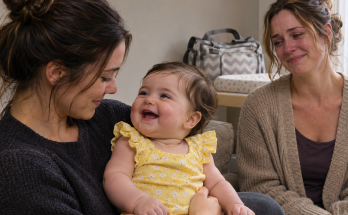
One afternoon, long after Lily's fracture had healed, Sarah came over with her.
Lily was wearing the little yellow outfit Sarah had bought months earlier.
She laughed as I lifted her carefully.
It was a beautiful sound.
Sarah stood watching us.
“I'm glad she has you.”
I looked at her.
“I'm glad she's safe.”
Sarah nodded.
That was what mattered.
I sometimes wondered what might have happened if I hadn't checked Lily's diaper that morning.
If I had continued believing the explanation about teething.
If the green onesie had remained closed.
If I had accepted that persistent crying was simply something babies did.
Those thoughts still unsettled me.
But I couldn't live forever inside possibilities.
I had noticed something wrong.
I had acted.
Other people had helped establish the truth and protect Lily.
Sarah had eventually accepted responsibility for her own failures and worked to change her circumstances.
None of those things could erase the injury.
They could, however, change the life that followed it.
I never forgot that powdery floral smell.
For a long time, encountering a similar fragrance made my stomach tighten.
Eventually, the reaction became less intense.
Other memories began taking its place.
Lily finishing her bottle at the hospital.
Her fingers closing around mine.
Her first comfortable afternoon at my home.
Her laughter while wearing that yellow outfit.
Those were the memories I wanted to carry forward.
The concealer had hidden a bruise.
It had also concealed fear, shame, and the terrible decisions adults had made to protect themselves.
Removing a small patch of it had exposed more than an injured leg.
It had exposed a family problem that could no longer remain private.
I learned that day that protecting a child sometimes required confronting someone you loved.
It required accepting that people close to you could make choices you found impossible to understand.
And it required putting the child's needs first, even when the consequences changed your entire family.
I still loved my sister.
But I no longer confused loving her with protecting her from accountability.
There was a difference.
Lily had taught me that before she was old enough to say a single word.
She had cried because something hurt.
She had needed somebody to understand.
And when I finally understood, I refused to look away.
The End
Read more original stories on Feel Every Story.
My Sister Left Her Six Month Old Daughter With Me That Morning, and I Thought I Understood Why She Was Crying
Part 10 of 10