Emily arrived carrying two books.
Nathan brought a board game with a slightly damaged box.
Stuart stood behind them in the hallway outside my apartment.
He had brought them over on the Saturday we had arranged.
Linda hadn't come.
I hadn't expected her to.
Things between us remained uncomfortable.
I opened the door wider.
Nathan rushed inside.
“Grandma, where's my room?”
I laughed.
“You'll have to share the living room with everybody else.”
He looked around.
Then he spotted the balcony.
Emily gave me a careful hug.
I held her a little longer than usual.
She looked up at me.
“I like your apartment.”
“Thank you, sweetheart.”
Stuart remained near the doorway.
He handed me a bag containing some things the children had brought.
Then he asked what time he should return.
I told him that seven would be fine.
He nodded.
Before leaving, he looked around the apartment.
His eyes rested briefly on Robert's photograph.
Then he noticed the picture beside it.
The wooden airplane.
He stared at it for a moment.
“I remember that.”
“So do I.”
He smiled faintly.
“Dad made it in the garage.”
“Yes.”
He looked as though he wanted to say something else.
Instead, he told the children to behave themselves.
Then he left.
I closed the door.
Emily helped me prepare dinner.
Nathan arranged the board game on the living room floor.
We had roasted chicken, mashed potatoes, vegetables, and the little dinner rolls they both liked.
I had bought fewer rolls this time.
Nathan still complained that there weren't enough.
I promised to buy more for his next visit.
Emily set the table without being asked.
When she opened the cupboard to find another plate, she noticed Robert's serving platter.
Her expression changed.
“Grandma?”
“Yes?”
“Isn't that the one from Thanksgiving?”
I looked at the platter.
“Yes.”
She touched the blue border carefully.
“I'm glad it didn't break.”
I felt a lump in my throat.
“So am I.”
She looked at me.
Then she asked something I hadn't expected.
“Were you really scared that day?”
I didn't want to lie to her.
But I also didn't want to burden her with more than she needed to carry.
“A little.”
She nodded.
“I was too.”
I put down the spoon I was holding.
Then I sat beside her.
I told her that adults were responsible for how they behaved, even when they were angry.
I explained that what happened wasn't her fault.
It wasn't Nathan's fault either.
She listened quietly.
Then she asked whether I hated her father.
“No.”
“Are you mad at him?”
“I'm disappointed in some of the things he's done.”
She thought about that.
“But you still love him?”
“Very much.”
She leaned against my shoulder.
I put my arm around her.
For a little while, we sat without speaking.
Then Nathan called from the living room.
He wanted somebody to help him read the game instructions.
Emily stood.
The serious expression disappeared from her face.
“I'm coming.”
I watched her leave.
Children had a wonderful ability to return to the present.
I wished adults could do it as easily.
When dinner was ready, I decided to use the porcelain platter.
I carried it to the table carefully.
The roasted chicken looked almost too small in the center.
Nathan asked whether Grandpa had bought the platter.
I told him that Robert and I had purchased it together.
Then I described how his grandfather used to carve the turkey every Thanksgiving.
Nathan wanted to know whether Robert had been good at it.
“Better than me.”
He laughed.
Emily asked whether she could have another dinner roll.
I passed her the basket.
There were no arguments.
No questions about my bank accounts.
Nobody suggested that my home belonged to someone else.
We ate.
We talked.
We laughed when Nathan dropped a piece of potato onto his shirt.
It was an ordinary dinner.
And it meant more to me than some of the elaborate family gatherings I had spent years preparing.
Afterward, we played the board game.
Nathan insisted on keeping score.
Emily accused him of inventing rules.
He denied it with great enthusiasm.
I laughed until my cheeks hurt.
When Stuart returned, the children were disappointed that the evening had ended so quickly.
He helped Nathan collect the game pieces.
Emily gathered her books.
At the door, Stuart thanked me.
“Thanks for having them.”
“You're welcome.”
He glanced at the dining table.
The platter was still there.
I saw him notice it.
He looked away.
Then he turned back toward me.
“I'm glad you had a good evening.”
I nodded.
“We did.”
He left with the children.
I closed the door and returned to the kitchen.
The apartment was untidy.
There were crumbs beneath the table.
Several cushions had been moved.
Nathan had left a small game token beneath the sofa.
I picked it up and placed it beside my telephone.
Then I began washing the dishes.
When I reached the platter, I held it beneath the warm water.
I remembered the Thanksgiving when it had struck my chest.
But I also remembered Emily passing the dinner rolls that evening.
I remembered Nathan laughing.
The platter hadn't changed.
What happened around it had.
That mattered.
Christmas arrived a few days later.
I spent part of the day with Helen.
We exchanged small gifts and ate lunch together.
She gave me a plant for the balcony.
I gave her a cookbook she had admired.
In the afternoon, I spoke to Emily and Nathan on the telephone.
They told me what they had received for Christmas.
Nathan described a toy in such extraordinary detail that I nearly forgot what the original question had been.
Emily told me she had finished another book.
Stuart wished me a merry Christmas.
Linda did the same.
Her voice remained somewhat distant.
I didn't try to force warmth into the conversation.
Some relationships needed time.
Others needed honesty that hadn't arrived yet.
I was willing to accept either possibility.
The following January, I began searching more seriously for a permanent home.
I visited several properties.
Some were too expensive.
Some required more maintenance than I wanted.
One had a lovely kitchen but very little natural light.
Another had a wonderful garden and too many stairs.
I kept looking.
I refused to hurry simply because I was staying in temporary accommodation.
Eventually, I found a small, single-story home in a quiet neighborhood.
It had two bedrooms.
A comfortable living room.
A kitchen with a window overlooking a modest garden.
There was enough space for my grandchildren to stay overnight.
I could reach the shops without driving very far.
And there was a little patch of soil where I could grow vegetables.
When I stepped into the garden, I immediately imagined Robert examining it.
He would have complained that the soil needed work.
Then he would have spent the following weekend improving it.
I smiled.
The agent asked whether I liked the property.
“Yes.”
I arranged the necessary professional checks before making my decision.
Daniel helped me ensure that everything was handled properly.
I reviewed the costs.
I considered my future expenses.
I made sure enough money would remain available for my long-term needs.
Then I bought the house.
It wasn't as large as my former home.
It didn't need to be.
On moving day, Helen arrived carrying the plant she had given me for Christmas.
She had been looking after it while I moved.
“Where do you want this?”
I pointed toward the kitchen window.
“Right there.”
She placed it carefully on the sill.
Then she looked around.
“This suits you.”
I thought so, too.
Over the following weeks, I began establishing new routines.
I walked most mornings.
I joined a reading group at the library.
I returned to volunteering at the community center where I had once helped before Robert became ill.
I discovered that several of the women I met there understood parts of my experience without needing lengthy explanations.
One woman had been pressured into giving money to her adult children.
Another had moved because relatives expected her to surrender the family home.
Their circumstances were different from mine.
But I recognized the hesitation in their voices when they discussed saying no.
I recognized the guilt.
I recognized the habit of apologizing for having ordinary needs.
I listened to them.
Sometimes they listened to me.
I didn't pretend to have every answer.
I was still learning myself.
One afternoon in early spring, Stuart called.
He asked whether I would meet him for coffee.
I agreed.
We returned to the same coffee shop where we had discussed his finances.
This time, he didn't bring Robert's leather folder.
He arrived wearing a clean shirt and looking considerably more rested.
He told me that he and Linda had begun making changes.
They had sold one of their cars.
They had reduced their spending.
They had sought professional advice about managing their debts.
Some plans had been canceled.
Others had been postponed.
He admitted that the adjustments hadn't been pleasant.
I listened.
Then I asked how the children were managing.
“Better than we expected.”
He smiled slightly.
“Nathan wasn't nearly as upset about the canceled vacation as we thought he'd be.”
I smiled, too.
Children sometimes understood what mattered more clearly than adults.
Stuart stirred his coffee.
Then he looked at me.
“I've been thinking about what you said.”
I waited.
“About whether I wanted you around if there wasn't any money involved.”
I remembered asking him that question.
He lowered his eyes.
“I didn't like hearing it.”
“I didn't like having to ask it.”
He nodded.
Then he admitted that he had become accustomed to thinking of my property as something that would eventually solve his problems.
He said it had started as an assumption.
Over time, that assumption had become an expectation.
Eventually, he had begun behaving as though I was withholding something that already belonged to him.
Hearing him describe it so plainly was difficult.
But I appreciated that he was no longer pretending it had all been about concern for my health.
He apologized again.
This time, he didn't follow the apology with a request for money.
He didn't bring financial statements.
He didn't ask about my will.
He simply sat there.
I reached across the table and touched his hand.
“Thank you.”
He looked at me.
“Can we get past this?”
I considered the question carefully.
“I hope we can.”
He nodded.
Then I added something.
“But getting past it doesn't mean going back to the way things were.”
He looked down at our hands.
“I understand.”
I hoped he did.
The legal arrangements remained unchanged.
I had no intention of restoring his former authority over my affairs.
My revised will remained in place.
The provisions for Emily and Nathan were protected according to the arrangements Daniel had helped me establish.
Stuart would receive what I had independently decided was appropriate.
He wouldn't receive an explanation of every figure while I was still alive.
Over the next several months, our relationship gradually became easier.
There were occasional awkward conversations.
There were moments when I wondered whether his old expectations might return.
But there were also ordinary telephone calls.
He asked about my garden.
He told me about Nathan's school activities.
Sometimes he brought the children over without asking for anything.
Those visits mattered.
Linda eventually came with him one Sunday.
She brought flowers.
After the children went outside, she sat with me in the kitchen.
She apologized for the way she had spoken to me during the weeks after Thanksgiving.
She admitted that their financial worries had influenced her judgment.
I appreciated her acknowledgment.
I also told her that I needed our relationship to remain separate from their financial expectations.
She nodded.
We didn't become suddenly close.
Life rarely repaired itself that neatly.
But we became more comfortable around each other.
That was enough for the time being.
When autumn arrived, I planted several flowers along the garden fence.
Stuart offered to help repair a loose board.
Before starting, he asked whether I wanted him to.
That small question meant more to me than he probably realized.
I said yes.
He brought his tools the following weekend.
Nathan helped carry a few things.
Emily sat nearby reading.
I made sandwiches for lunch.
While Stuart worked, I watched him from the kitchen window.
His hands still reminded me of Robert's.
That resemblance no longer made me feel quite so sad.
He was his father's son.
But he was also responsible for becoming his own man.
I couldn't do that work for him.
Thanksgiving approached.
I thought carefully about whether I wanted to host dinner.
The previous year's memories hadn't disappeared.
I could still remember the sound of the platter striking the floor.
I could still remember Emily's frightened expression.
But I didn't want that afternoon to claim every Thanksgiving that followed.
I invited Helen.
I invited Emily and Nathan.
I invited Stuart and Linda.
I made it clear that I wanted an ordinary, pleasant meal.
No financial discussions.
No arguments about property.
No suggestions about how I ought to live.
Stuart agreed.
On Thanksgiving morning, I woke early.
I prepared a smaller turkey than the one I had purchased the previous year.
I made cranberry sauce.
I peeled potatoes.
I set out the dinner rolls.
Then I opened the cupboard and took down the white porcelain platter with its blue border.
I examined it carefully.
There were still no cracks.
I placed it beside the stove.
When everyone arrived, Nathan immediately asked when dinner would be ready.
Emily rolled her eyes.
Helen laughed.
Stuart offered to help in the kitchen.
I handed him a bowl of potatoes.
Linda arranged the drinks.
Nobody questioned my decisions.
Nobody mentioned the house I had sold.
For the first time in a long while, I enjoyed having everyone around me.
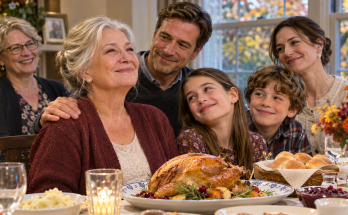
When the turkey was ready, I placed it on Robert's platter.
Stuart watched me carry it toward the table.
He stood.
For a moment, neither of us spoke.
Then he moved a serving bowl aside to make room.
“Would you like me to carve it?”
I looked at him.
“Yes, please.”
He handled the platter carefully.
I sat down.
Emily reached for my hand beneath the table.
I squeezed it gently.
Then Stuart asked whether he could say something before we ate.
Everyone became quiet.
He looked at me.
“I'm grateful you're here, Mom.”
I felt my eyes sting.
He continued.
“And I'm grateful you invited us.”
I nodded.
“I'm glad you came.”
That was all.
There was no dramatic speech.
No sudden announcement about money.
No promise that everything would always be perfect.
We simply began eating.
Nathan asked for another roll.
Helen told a funny story about her neighbor.
Linda complimented the cranberry sauce.
Emily talked about school.
I looked around the table.
A year earlier, I had believed keeping my family together meant giving them whatever they expected from me.
I knew better now.
I could love my son without placing my security in his hands.
I could help my grandchildren without allowing their parents to control my future.
I could forgive someone without returning to the circumstances that had allowed them to hurt me.
And I could grow older without becoming less important.
After dinner, Stuart helped clear the table.
He carried the porcelain platter into the kitchen.
I watched him place it gently beside the sink.
“Where does this go?”
I pointed toward the cupboard.
“On the second shelf.”
He washed it, dried it, and returned it to its place.
Then he joined the others in the living room.
I remained in the kitchen for a moment.
Through the window, I could see the garden fence he had repaired.
Beyond it, the evening sky was beginning to darken.
Robert's photograph stood on a nearby shelf.
Beside it was the picture of Stuart holding his wooden airplane.
I smiled at both of them.
Then I turned off the kitchen light and went to join my family.
I had sold the house where I spent more than thirty years.
I had changed the documents I once believed would never need changing.
I had accepted painful truths about the child I loved.
But I hadn't lost everything.
I still had my memories.
I still had my grandchildren.
I still had the possibility of a better relationship with my son.
Most importantly, I still had myself.
My name was Margaret Hayes.
I was seventy-two years old.
I had a comfortable home, enough money to support myself, and plans for the years ahead.
For the first time since Robert died, I understood that my future wasn't something somebody else needed to arrange.
It was something I was still living.
And it belonged to me.
The End
Read more original stories on Feel Every Story.
I Spent Three Days Preparing Thanksgiving Dinner for My Family Without Realizing My Son Had Already Made Plans for My Future
Part 10 of 10