I had never imagined calling a lawyer about my marriage.
Whenever somebody mentioned divorce, I pictured arguments about money, furniture, and who had said what during the final months.
I hadn't imagined sitting in my sister's spare bedroom with medical papers spread across the bed.
I hadn't imagined taking breaks because reading made my head hurt.
And I certainly hadn't imagined explaining that my three-year-old daughter had been the only person willing to help me.
The attorney's name was Helen.
During our first conversation, she asked what I wanted to accomplish.
I told her I wasn't entirely sure.
I wanted to understand my options.
I wanted Ellie to be safe.
I wanted time to recover without being pressured to return home.
Helen said those were reasonable things to discuss.
She asked several questions about our marriage and living arrangements.
I answered carefully.
When she asked whether I had made a final decision about divorce, I said no.
That was the truth.
Part of me still hoped Grant would understand what he had done.
Not just acknowledge the outcome.
Understand the choices that had produced it.
Helen explained that speaking with her didn't require me to end my marriage.
I could obtain information before making a permanent decision.
We discussed temporary arrangements involving Ellie.
She explained why clear communication and proper legal advice mattered when parents lived separately.
I didn't want to use Ellie against Grant.
I made that clear.
Whatever happened between us, she loved her father.
I wasn't going to punish her for that.
But I also wasn't going to ignore her distress.
Helen asked whether I had documentation.
I told her about the hospital papers, my written recollections, and Lacey's email.
She asked me to preserve everything.
I agreed.
After the conversation, I sat quietly for several minutes.
Nothing dramatic had happened.
I hadn't filed anything.
Nobody had been served with papers.
Yet I felt different.
For the first time, I understood that returning home wasn't my only option.
That afternoon, I took Ellie to her first appointment with the child therapist.
The room contained toys, picture books, and several small chairs.
Ellie stayed close to me initially.
The therapist spoke gently.
She allowed Ellie to choose something to play with.
My daughter selected a small collection of wooden animals.
She arranged them in a row.
Then she moved one away from the others.
I watched without trying to interpret everything she did.
The therapist asked simple questions.
Ellie answered some.
Others she ignored.
Nobody forced her to explain the birthday dinner.
Nobody demanded that she describe frightening moments.
The appointment was about allowing her to become comfortable and identifying what support might help.
Near the end, Ellie chose a picture book.
There was a mother bear on the cover.
She pointed at it.
“That's the mommy.”
The therapist smiled.
“Yes.”
Ellie turned several pages.
Then she asked whether the baby bear helped its mother when she fell.
The therapist answered gently.
“Usually, grown-ups help other grown-ups.”
Ellie looked at me.
I nodded.
She returned to the book.
It was such a small exchange.
But afterward, I cried in Rachel's car.
I wanted that idea to become ordinary to my daughter again.
Grown-ups helped.
Children didn't have to save them.
Rachel handed me a tissue.
She waited until I was ready to go home.
Over the following days, Grant called regularly.
Sometimes the conversations went well.
He asked about Ellie's meals and bedtime.
He wanted to know whether she needed more clothes.
He brought her favorite pajamas and several books.
I appreciated those things.
I didn't want to pretend he was incapable of kindness.
That would have been another kind of dishonesty.
There had been good moments in our marriage.
There had been mornings when he made pancakes with Ellie.
There had been evenings when we sat together after she fell asleep and talked about our plans.
I remembered laughing with him.
I remembered trusting him.
Those memories made my decision harder.
They didn't make what happened at dinner less serious.
One evening, Grant asked whether we could meet privately.
He wanted to discuss coming home.
I agreed to meet him the following afternoon at Rachel's house.
Rachel took Ellie into another room.
Grant sat opposite me at the dining table.
He brought a small envelope containing copies of some household expenses.
He said he wanted me to know that everything was being taken care of.
I thanked him.
Then he asked whether I was ready to return.
“Not yet.”
He looked disappointed.
“How much longer?”
“I don't know.”
He leaned back.
“Claire, we can't keep living like this.”
I looked at him.
“We've been apart for several days.”
“It feels longer.”
I believed him.
It felt longer to me too.
Pain had changed the shape of every day.
A simple shower required planning.
Sleeping through the night had become an accomplishment.
Making breakfast sometimes left me exhausted.
I was living differently.
Grant wanted his previous life back.
I wanted to know whether that life had ever been as secure as I thought.
He began talking about the things he would change.
Lacey wouldn't be invited over again.
Margaret would be more considerate.
He would help with dinner and household chores.
He would make sure nothing similar ever happened.
I listened.
Some of those changes would have mattered before the accident.
But they weren't the question I needed answered.
“Grant, why did you leave me there?”
His face changed.
“We've discussed this.”
“You've told me you thought I was pretending.”
“That's what I thought.”
“Why?”
He rubbed his face.
“Because you were angry.”
“How did you know?”
He looked puzzled.
“You didn't get up.”
I stared at him.
The reason he believed I was pretending was the very thing that should have concerned him.
“Did you ever ask yourself whether I couldn't get up?”
“Obviously, eventually I did.”
“Before Ellie started screaming.”
He looked toward the hallway.
“I don't know.”
I waited.
He became irritated.
“What answer do you want?”
“The truth.”
“I've told you the truth.”
I shook my head.
“You've told me what you believed. I'm asking why you believed it.”
He looked at me for a long time.
Then he said something quietly.
“I didn't want Lacey to feel bad.”
I didn't move.
He continued.
“It was supposed to be a funny evening. Mom was enjoying herself.”
I waited.
“And when you didn't get up, it felt like you were making everybody uncomfortable.”
For a moment, I could hear nothing but the small clock on Rachel's kitchen wall.
There it was.
Something honest.
Something I had suspected but hadn't wanted to hear.
He hadn't simply misunderstood my condition.
He had been irritated because my reaction interrupted the evening.
He had been protecting Lacey from embarrassment.
He had been protecting Margaret's birthday celebration.
And in doing so, he had left me on the floor.
I asked one more question.
“Even if I had been angry, why wouldn't you help me?”
Grant opened his mouth.
Then closed it.
I watched his hands.
He kept rubbing one thumb against the other.
Eventually, he said he didn't know.
I believed that he had never seriously considered the question.
That frightened me.
If he could dismiss me for being angry, what else might he dismiss?
What would happen the next time my needs were inconvenient?
What would happen if Ellie said something that embarrassed him?
I remembered our daughter's words.
Grandma said you made everybody scared.
Daddy didn't know you were hurt.
I was good, Mommy.
Those were the explanations she had been given or had created for herself.
None of them belonged on the shoulders of a three-year-old.
Grant leaned forward.
“I know I messed up.”
I nodded.
“But I love you.”
I looked at him.
“Love should have made you check.”
He lowered his head.
“I know.”
“Love should have made you listen to Ellie.”
He didn't answer.
I felt tears coming.
I hadn't wanted this conversation to end our marriage.
I had wanted it to show me a way forward.
Instead, I was beginning to understand how much of our relationship had depended on me accepting things that hurt me.
I had accepted jokes because everyone else was laughing.
I had accepted criticism because Margaret was difficult to please.
I had accepted Grant's decisions because arguing exhausted me.
And when I finally couldn't cooperate, they had treated my helplessness as another act of inconvenience.
Grant reached across the table.
I moved my hand.
He stopped.
“What are you saying?”
I took a slow breath.
“I can't come home right now.”
His expression tightened.
“Right now?”
“I need us to remain separated while I decide what comes next.”
He stared at me.
Then he asked whether Rachel had encouraged me to leave.
“No.”
“Has somebody told you to do this?”
“No.”
He looked frustrated.
I understood why he wanted another person to be responsible.
If Rachel had persuaded me, he could blame her.
If a lawyer had advised me, he could blame the lawyer.
Accepting that I had made my own decision was more difficult.
“I spoke to an attorney,” I told him.
He became very still.
“You did what?”
“I needed advice.”
“Without telling me?”
“Yes.”
His voice rose.
“Claire, this is our marriage.”
Rachel appeared briefly in the doorway.
I told her everything was fine.
She didn't leave immediately.
Grant noticed.
He lowered his voice.
“You're seriously considering divorce over this?”
I looked at him.
“Over what?”
He hesitated.
“The accident.”
I shook my head.
“I'm considering what to do because you decided that my safety mattered less than keeping everybody happy.”
He looked away.
I continued.
“And because our daughter spent hours begging you to help me.”
He wiped his eyes.
I hadn't expected him to cry.
For a moment, I felt the familiar urge to comfort him.
I almost reached across the table.
Then I remembered Ellie trying to spread her little blanket over my body.
She had comforted me when I needed it.
Nobody had asked her whether doing so was convenient.
I kept my hands in my lap.
Grant said he didn't want to lose his family.
I told him I didn't want Ellie to lose her father.
We discussed how he could spend time with her while we worked out arrangements.
I wanted those conversations to remain calm and focused on her needs.
I wasn't willing to argue in front of her.
He agreed, although he looked unhappy.
Before leaving, Grant asked whether he could see Ellie.
Rachel brought her into the room.
She ran toward him.
“Daddy!”
He lifted her carefully.
She hugged him.
Then she looked toward my chair.
“Mommy's sitting good.”
Grant followed her gaze.
“Yes, sweetheart.”
“Don't move it.”
His face changed.
He looked at me.
Then he looked back at Ellie.
“I won't move Mommy's chair.”
She seemed satisfied.
She began telling him about the wooden animals she had played with.
I watched them together.
I felt sadness rather than anger.
There was still affection between them.
I wanted that affection to survive.
But I wanted it to become something Ellie could trust.
Grant stayed with her for a little while.
When he eventually left, she waved from Rachel's window.
I didn't know whether he would reflect on our conversation or spend the evening explaining it to Margaret.
That was no longer something I could control.
I could control the decisions I made for myself.
The following morning, I contacted Helen again.
I told her I wanted help establishing a clear temporary separation arrangement.
I explained that I wasn't prepared to return home.
She discussed the next steps and the information she would need from me.
I wrote everything down.
Afterward, I opened the suitcase Grant had brought from our house.
I sorted through Ellie's clothes.
At the bottom, underneath a pair of pajamas, I found a folded piece of paper.
It was Margaret's birthday card.
I recognized the uneven edges immediately.
Ellie must have put it inside her bag.
I opened it carefully.
There were the three people she had drawn.
Grant.
Me.
Our daughter with enormous purple shoes.
Around us was the red circle she had described as our house.
I sat on the edge of the bed.
For several minutes, I couldn't move.
Then Ellie came into the room.
She noticed the card.
“That's mine!”
I handed it to her.
“Do you remember drawing it?”
She nodded.
She pointed to each figure.
“Daddy. Mommy. Me.”
I smiled.
“And what is this?”
I touched the red circle.
“Our house.”
She studied the picture.
Then she looked around Rachel's bedroom.
“Can this be our house too?”
I felt something inside me soften.
“Yes, sweetheart.”
She smiled.
Then she carried the drawing downstairs to show Rachel.
I remained beside the open suitcase.
For years, I had believed that keeping my marriage together was the best way to protect our daughter.
I was beginning to understand that protecting her might require something different.
I didn't need to decide every detail of our future that morning.
I didn't need to know where I would live a year later.
I didn't need to know whether Grant would ever understand the full consequences of what he had done.
I only needed to stop returning to situations that frightened us simply because they were familiar.
I folded the remaining clothes.
I placed my medical documents inside the folder.
Then I went downstairs.
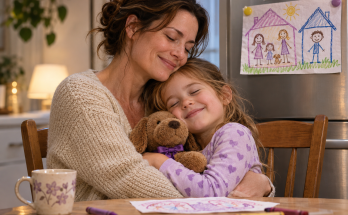
Rachel had given Ellie fresh paper and crayons.
My daughter was drawing another picture.
This one contained four people.
She pointed to Rachel.
Then to me.
Then to herself.
Grant stood a little farther away.
There was no red circle around them.
I didn't ask her why.
She was three years old.
She was allowed to draw whatever she wanted without an adult turning it into something more.
Instead, I sat beside her.
She handed me a purple crayon.
“Mommy, you can draw too.”
I accepted it.
And for the first time since Margaret's birthday, I spent an entire afternoon doing something with my daughter without feeling that I owed anybody an explanation.
Click here to continue reading: PART 9: When My Husband Finally Understood That I Was Not Coming Home, He Asked Me to Give Our Marriage One More Chance
I Thought My Husband Would Be the First Person to Protect Me Until I Saw What Made Him Laugh That Evening
Part 8 of 10