
Ivy's school event was on a Thursday.
She had been practicing a little song with her classmates, and she reminded me about it every morning while eating breakfast.
I wrote the time on our kitchen calendar.
I also circled it in my notebook.
There was another appointment that week concerning Graham's criminal case, but I refused to let it push everything else out of our lives.
Ivy deserved a mother who remembered school songs as well as court dates.
On Thursday morning, she wore a yellow dress and her silver-star shoes.
She asked me to put two purple clips in her hair.
One kept slipping.
We stood in front of the bathroom mirror until I managed to secure it properly.
“Is it pretty?”
“Very pretty.”
She smiled at herself.
The bathroom door was open.
I noticed that she hadn't asked me to leave it that way.
It had simply become our normal arrangement.
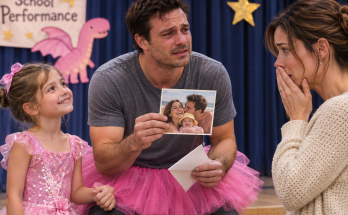
At school, the children stood in two uneven rows.
Some waved at their parents.
Others looked frightened.
Ivy searched the audience until she found me.
I waved.
She smiled and began singing.
She forgot several words and looked at the little boy beside her for help.
I laughed quietly.
When the song ended, she clapped along with everyone else.
I took a photograph.
Later, she asked whether I had enjoyed it.
“I loved every minute.”
She slipped her hand into mine.
“Even when I forgot?”
“Especially then.”
We walked to the car together.
My phone contained two missed calls from my attorney.
I didn't return them until Ivy was safely occupied with her coloring books at home.
My attorney explained that discussions concerning a possible resolution of Graham's criminal case had progressed.
The prosecution had reviewed the laboratory findings, the medical records, the interviews, and Graham's own documentation.
His changing explanations had also been considered.
I listened carefully.
There were still legal matters to resolve, but Graham was considering accepting responsibility for conduct that had endangered Ivy.
I asked what that would mean.
My attorney explained that any agreement would have to be formally reviewed and accepted by the court.
There could be significant restrictions, supervision, mandatory treatment, and other consequences.
I rubbed my forehead.
“Would Ivy have to testify?”
She couldn't give me a guarantee at that stage.
However, a resolution without a contested trial could reduce the likelihood of Ivy having to participate further in court proceedings.
That was important to me.
I wanted Graham held accountable.
I also wanted my daughter spared unnecessary distress.
After the call, I sat at the kitchen table for a long time.
I could hear Ivy humming the song she had performed at school.
She was trying to remember the words she had forgotten.
I opened my notebook.
There was a grocery list on the first available page.
I turned past it and wrote down the information my attorney had given me.
Then I closed the notebook.
I had spent months waiting for something definite.
Now that a resolution seemed possible, I wasn't sure how I felt.
Relieved, perhaps.
Angry.
Sad.
Mostly tired.
That evening, Natalie came over carrying a container of homemade soup.
She found me washing dishes.
I told her about the telephone call.
She listened while putting the soup into smaller containers.
“Do you think he'll admit what he did?”
“I don't know.”
“Would it help you if he did?”
I considered that question.
Months earlier, I would have answered immediately.
I had wanted Graham to acknowledge everything.
I had wanted him to look me in the eyes and tell me that I hadn't imagined the danger.
Now I wasn't sure I needed that from him.
The pediatrician had confirmed that his original explanation was false.
The investigation had established that the substance wasn't part of Ivy's approved treatment.
His own records supported concerns about repeated incidents.
And Ivy had told us that she had been frightened.
Those facts existed whether Graham accepted them or not.
“I think it would help Ivy someday,” I said.
Natalie nodded.
We finished putting the soup away.
The following week, Graham submitted a written statement through his attorney.
My attorney reviewed it with me.
He acknowledged that he had administered an inappropriate product without obtaining proper medical guidance.
He acknowledged that he had insisted on continuing the bathroom routine despite Ivy's distress.
He also acknowledged that he had instructed her not to tell me.
I stared at the paper.
Three admissions.
Three things I had spent months hearing him explain away.
The statement described his behavior as a serious failure of judgment.
It included expressions of regret.
But even then, I noticed how often he referred to his intentions.
He had intended to help.
He had believed his approach was reasonable.
He had not intended to frighten Ivy.
Perhaps those statements were important to him.
They didn't change what my daughter had experienced.
I remembered her little hands gripping that towel.
A frightened child didn't become less frightened because an adult claimed good intentions.
I put the statement down.
My attorney asked whether I wanted some water.
I nodded.
She brought me a paper cup.
For a moment, I stared at it.
Then I asked whether I could have a glass instead.
She didn't question me.
She brought one.
I drank slowly.
There were still things my body remembered before my mind had time to think.
Paper cups.
Timers.
Certain sounds behind closed doors.
I wondered how long those reactions would remain.
I wondered the same thing about Ivy.
A few days later, her counselor asked how things were going at our apartment.
I told her that Ivy was sleeping better.
She was enjoying school.
She had started choosing her own clothes without asking whether I approved of every detail.
The counselor smiled.
We discussed how to continue supporting her.
There was no expectation that recovery would happen in a straight line.
Some days would be easier.
Others might bring back feelings neither of us expected.
I had learned not to measure Ivy's progress against a calendar.
She wasn't late.
She wasn't behind.
She was a child finding her way through something she should never have experienced.
After the appointment, she asked whether we could visit the playground.
We went.
She climbed the slide and called for me to watch.
I watched every time.
On the way home, she asked about Graham.
“Is Daddy still in trouble?”
I stopped beside the car.
“Some grown-ups are deciding what happens because of the things Daddy did.”
“Did I get him in trouble?”
“No.”
She looked uncertain.
I crouched beside her.
“Daddy made his own choices. You didn't make those choices for him.”
She picked at the sleeve of her sweater.
“I told.”
“Yes.”
“Was that bad?”
“No, sweetheart. Telling someone when you're frightened is a good thing.”
She looked at me for several seconds.
Then she nodded.
I kissed her forehead.
We got into the car.
That evening, she helped me prepare dinner.
I washed the vegetables while she arranged pieces of bread on two plates.
She gave me the bigger piece.
“That's yours.”
“Thank you.”
She was pleased with herself.
I thought about how naturally generous she was.
How easily she worried about other people's feelings.
I wanted that kindness to remain part of her.
I also wanted her to understand that kindness didn't require surrendering her own safety.
The court date arrived in early spring.
Natalie came to our apartment before breakfast.
She promised to collect Ivy from school and keep her occupied until I returned.
I thanked her.
I wore the same navy blouse I had worn to the earlier custody hearing.
It was beginning to look worn around the cuffs.
I didn't care.
At the courthouse, my attorney met me near the entrance.
We discussed what was expected to happen.
Then we went inside.
Graham was already there.
His hair wasn't as neatly arranged as usual.
He looked thinner.
For a moment, I felt an instinctive urge to ask whether he was eating properly.
That surprised me.
Years of caring about someone didn't disappear just because the relationship ended.
But I kept my attention on the proceedings.
The court reviewed the proposed resolution.
Graham answered questions about his conduct and his understanding of the agreement.
His voice was quieter than I remembered.
When he accepted responsibility, I looked down at my hands.
I had imagined that moment many times.
In some versions, I cried.
In others, I felt angry enough to stand up and speak.
In reality, I simply sat there.
The court accepted his plea and imposed a sentence that included a period of confinement followed by supervised conditions, mandatory counseling, and restrictions concerning contact with Ivy.
Any future contact would depend on legal authorization and the appropriate safety assessments.
I listened as each condition was explained.
The case would have lasting consequences for Graham.
His career had already suffered.
His freedom would now be restricted.
His relationship with Ivy would never return to what it had been.
But the person paying the greatest price had not been the person standing before the court.
It had been a five-year-old girl sitting in a bathtub, afraid to ask for her mother.
I wished someone could give those moments back to her.
Nobody could.
I had prepared a statement describing the impact of Graham's actions.
When I was given the opportunity to speak, I unfolded the pages.
My hands shook.
I took a breath.
Then I began.
I spoke about the secrecy.
I spoke about the medical uncertainty and the fear Ivy had experienced.
I explained what it had meant to hear my daughter question whether she was allowed to tell the truth.
I didn't ask the court to punish Graham for failing to be the husband I had wanted.
That wasn't why we were there.
I spoke about Ivy.
At the end, I added something I hadn't written down.
“She should never have had to choose between being safe and making her father happy.”
My voice cracked.
I stopped.
Then I returned to my seat.
Graham didn't look at me.
I didn't need him to.
After the hearing, my attorney walked outside with me.
She explained several remaining matters involving the divorce and longer-term custody arrangements.
The criminal proceedings had reached an important resolution, but our family court matters still required attention.
I understood.
We stood near the courthouse steps.
“Are you all right?” she asked.
“I think so.”
It was the best answer I had.
I called Natalie.
She told me that Ivy had eaten an unusually large snack after school.
Apparently, she was growing.
I smiled.
“I'll be home soon.”
On the drive back, I passed familiar Austin streets.
I remembered traveling those same roads on the day Natalie took us home from the hospital.
Back then, I had been unable to understand how everyone else could continue living normally.
Now I was one of those people driving home to make dinner.
Something terrible had happened.
Life was continuing.
Both things were true.
When I entered the apartment, Ivy ran toward me.
“Mommy!”
I put my bag down and hugged her.
She showed me a little paper butterfly she had made at school.
One wing was larger than the other.
She was proud of it.
We found a place for it beside her other pictures.
Natalie stayed for dinner.
We talked about school and groceries and whether Ivy needed another pair of shoes.
Nobody mentioned court while she was sitting at the table.
Later, when Natalie and I were alone, she asked what Graham had said.
I told her.
She reached for my hand.
“It's finished?”
“The criminal case has been resolved. There are still a few other things.”
She nodded.
I looked toward Ivy's bedroom.
For months, I had imagined the conclusion of the criminal proceedings as a moment when everything would suddenly feel different.
But our apartment looked exactly the same.
The kitchen drawer still stuck.
The yellow curtains still needed washing.
There were crayons beneath the couch.
And Ivy needed help getting ready for bed.
I went to her.
She was sitting on the carpet with Bunny.
“Can we read two books tonight?”
“Why two?”
“Because I want two.”
I laughed.
“All right.”
We read the rabbit story first.
Then we read another about a little bear.
When I finished, Ivy curled beneath her blanket.
I kissed her forehead.
She reached for my hand.
“Mommy?”
“Yes?”
“I'm glad you came when I was in the bathroom.”
I felt tears gather in my eyes.
I squeezed her hand.
“I'm glad I came too.”
She closed her eyes.
I stayed beside her until she fell asleep.
There was still much I wished I could change.
But I would never regret opening that bathroom door.
Not for Graham.
Not for our marriage.
Not for the people who thought protecting a family meant protecting its secrets.
I had made the right choice that afternoon.
My daughter had needed me.
And I had finally listened.
Click here to continue reading: PART 10: Years After I Opened That Bathroom Door, My Daughter Showed Me What It Truly Meant to Give a Child a Safe Home
I Thought I Knew the Man I Married Until a Quiet Voice Behind Our Bathroom Door Made Me Question Everything
Part 9 of 10

One Comment on “PART 9 – When Graham Finally Had to Answer for What Happened Behind That Bathroom Door, I Stopped Waiting for the Apology I Deserved”