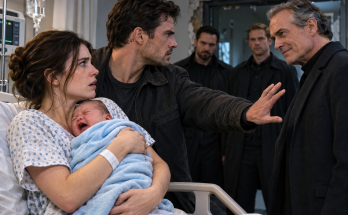
Telling Lucy was the hardest thing I had ever done.
I sat beside her and tried to find words that a four-year-old could understand.
She looked at me expectantly.
“Are we going to see Daddy?”
I shook my head.
“Not today, sweetheart.”
“Tomorrow?”
I took her little hands.
“Daddy was very, very sick.”
She nodded.
She already knew that part.
“The doctors tried to help him, but his body couldn't get better.”
She looked confused.
I struggled to continue.
“Daddy died, Lucy.”
She stared at me.
For several seconds, she didn't say anything.
Then she asked a question I hadn't prepared myself for.
“Does that mean he can't come home?”
I pulled her into my arms.
“Yes, sweetheart.”
She began crying.
I held her against me while she asked why the doctors couldn't fix him.
I didn't have an explanation that would make sense to her.
I barely had one that made sense to me.
We sat together until she became quiet.
Then she asked whether Daddy knew she loved him.
That question nearly broke me.
“He knew.”
“Really?”
“Every single day.”
She leaned against my shoulder.
I held her until she fell asleep.
For the next several days, there were arrangements to make.
People called.
There were documents to sign.
I had to answer questions about things I had never imagined deciding without Jack.
I dealt with everything mechanically.
Organization had always been my way of coping.
Now it was the only thing keeping me moving.
Whenever I finished one responsibility, I found another.
I was afraid of the moments when there was nothing left to do.
Those were the moments when I remembered that my husband was dead.
The funeral passed in a strange mixture of familiar faces and unfamiliar feelings.
People told me Jack had been a wonderful man.
They shared memories of him.
They spoke about his kindness and the way he could make people laugh.
I appreciated every story.
But hearing them also made me painfully aware that there would be no new memories.
Lucy stayed close to me.
She didn't fully understand what was happening.
She recognized photographs of her father and occasionally pointed toward them.
“That's my daddy.”
I held her hand.
“Yes, it is.”
There was something about hearing her speak of him that way that made me want to protect every photograph we owned.
Every little reminder.
Every ordinary thing that proved he had been here.
When we returned home, I found his jacket still hanging near the door.
I stood looking at it.
I couldn't bring myself to move it.
It belonged there.
For several days afterward, I walked past that jacket without touching it.
Sometimes I caught myself listening for Jack's voice.
Sometimes I wanted to call upstairs to ask him something.
Once, while sorting paperwork, I almost made a joke about how much space my little office was taking up.
Then I remembered.
The silence afterward was unbearable.
At night, Lucy sometimes asked whether she could talk about Daddy.
I always told her she could.
She wanted to know whether he had liked the picture she had drawn.
I told her he had loved it.
She asked whether Emma would know who he was.
“Yes.”
“How?”
“We'll tell her.”
Lucy considered that.
“I can tell her things.”
“I'd like that.”
She seemed satisfied.
I wished grief could be as simple as finding someone new to tell your stories to.
Unfortunately, the practical responsibilities of our lives had not disappeared when Jack died.
Household bills still arrived.
Insurance matters still needed attention.
There were medical expenses to review.
I continued working at the kitchen table.
One afternoon, I realized I needed information from Jack's laptop.
He had handled certain documents himself, and I couldn't locate everything I needed among the papers already in my possession.
I brought his computer to the table.
Opening it felt strangely intimate.
His familiar desktop appeared.
I looked at the screen for a long moment.
Then I started searching for the documents I needed.
There were ordinary files concerning our household.
Financial records.
Insurance information.
Photographs.
Things I recognized.
But there was also a folder I had never seen before.
It was labeled simply with the letter M.
I moved the cursor toward it.
Then I stopped.
I remembered the way Jack used to close documents whenever I entered the room.
I remembered the name written inside his jacket.
Margaret Ellis.
I opened the folder.
There were several scanned documents inside.
Some were old enough that the writing had faded.
Others appeared to be recent correspondence.
I opened the first document.
It was a copy of a birth certificate.
The name on it was Jack's.
I didn't understand why he had saved it separately from our other important documents.
I looked more closely.
The mother's name was unfamiliar.
Margaret Anne Ellis.
I stared at those words.
Then I read them again.
Jack's mother, the woman he had spoken about throughout our marriage, had never been named Margaret.
I knew that much.
I checked the date.
It was his birthday.
I checked the remaining information.
Everything seemed to match.
My first thought was that there had been some administrative mistake.
Perhaps the document belonged to another person with the same name.
But there were too many details that seemed to correspond.
I opened another file.
It was a scanned letter from an organization that maintained adoption records.
I read the first paragraph slowly.
Then I went back to the beginning.
Jack had requested information about his birth family.
The letter referred to an adoption that had taken place during his infancy.
I put my hand over my mouth.
Adoption.
In all the years we had spent together, Jack had never mentioned being adopted.
I couldn't remember a single conversation in which he had even suggested it.
I looked toward the jacket by the door.
Suddenly, the unfamiliar address inside its pocket seemed far more significant.
I returned to the computer.
There were several more documents.
A request for historical records.
Correspondence concerning identity verification.
Information about contacting a birth relative.
Some of the documents had been created months before Jack died.
I checked their dates.
He had been pursuing this while he was ill.
While I was arranging his medication.
While I was taking Lucy to preschool and trying to keep our household together.
I sat back.
I didn't know how I was supposed to feel.
Part of me was hurt that he had kept such an important matter from me.
Another part of me wondered whether he had only recently discovered the truth himself.
I opened a document containing notes he had written.
There was an address.
It matched the address in his jacket.
There was also a telephone number.
Beside Margaret's name, Jack had written a short sentence.
She agreed to meet.
I stared at that sentence.
Had he gone to see her?
Was that where he had been going when he left the house without explaining himself?
I remembered the private telephone calls.
The documents disappearing from his laptop.
His reluctance to tell me what he was working on.
For the first time, those things seemed connected.
But they still didn't tell me the entire story.
I searched the folder again.
There were no photographs of Margaret.
No written account of a meeting.
Nothing explaining what Jack had learned or how he felt about it.
There was, however, a document dated shortly before his final hospitalization.
I opened it.
It contained only a few unfinished paragraphs.
The first line was addressed to me.
Claire,
I stopped reading.
Seeing my name written by him felt different now.
It was as though he had spoken from somewhere inside that computer.
I swallowed and continued.
He had written that something had happened during the previous year that he hadn't known how to discuss.
He said it wasn't because he distrusted me.
He was trying to understand certain things before bringing them into our lives.
He mentioned our daughters.
He said he wanted them to have answers to questions that might become important someday.
Then the letter ended.
There was no signature.
No final explanation.
The last sentence wasn't even complete.
I touched the screen without thinking.
“Oh, Jack.”
My tears came suddenly.
I cried for the conversation we had never managed to have.
For the fact that he had clearly wanted to explain himself.
For the possibility that illness had taken away his chance.
I didn't know how long I sat at the kitchen table.
Eventually, Lucy came downstairs.
She asked why I was crying.
I closed the document.
“I'm missing Daddy.”
She climbed onto the chair beside me.
“Me too.”
I put my arm around her.
We sat together.
She asked whether we could look at photographs.
I opened a folder containing pictures of our family.
We looked at Jack holding her when she was younger.
We looked at photographs from holidays.
Lucy laughed at one where he had made a silly face.
For a few minutes, I laughed with her.
Later that evening, after Lucy had gone to sleep, I returned to the documents.
I wrote Margaret's telephone number on a piece of paper.
Then I placed my phone beside it.
I considered calling.
I imagined a woman answering and asking who I was.
What would I say?
That I was the wife of a man she might have given birth to decades earlier?
That he had died?
That I had discovered her name among his private belongings?
I wasn't prepared for that conversation.
Not yet.
I folded the piece of paper and placed it beside the laptop.
Over the following days, I concentrated on Lucy and the pregnancy.
My appointments became increasingly frequent.
The baby was doing well.
Every time I heard her heartbeat, I felt grateful and heartbroken in equal measure.
Jack should have been there.
I wanted to tell him that Emma was growing.
That Lucy had started talking to my stomach.
That our house still looked exactly as it had before he died because I couldn't bring myself to change anything.
I also wanted to ask him about Margaret.
Sometimes I felt angry that he had left me with questions.
Then I felt guilty.
He hadn't chosen to leave.
He hadn't chosen to become ill.
I understood that.
Understanding didn't make the uncertainty disappear.
One afternoon, I finally took his jacket from the hook.
I sat at the kitchen table with it across my lap.
I retrieved the paper containing Margaret's address.
Then I looked through the inside pocket, which I hadn't checked before.
There was a small envelope.
My name was written on the front.
I recognized Jack's handwriting immediately.
Unlike the unfinished letter on his laptop, this envelope had been sealed.
I turned it over several times.
My hands were trembling.
For reasons I couldn't explain, opening it frightened me more than discovering the birth certificate had.
I had spent months wanting Jack to tell me what he was hiding.
Now that I might finally receive an explanation, I wished I could hear it directly from him.
I took a breath and carefully opened the envelope.
Inside was a single handwritten page.
Jack had written it for me.
Not an insurance company.
Not a records office.
Me.
I unfolded the page and began reading.
Click here to continue reading: PART 7: The Letter Inside His Jacket Explained Why He Had Been Searching, but One Important Question Remained for the Woman He Found
I Thought Keeping Our Family Together Meant Knowing Everything, Until My Husband Started Keeping Certain Things to Himself
Part 6 of 10