Several months later, my parents sold their estate.
I learned about it without much detail.
The house that had once been central to my mother's carefully maintained image no longer belonged to them.
They moved somewhere smaller.
Dexter was left dealing with the consequences of his failed business.
I didn't know every detail of their financial arrangements.
For once, I didn't feel obligated to find out.
My parents were adults.
My brother was an adult.
They had decisions to make, just as Camille and I had decisions to make about our own lives.
I hoped they would make better ones.
I understood that hoping wasn't the same as taking responsibility for them.
The news about the house stayed with me for several days.
I remembered its dining room.
The staircase.
The fireplace where Dexter had been pacing on Christmas Eve.
I remembered how warm everything had looked from inside.
Then I remembered how cold it had been when Camille and I walked out.
My father had ordered us to leave because I wouldn't give my brother fifty thousand dollars.
Now the house itself was gone.
I felt no desire to drive past it.
There wasn't anything I needed to see.
Instead, I went to work.
I came home.
I made dinner with my wife.
We talked about spending another weekend at the cabin.
Our life continued in the quiet manner I had come to appreciate.
One afternoon, I received a message from Dexter.
It was considerably shorter than his previous messages.
He told me he was trying to figure out what to do next.
There was no mention of the cabin.
No request for money.
I read the message twice.
Then I replied.
I told him I hoped things improved for him.
I meant it.
He didn't respond immediately.
When he eventually did, he thanked me.
Two words.
Nothing more.
It wasn't an apology.
It wasn't evidence that everything between us had changed.
But it was the first exchange in a long time that hadn't ended with him demanding something.
I decided to accept it for what it was.
Nothing larger.
Nothing smaller.
My mother contacted me occasionally.
Sometimes she spoke about ordinary matters.
Other times, the conversation returned to what she believed our family had lost.
I noticed that she remained reluctant to discuss what had happened on Christmas Eve.
Whenever the subject became uncomfortable, she preferred to talk about moving forward.
I understood why.
Moving forward was easier than acknowledging the past.
But I wasn't willing to pretend that forgetting something and repairing it were the same thing.
During one conversation, she asked when Camille and I might visit.
I sat at the kitchen table and considered my answer.
“Not yet.”
“Why?”
“Because things between us haven't been resolved.”
She sounded disappointed.
“We're your parents, Warren.”
“I know.”
“Surely that means something.”
“It does.”
I looked toward my wedding ring.
“So does being Camille's husband.”
My mother became quiet.
I continued carefully.
“If we're going to have a relationship, you need to treat her properly.”
“I've never understood why you're so sensitive about that.”
I shook my head.
There it was again.
The problem was still being presented as my reaction rather than their behavior.
“I'm not discussing visits until that changes.”
She sighed.
I could hear the disappointment in her voice.
I allowed myself to feel it without immediately trying to remove it.
When the conversation ended, I wasn't angry.
I was sad.
There were things I still wanted from my mother.
An honest apology.
An acknowledgment that she had hurt me.
A willingness to know my wife as a person rather than treat her as the reason I had stopped obeying.
I couldn't make those things happen.
I was beginning to accept that.
My father was more difficult.
He remained largely silent.
Sometimes I wondered whether he regretted threatening me in Sterling's office.
Sometimes I wondered whether he thought about Grandpa.
I didn't know.
I had spent enough of my life guessing what my father was thinking.
I no longer wanted those guesses to determine my future.
One Saturday morning, Camille and I packed the car for another trip to the cabin.
I brought some tools.
There were several repairs I had been planning to complete.
Camille brought food and a few things she wanted to leave there.
Before we departed, I went back inside our house for Grandpa's tackle box.
It was sitting on my desk.
I picked it up.
The cedar felt smooth in places from years of handling.
I ran my fingers along the bottom panel.
Then I carried it outside.
The drive was peaceful.
Camille and I talked about work, our plans, and the improvements we wanted to make to the cabin.
Nothing elaborate.
We didn't want to turn it into something unrecognizable.
We wanted it to remain the place Grandpa had loved.
When we arrived, I opened the cabin and let the fresh air inside.
Camille began putting things away.
I carried my tools outside and examined the roof.
There were sections that needed attention.
I remembered standing beside Grandpa while he explained how water found its way through even a small opening.
Back then, I had been impatient.
I had wanted to finish the job quickly.
Grandpa had taught me to understand the problem before attempting to repair it.
I smiled at the memory.
Then I got to work.
The afternoon passed without much conversation.
I heard Camille moving around inside.
Every so often, she came outside to see how I was doing.
Eventually, she brought me something to drink.
“Making progress?”
“Getting there.”
She looked up at the roof.
“Your grandpa would be impressed.”
I smiled.
“I hope so.”
For a moment, I could almost imagine him standing beside me.
His old work clothes.
His rough hands.
The patient expression he wore when I was trying to figure something out.
I missed him.
That feeling hadn't disappeared with the passing years.
It had simply become easier to carry.
When I finished the repairs, I packed away the tools.
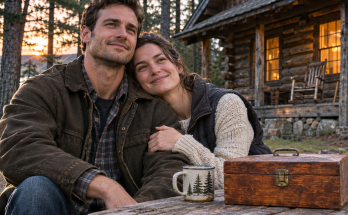
Camille was sitting outside.
I joined her.
The trees moved gently in the breeze.
There was a familiar smell of pine and damp soil.
I took a deep breath.
My wife leaned against my shoulder.
“This was a good idea.”
“Coming here?”
“Keeping it.”
I looked at the cabin.
“Yes.”
I thought about the letter that had arrived on that Tuesday afternoon.
The thirty-day deadline.
The leather folder.
Mr. Sterling's pen moving across the mahogany table when my father struck it.
At the time, I had believed I was fighting to protect an inheritance.
Sitting beside Camille, I realized the inheritance had been more complicated than that.
Grandpa had left me a place where I could remember who I was before my family's expectations became so heavy.
He had left me evidence that somebody had noticed what was happening.
Somebody had cared enough to make sure I wasn't left defenseless.
But there was something else.
He had given me the opportunity to make my own decision.
Whether I kept the cabin or eventually sold it was supposed to be my choice.
Not Dexter's.
Not my mother's.
Not my father's.
Mine.
That distinction had taken me thirty-two years to understand.
Later that afternoon, I opened the tackle box.
Camille sat across from me at the cabin table.
I looked at the old wood and the small screws holding the bottom panel in place.
“It's funny,” I said.
“What is?”
“Dad probably wouldn't have given this box a second look.”
She smiled.
“Probably not.”
“He would have thought it was worthless.”
Camille reached across the table and touched my hand.
“He would have been wrong.”
I laughed quietly.
She was right.
The box had very little financial value compared with the property it had helped protect.
Yet if someone had offered me a choice between the tackle box and an expensive possession of my father's, I knew which one I would have taken.
Every time.
I closed the lid.
There was something comforting about leaving it closed.
I didn't need to search for another hidden document.
I didn't need another revelation.
Grandpa had already given me everything I needed to understand.
That evening, my phone received a message from my father.
I looked at the screen.
He had written only a few sentences.
He said he hoped I was taking care of the cabin.
He mentioned that Grandpa had always been particular about maintaining the roof.
I read the message several times.
There was no demand.
No reference to Dexter's debts.
No threat involving lawyers.
For a moment, I felt a familiar longing.
I wanted to believe that this small message meant something important had changed.
But I knew better than to build an entire reconciliation around a few ordinary words.
I showed Camille.
“What do you think?”
She read it.
“It's a start, maybe.”
“Maybe.”
She handed the phone back.
“You don't have to decide anything tonight.”
I appreciated that.
She wasn't telling me to forgive him.
She wasn't telling me never to speak to him again.
She was allowing me to decide what felt appropriate.
I typed a reply.
I told my father that I had repaired the roof that afternoon and that the cabin was being looked after.
I didn't mention our argument.
I didn't offer money.
I didn't invite him to visit.
I sent the message and put my phone away.
Whatever relationship we might have in the future would depend on more than a shared memory of my grandfather.
It would require respect.
Honesty.
A willingness to acknowledge what had happened.
Until then, I could maintain my distance without wishing him harm.
I could hope my mother found peace in her smaller home.
I could hope Dexter learned how to rebuild his life without relying on somebody else's sacrifice.
None of those hopes required me to surrender my own happiness.
As evening settled around the cabin, Camille and I prepared dinner.
The room smelled of food and old wood.
We sat at the table where I had placed the tackle box earlier.
Camille told me something funny that had happened during one of her shifts at the hospital.
I laughed.
She laughed, too.
It was an ordinary conversation between a husband and wife.
No one interrupted us to demand money.
No one questioned whether her work was respectable.
No one told me I was fortunate to be tolerated.
I looked at her across the table.
My father had once insulted her profession on our wedding day.
He had failed to understand the kind of person she was.
His opinion had never diminished her worth.
I was ashamed that I had ever allowed his approval to occupy so much space in my thoughts.
Camille had stood beside me when we walked into the snow.
She had stood beside me when the attorney's letter arrived.
She had never demanded that I prove my love by sacrificing something important.
I reached for her hand.
“What?”
“Nothing.”
She smiled.
I smiled back.
The following morning, I woke early and went outside.
The air was cool.
I stood quietly near the cabin and listened to the sounds around me.
For a long time, I had imagined that happiness would arrive when my parents finally recognized everything I had done.
I had believed that earning enough money, building a successful career, and becoming a dependable adult would eventually make them proud.
I had been wrong.
The happiness I wanted hadn't come from convincing them that I deserved better.
It had come from no longer allowing their judgment to determine what I deserved.
When Camille joined me, we walked together beneath the trees.
I told her that I wanted us to keep coming back.
She squeezed my hand.
“We will.”
I believed her.
Before we left that afternoon, I checked the roof once more.
Everything looked good.
I gathered my tools and picked up the cedar tackle box.
Then I paused.
I carried it back inside and placed it on the cabin table.
Camille watched me.
“Leaving it here?”
“Yes.”
The important documents were secure at home.
The box didn't need to protect them anymore.
It could simply be Grandpa's tackle box again.
I rested my hand on its lid.
“Thank you, Grandpa.”
My voice was barely above a whisper.
I wished he could have heard me.
Perhaps, in his own way, he had known that this moment would come.
He had understood that someday I would need more than advice about repairing roofs or catching fish.
I would need the courage to say no.
I would need to understand that love didn't require obedience.
And I would need somewhere to remember that I mattered.
He had given me that somewhere.
I turned toward Camille.
She was waiting by the door.
I joined her, stepped outside, and locked the cabin.
The key rested in my palm.
Such a small thing.
For years, my father had acted as though he held the keys to my future.
Now I stood beside my wife, holding the key to a place that belonged to me.
I slipped it into my pocket.
We walked toward the car together.
I didn't look back with fear.
I knew the cabin would be there when we returned.
The inheritance was safe.
My marriage was strong.
And whatever happened between me and my parents from that point forward would happen on terms that respected my dignity.
I hadn't destroyed my family by refusing to sign that document.
I had simply stopped destroying myself to keep everyone else comfortable.
Grandpa Cyrus had known that I deserved a life of my own.
At last, I knew it, too.
The End
Read more original stories on Feel Every Story.
My Father Had Not Spoken to Me in Two Years, but Somehow He Still Believed He Could Tell Me What to Do
Part 10 of 10