
I didn't leave the hospital immediately.
There were more conversations.
More questions.
More checks on my health.
My mother cooperated with the people assessing whether I could safely stay with her.
Dad provided the necessary information.
Eventually, after the appropriate arrangements were made, I was permitted to leave with Elena.
It wasn't a final resolution of every legal issue between my parents.
Those matters would take longer.
But I wasn't being sent back to the farmhouse that day.
When the nurse told me I could get dressed, I looked at my mother.
“I'm really coming with you?”
She smiled.
“Yes.”
I picked up the sweatshirt Dad had brought.
Then I reached for my backpack.
Mom offered to carry it.
“I've got it.”
She didn't insist.
I slipped the straps over my shoulders.
Before leaving, I thanked the nurses who had looked after me.
One of them reminded me to follow the medical instructions they had provided.
Mom made sure we had everything.
Then we walked toward the hospital entrance.
I stopped near the doors.
Outside, the pavement was still wet.
My mother noticed me hesitate.
“What's wrong?”
“Nothing.”
She waited.
I looked at the gray sky.
“I just don't like the rain right now.”
She nodded.
“That's understandable.”
We stood there for another moment.
Then she walked outside with me.
I wasn't alone this time.
Her car was warm.
She waited until I had fastened my seat belt before pulling away.
I held my backpack on my lap.
As we drove, I watched the buildings pass.
For the first few minutes, neither of us spoke.
Then Mom asked what I wanted to eat later.
I told her I didn't know.
She said we could decide together.
I smiled.
Something as simple as choosing dinner felt unfamiliar.
When we reached her place, she showed me where I would be sleeping.
There was a bed, a lamp, and space for my belongings.
She explained that we could arrange everything properly once I had recovered.
I placed my backpack beside the bed.
“Is it okay there?”
“Of course.”
I looked around.
There wasn't anything especially impressive about the room.
It was clean.
Warm.
Quiet.
And nobody was angry with me.
That was enough.
My mother showed me where we could keep my medical supplies.
She wanted them to remain easily accessible.
Together, we went through the hospital's instructions.
We checked what I had brought and what needed replacing.
She asked me to explain my usual routine.
I did.
I had been managing diabetes for four years.
I knew a great deal about it.
But I was still a child who needed dependable adult support.
Mom understood that.
She arranged to coordinate with my medical team and made sure we had the necessary supplies.
She didn't treat my condition like an inconvenience.
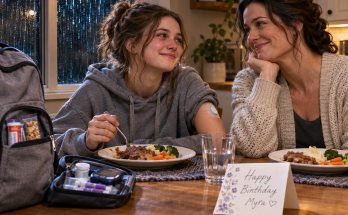
That evening, she prepared dinner.
I sat at the table and watched her set down the plates.
Before eating, we followed my established medical routine.
Then she sat across from me.
“Ready?”
I nodded.
I took my first bite.
For some reason, I started crying.
Mom put down her fork.
“Are you feeling unwell?”
“No.”
“Is something wrong?”
I shook my head.
I didn't know how to explain it.
Eventually, I managed a few words.
“I just wanted dinner.”
She understood.
She reached across the table.
I took her hand.
We sat like that for a little while.
Then we finished eating.
Nobody mentioned money.
Nobody searched my belongings.
Nobody told me to leave.
When I went to bed that night, I placed my phone on the bedside table.
My mother's number was still saved as an emergency contact.
I looked at it.
Then I turned off the screen.
She was only a short distance away.
I didn't need to send her a message to make sure she remembered me.
She was there.
The next few weeks were not easy.
There were interviews concerning what had happened.
There were discussions about my parents' arrangements.
My mother continued providing records of her attempts to remain involved in my life.
The birthday cards became part of those discussions.
So did the returned envelopes.
So did the emails Dad had sent.
I wasn't required to decide which adult deserved to win.
I was allowed to explain what I had experienced.
That made a difference.
I returned to school when I was medically ready.
I carried the same gray backpack.
The same kind of glucose tablets.
The same emergency snacks.
For a while, I became anxious whenever somebody touched my bag without asking.
I knew why.
The memory of Dad emptying it across the kitchen table hadn't gone away.
My mother encouraged me to speak with someone who could help me work through what had happened.
At first, I didn't think talking would change anything.
But I tried.
Slowly, I became better at explaining when I was frightened.
I stopped pretending every uncomfortable feeling was something I should be ashamed of.
Some days were better than others.
Whenever heavy rain hit the windows, I remembered the gravel driveway.
I remembered my wet sneakers.
I remembered trying to read the letters on my phone.
Sometimes I checked my emergency supplies more than once.
Mom never laughed at me.
She helped me feel prepared without making my fear the center of everything.
Eventually, Brin wrote to me.
Her letter was several pages long.
She apologized for taking the money.
She apologized for mentioning my backpack.
She apologized for staying quiet when Dad opened the front door.
Near the bottom, she had written something that made me stop reading.
She said she kept remembering the moment I asked her to tell the truth.
I folded the letter.
Then I unfolded it.
Brin was thirteen.
I knew she had been afraid.
I also knew that her choices had hurt me.
Both things could be true.
I didn't have to pretend otherwise.
Several weeks later, I agreed to speak with her again under arrangements the adults considered appropriate.
She looked nervous when she saw me.
Her eyes immediately filled.
“Hi, Myra.”
“Hi.”
For a moment, neither of us moved.
Then she asked whether she could hug me.
I nodded.
She wrapped her arms around me.
“I'm so sorry.”
I closed my eyes.
“I know.”
She pulled away.
“I wish I'd told the truth.”
“So do I.”
We sat down.
She told me she hadn't bought the phone.
The money had been returned.
Colleen and Dad had dealt with what she had done.
She wasn't asking me to excuse her.
She wanted me to know she understood that she had caused harm.
I listened.
Then I told her something I had thought about for weeks.
“You shouldn't be scared to tell the truth, even when you've done something wrong.”
She nodded.
“I know.”
“And you can't blame somebody else just because you're afraid.”
She began crying again.
I handed her a tissue.
I didn't want my sister to spend the rest of her life believing that one terrible decision made her beyond forgiveness.
But I needed her to understand that forgiveness didn't mean everything returned to normal immediately.
We would have to rebuild our relationship.
Little by little.
She accepted that.
Dad's relationship with me took longer.
The investigation and family arrangements continued.
Eventually, it was established that I would live with my mother, with contact involving Dad subject to the agreed safety arrangements.
He was expected to address the concerns surrounding his behavior and my medical needs.
He couldn't simply declare that everything was over.
During one of our later conversations, he told me he had begun recognizing how often anger had controlled his decisions.
I listened.
I didn't know whether he would truly change.
Only his actions over time could answer that.
He apologized again for withholding the birthday cards.
He admitted that he had wanted to keep my mother at a distance.
He had convinced himself that controlling the information I received was protecting his household.
Instead, he had hurt both of us.
“I thought I knew what was best,” he told me.
I looked at him.
“You didn't ask me.”
He nodded.
“No.”
I remembered how easily he had dismissed my explanation about the granola bars.
How quickly he had decided I was lying.
How certain he had been.
“I need you to listen when I tell you something.”
He promised he would try.
I hoped he would.
But I no longer believed I was responsible for making him into a better father.
That responsibility belonged to him.
Colleen also apologized again.
She acknowledged that standing silently beside Dad had been a choice.
She had known I needed food and medical supplies.
She had failed to intervene.
I appreciated hearing her accept that.
I didn't forget what had happened.
I didn't pretend we were suddenly close.
But I was glad she had stopped describing that evening as something nobody could have predicted.
There had been warnings.
I had given them myself.
Months passed.
My mother's home began feeling like my home.
My clothes filled the drawers.
My schoolbooks collected beside the lamp.
My medical supplies had their own accessible place.
My backpack usually rested beside the door.
I no longer felt the need to keep it against my body whenever I was frightened.
One afternoon, Mom took me back to the public library where we had first met.
We sat near the same area.
I remembered pretending to read while watching the entrance.
She remembered how nervous I had looked.
We laughed a little.
Then I asked her whether she had ever expected our reunion to happen the way it had.
“Never,” she said.
“I wanted something much happier for you.”
I understood.
Neither of us would have chosen a hospital room.
Neither of us would have chosen the freezing rain.
But I was grateful we had found each other before that evening.
I was grateful I had discovered the unopened card.
Without that email address, I wouldn't have known whom to contact.
Without our secret conversations, I might never have saved her number.
And without Officer Vern Brangan, I might never have reached the hospital safely.
I decided to write him a thank-you letter.
I didn't know how to express everything.
In the end, I kept it simple.
I thanked him for stopping.
I thanked him for staying until help arrived.
And I thanked him for reminding me that what happened wasn't my fault.
I signed my name.
Myra.
Mom helped me arrange for the letter to reach him.
Sending it brought me a quiet kind of relief.
My next birthday arrived several months later.
I woke to the sound of my mother moving around in the kitchen.
There was breakfast waiting.
Beside my plate sat an envelope.
My name was written across it.
I recognized the handwriting immediately.
I picked it up.
For a moment, I couldn't open it.
Mom noticed.
“Everything okay?”
I nodded.
Then I carefully separated the flap.
Inside was a birthday card.
She hadn't written anything complicated.
She told me she was proud of me.
She told me she loved being part of my life.
She told me she was grateful we could celebrate together.
I read it twice.
Then I hugged her.
“Thank you, Mom.”
She held me tightly.
“Happy birthday, sweetheart.”
Later that day, she showed me the photographs of the older cards again.
The ones I had never received.
I didn't ask to read every message.
Not yet.
I knew they existed.
I knew she had remembered.
That knowledge was enough for me.
I kept my new birthday card on the bedside table.
Occasionally, I would pick it up and look at my name.
Nobody had hidden it.
Nobody had decided I shouldn't receive it.
It belonged to me.
One evening, another storm moved through the area.
Rain struck the windows.
The wind became louder.
I stopped what I was doing.
For a moment, I was fifteen again, standing on that narrow farmhouse porch without a coat.
Then I looked around.
My mother was preparing dinner.
My phone was charging nearby.
My backpack was within reach.
I was warm.
I was safe.
Mom called from the kitchen.
“Dinner's almost ready.”
I walked toward the table.
She asked me to make sure we were following my usual medical routine before eating.
I did.
Then we sat down together.
The rain continued outside.
I picked up my fork.
For years, I had believed love was something I could lose by disappointing someone.
I had believed that being a good daughter meant staying quiet whenever an adult was angry.
I didn't believe those things anymore.
I could make mistakes.
I could ask questions.
I could disagree.
I could need help.
None of those things meant I deserved to be abandoned.
My father had taken years from my relationship with my mother.
He couldn't return them.
But he could no longer decide whether we were allowed to love each other.
That part of my life belonged to us now.
I looked across the dinner table.
Mom smiled.
I smiled back.
Then I finished my meal while the storm passed outside.
The front door remained closed.
And this time, it was closed to keep the cold out.
Not to keep me out.
The End
Read more original stories on Feel Every Story.
I Had Spent Years Believing My Mother Never Wanted Me, Until I Found Her Sitting Beside My Hospital Bed
Part 10 of 10

One Comment on “PART 10 – I Eventually Left the Hospital With My Mother, and Slowly Learned That Having a Home Should Never Depend on Being Perfect”