I woke up Thursday morning and reached for my phone.
There were no messages from Kirk.
Usually, silence from my son meant he was angry with me or didn't need anything.
I wondered which it was.
Then I wondered why I was still organizing my mornings around his moods.
I put the phone down.
I made breakfast, washed my dishes, and opened the kitchen curtains.
The silver SUV was outside.
A little rainwater had collected on the windshield overnight.
I stood looking at it until my toast popped up.
That vehicle had occupied more of my thoughts than anything I had purchased in seventy-two years.
I wanted that to change.
After breakfast, I took the brown envelope from the drawer and reviewed the documents again.
Then I opened my household budget.
I had always been careful about money.
But careful wasn't necessarily the same as protective.
There were several payments leaving my account every month that had nothing to do with my own household.
Kirk's telephone bill was one of them.
I had started paying it when he was between jobs.
He had been working steadily for quite some time.
The payments had never stopped.
I was also contributing toward an insurance expense that he had once told me was temporary.
Temporary had become a remarkably flexible word in our family.
I wrote down the amounts.
Then I called Kirk.
He answered after several rings.
“What's going on, Mama?”
“I'm going through my monthly expenses.”
“Okay.”
“I need you to arrange payment for your own telephone service.”
He didn't speak.
I could hear something moving in the background.
“Starting when?”
“Next month.”
“Why?”
“Because it's your telephone.”
He gave a little laugh.
It reminded me of the laugh he had given me when he found the SUV in my driveway.
“You've been paying that for years.”
“Yes.”
“So what's changed?”
I looked at the numbers on the page.
“I have.”
He sighed.
“Mama, this is getting out of hand.”
I folded my hands on the table.
“I'm giving you notice so you can make arrangements.”
“What arrangements?”
“The same ones other adults make when they have bills.”
He didn't like that answer.
I knew he wouldn't.
But I had finally realized that his approval wasn't a necessary part of every financial decision I made.
We ended the conversation without an argument.
At least, without an argument from me.
I finished reviewing the expenses and made the appropriate calls.
Nothing was canceled without notice.
I wasn't interested in creating emergencies.
I simply wanted to stop financing responsibilities that weren't mine.
When I finished, I wrote the changes into my budget.
The money remaining at the end of the month surprised me.
I hadn't understood how much of my retirement income had gradually become available to somebody else.
A little here.
A little there.
It didn't seem like much until I saw it together.
That afternoon, I went into town with a woman from church.
She needed groceries, and I needed a few things for the house.
We stopped at a small café afterward.
I ordered a slice of lemon cake.
I hadn't planned to.
Usually, I looked at the prices and reminded myself that I had perfectly good food waiting at home.
That afternoon, I bought the cake.
It cost less than one of Kirk's church rides.
I thought about that as I ate.
Then I made myself stop thinking about it.
I didn't want every pleasant experience to become another comparison with my son's behavior.
When I returned home, I found a message from his wife.
She wanted to know whether I was really stopping the telephone payments.
I answered that I was.
Her response came almost immediately.
“We're family, Ozella.”
I read those words several times.
Then I typed my reply.
“Yes, we are.”
I didn't add anything else.
Friday evening, Kirk arrived unexpectedly.
He had gotten a ride from someone at work.
I invited him inside.
He walked toward the kitchen and sat in his usual chair.
For a while, we talked about his job.
He told me about a difficult afternoon.
I listened.
It almost felt normal.
Then he mentioned the vehicle.
“We've been looking at used cars.”
“That's probably a good idea.”
“They're expensive.”
“I know.”
He studied my face.
I understood what he was waiting for.
In the past, that would have been the moment when I offered to help.
I would have asked how much he needed.
I might even have suggested going to the dealership with him.
This time, I asked whether he had worked out a budget.
He looked disappointed.
“Not yet.”
“Well, that's where I'd start.”
He pushed his chair back slightly.
“You make everything sound so easy.”
“No, sweetheart. I just make it sound possible.”
He looked toward the driveway.
For a moment, I thought he was going to ask for the SUV again.
Instead, he asked whether I intended to sell it.
“I haven't decided.”
“What would you do with the money?”
I considered the question.
Then I realized I didn't owe him an answer.
“Whatever I decide is best for me.”
He nodded slowly.
I could see that he was still adjusting to hearing me speak that way.
I was adjusting to it myself.
After he left, I called the woman from church who had driven me the previous Sunday.
I offered to take her to lunch after the next service.
She accepted.
We spent several minutes talking about where we might go.
It was a pleasant conversation.
Nobody needed rescuing.
Nobody asked for money.
Nobody expected me to solve a problem.
I had forgotten how enjoyable ordinary companionship could be.
Saturday morning, I cleaned the inside of the SUV.
I found an old grocery receipt beneath the passenger seat.
There were empty water bottles in the back.
A few coins had fallen between the seats.
I put the rubbish into a bag.
Then I wiped the dashboard.
There was something satisfying about taking care of an object that belonged to me.
For months, I had barely seen the inside of that vehicle except from the passenger seat.
Now I could decide when it needed cleaning.
I could decide where it went.
I could decide who sat inside it.
Those were small freedoms.
At seventy-two, I was beginning to appreciate them differently.
Sunday came.
I wore my lavender dress again.
My Bible was waiting beside my handbag.
When my friend arrived, I walked outside without reaching for my wallet.
She greeted me warmly.
We went to church and afterward shared lunch.
I paid for both meals because I wanted to.
There was a difference between generosity and obligation.
I was learning to recognize it.
When I returned home, Kirk was sitting on my porch.
He stood when he saw me.
“Where have you been?”
“Church and lunch.”
“With who?”
“A friend.”
He glanced at the woman as she drove away.
“She takes you every Sunday now?”
“For the time being.”
He looked uncomfortable.
“I could still take you.”
I stopped beside the porch railing.
“Could you?”
“Yes.”
“How much?”
He lowered his eyes.
“Come on, Mama.”
I wasn't trying to humiliate him.
But I wasn't willing to pretend the question didn't matter.
He reached into his pocket.
Then he handed me two twenty-dollar bills.
I looked at them.
“What's this?”
“The money you paid me.”
I took the bills.
His face appeared tense.
“I shouldn't have charged you.”
I waited.
He rubbed the back of his neck.
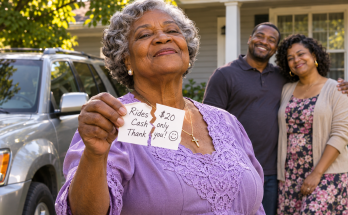
“And I shouldn't have let her make that card.”
There was something different about his voice.
Still, I wanted him to understand something.
“You held the card, Kirk.”
“I know.”
“You made the decision to give it to me.”
He nodded.
“I know that, too.”
I folded the money.
Then I put it inside my handbag.
“Thank you.”
He watched me carefully.
I could almost see the question forming.
Finally, he asked it.
“So are we okay?”
“We're talking.”
“What about the SUV?”
There it was.
I looked at my son.
He looked away.
“I guess I shouldn't have asked that.”
“No, you shouldn't have.”
He sat back down.
I sat beside him.
We watched a car travel slowly along the street.
Neither of us spoke for a while.
Then Kirk said something about finding a cheaper vehicle.
He had been comparing prices.
He thought he could manage a monthly payment if he saved enough for a deposit.
I encouraged him.
Not financially.
Just as his mother.
I told him that I believed he could figure it out.
He seemed uncertain about what to do with encouragement that didn't come with a check.
Eventually, he stood.
He had arranged for someone to pick him up.
Before leaving, he asked whether he could come by later in the week.
“Of course.”
He looked at me.
“Even if I don't need anything?”
I smiled.
“Especially then.”
After he left, I carried my handbag into the kitchen.
I removed the two twenty-dollar bills.
For a moment, I considered putting them inside the brown envelope.
Then I decided against it.
They weren't evidence anymore.
They were simply my money.
I placed them in my wallet.
The little white card remained with the vehicle documents.
But the cash was going back into circulation.
I had spent enough time treating forty dollars as though it contained the whole story of my relationship with my son.
It didn't.
The real question was whether Kirk could learn to love me without expecting me to pay for the privilege.
And whether I could learn to expect that kind of love.
Click here to continue reading: PART 6: A Quiet Afternoon at My Kitchen Table Forced My Daughter-in-Law to Explain Why Her Mother Had Deserved Something She Denied Me
I Thought Buying My Son a Vehicle Would Bring Us Closer, Until One Sunday Morning Changed Everything I Believed About Family
Part 5 of 10