
The first thing Monica brought into the bungalow was a cardboard box containing kitchen utensils.
There were two saucepans inside.
Several mismatched plates.
A wooden spoon with a dark mark near its handle.
She placed the box on the kitchen counter and began unpacking.
I stood near the doorway while the housing coordinator reviewed the remaining documents.
The arrangements had finally been completed.
I retained ownership of the property, and Monica and Laya would occupy it under the organization's transitional-housing program.
There were clear responsibilities on both sides.
Nothing depended on a personal promise that could change without warning.
Monica had signed the agreement.
So had I.
The coordinator handed her the keys.
Monica looked down at them for a long time.
Then she closed her fingers.
“Thank you.”
I smiled.
“You're welcome.”
Laya was already exploring the smaller bedroom.
The organization had arranged some basic furniture.
There was a bed, a dresser, and a little desk near the corner Dad had originally chosen for his reading chair.
Laya sat at the desk.
She opened her backpack and took out a pencil case.
Then she arranged several pencils across the wooden surface.
I watched from the doorway.
She wasn't doing homework.
She was simply putting things somewhere she expected to find them again.
I hadn't understood how important that could be until meeting her.
Monica joined me.
She watched her daughter for a moment.
Then she wiped her eyes.
“She hasn't had her own room for a while.”
I nodded.
There wasn't much I could say that wouldn't interrupt the moment.
Laya opened one of the desk drawers.
She looked inside.
“Can I keep my school papers here?”
Monica smiled.
“That's what it's for.”
I turned toward the living room.
Simple curtains now hung across the bay window.
They weren't the ones Mom had imagined.
They had been donated by somebody connected to the housing program.
They fit reasonably well.
That was enough.
Before leaving, I handed Monica the contact information she needed for maintenance issues.
I reminded her that the coordinator would remain available to help with the program.
She thanked me again.
Then she surprised me.
She asked whether I would like to come back for coffee sometime.
Not because something needed fixing.
Not because she had a favor to request.
Just coffee.
I told her I would enjoy that.
Outside, I sat in my car and looked at the bungalow.
Through the window, I could see Laya moving around the living room.
There were cardboard boxes everywhere.
The furniture didn't match.
The curtains weren't particularly attractive.
But the house was becoming somebody's home.
That was what I had wanted when I bought it.
The people living inside were different from the ones I had originally imagined.
The purpose wasn't.
Over the following months, the matter concerning Grandpa's estate continued.
Dad provided the records he had collected.
The attorneys reviewed them alongside documents Patricia had obtained and additional financial information.
The process wasn't quick.
Some records were incomplete.
Certain expenses were legitimate.
Others were difficult to justify under the arrangements Grandpa had established.
I learned that recovering money after so many years could be complicated.
There were legal limitations and evidentiary questions that needed careful consideration.
I didn't want to spend the rest of my life fighting over every transaction.
But I wasn't prepared to walk away without an honest accounting.
Eventually, the attorneys began discussing a negotiated resolution.
Dad acknowledged that funds intended for my benefit had been used for other purposes.
He agreed to a financial settlement rather than forcing the matter into a prolonged dispute.
The amount didn't represent everything Grandpa's property might have become over the years.
It couldn't account perfectly for lost opportunities or the years during which I hadn't known about the arrangement.
But it recognized that something had been wrong.
That mattered to me.
The agreement included an initial payment and further payments under documented terms.
Dad received his own legal advice before signing.
I wanted him to understand exactly what he was agreeing to.
I didn't want either of us relying on assumptions again.
When the final documents were ready, my attorney placed them in front of me.
I read every page.
Then I signed.
There was no dramatic confrontation.
Nobody raised their voice.
Nobody stood in a courtroom announcing that I had finally won.
There was just a pen, some paper, and a quiet acknowledgment of what had happened.
Afterward, I called Patricia.
She listened while I explained the resolution.
When I finished, she became quiet.
Then she said something that made me smile.
“Your grandfather would be relieved.”
I looked at the documents beside me.
“So am I.”
That afternoon, I opened a savings account specifically for the money recovered through the settlement.
I didn't have immediate plans for it.
I wasn't going to spend it to prove anything.
I wasn't going to give it away because somebody else had a greater need.
I intended to keep it available for my own future.
That decision felt surprisingly unfamiliar.
I had always been good at saving.
I hadn't always been good at allowing myself to benefit from what I saved.
Grandpa's letter remained in its protective sleeve.
Eventually, I bought a small document box for it.
I placed the estate records inside as well.
The box went into a drawer in my apartment.
I knew where everything was.
I didn't need to look at it every day.
Meanwhile, Monica found another payroll position.
She called me after receiving the offer.
Her voice shook with excitement.
The job wasn't everything she had hoped for professionally.
But it provided a regular income and an opportunity to rebuild.
She told me she had already discussed her new circumstances with her case manager.
Together, they were developing a savings plan and considering her longer-term housing options.
I congratulated her.
She laughed.
“I can finally stop filling out job applications every night.”
I could hear Laya celebrating in the background.
I smiled for the rest of the afternoon.
In April, I visited the bungalow.
There were little yellow flowers beneath the bay window.
Some leaned awkwardly toward the driveway.
Others looked as though they might not survive.
Laya was watering them with a small plastic container.
She waved when she saw me.
“Look what we planted!”
I crouched beside the flower bed.
She pointed out which ones she had chosen.
She explained that her mother had helped dig the holes.
Then she told me about school.
She had completed a project at her bedroom desk and received a good grade.
Her teacher had written a little comment at the bottom of the page.
Laya ran inside to find it.
Monica stood beside me.
She looked healthier than when I first met her.
Less exhausted.
She still had worries.
Employment hadn't solved every financial problem.
But she was making progress.
She wasn't spending every week wondering where she and her daughter would sleep.
That afternoon, we drank coffee at the kitchen table.
We talked about ordinary things.
Work.
School.
The weather.
Monica complained about the price of groceries.
I told her Grandpa used to do exactly the same thing.
She laughed.
There was something wonderful about a conversation that didn't require anyone to perform a particular family role.
I wasn't the responsible daughter.
The difficult sister.
The person expected to fix something.
I was simply a woman having coffee with another woman.
I liked being that person.
My relationship with Leah changed gradually.
She stopped bringing up the money our parents had once intended to give her.
She began making financial plans based on her own circumstances.
Occasionally, she called just to talk.
The first time she offered to pay for my coffee, I almost refused out of habit.
Then I accepted.
It wasn't an expensive coffee.
But the gesture mattered.
She had thought about me.
She wasn't asking for anything.
She was simply buying her sister a drink.
One afternoon, she brought up the joke Dad had made before Christmas.
She admitted that it had embarrassed her more than she had been willing to say at the time.
She had appreciated me defending her.
Then she had allowed Dad to treat my defense as a reason to exclude me.
“I should have stood beside you.”
I nodded.
“Yes.”
She didn't argue.
She didn't tell me I needed to understand how difficult Dad could be.
We sat quietly for a while.
Then we changed the subject.
I wasn't interested in punishing Leah indefinitely.
I wanted our relationship to become more honest.
That required both of us to stop pretending uncomfortable things hadn't happened.
Mom took longer.
For several months, almost every conversation returned to the bungalow.
She would mention its location.
The convenience of having everything on one level.
How pleasant the kitchen had looked.
Eventually, I told her that I couldn't continue discussing the property as though it remained available to her.
She became upset.
Then she asked whether Monica was still living there.
I said she was.
Mom nodded.
That was the last time she raised the subject for quite a while.
My parents decided to remain in their existing house while reviewing their retirement finances.
They adjusted their plans.
Some improvements were postponed.
They no longer expected to provide Leah with $180,000.
Their circumstances weren't ideal.
But they had options.
They had a home.
They were capable of making decisions about what belonged to them.
For years, I had confused their difficulties with my obligations.
I was learning to separate them.
Dad and I spoke occasionally.
Our conversations were shorter than they used to be.
At first, he sounded uncomfortable whenever I expressed an opinion that differed from his.
Sometimes he became defensive.
When that happened, I ended the conversation rather than spending another hour trying to convince him that I was entitled to disagree.
Over time, he began making more effort.
It wasn't a complete transformation.
He was still my father.
He still had habits that had taken decades to develop.
But he was learning that I would no longer remain present simply because he expected me to.
His apology was only the beginning of that lesson.
The payments under the settlement began as agreed.
I kept records of them.
Our financial arrangement remained separate from our personal relationship.
I didn't want Dad believing that being friendly with me would change his responsibilities.
And I didn't want myself believing that receiving what he owed required me to overlook everything else.
By autumn, Monica had accumulated enough savings to begin considering permanent rental accommodation.
Her housing coordinator helped her review suitable options.
She wasn't ready to move immediately, but there was a realistic path ahead.
I was pleased.
The bungalow wasn't meant to make her permanently dependent on me.
It was meant to give her time.
Time to earn.
Time to save.
Time to make decisions without the constant pressure of an approaching checkout date.
One afternoon, Laya told me she wanted to become a teacher.
A week later, she wanted to become a veterinarian.
I told her she didn't have to decide yet.
She had plenty of time.
She accepted that answer without worrying about which ambition would make me happiest.
I thought Grandpa would have liked her.
When December arrived, Monica invited me to the bungalow for Christmas.
She was planning a small meal.
Nothing extravagant.
She explained that she and Laya wanted to celebrate their first Christmas in a place that felt settled.
I accepted.
A few days later, Mom called.
She wanted to know whether I would come to their house on Christmas Eve.
She told me the exact time.
Then she hesitated.
“You don't need to bring anything.”
I smiled faintly.
That was new.
I agreed to visit.
I didn't offer to organize the meal.
I didn't ask whether anyone needed presents picked up.
I didn't inquire about seating arrangements or dietary requirements.
I arrived at the time Mom had given me.
Patricia was there.
So was Leah.
Dad opened the door.
He looked at the little package I was carrying.
“You didn't have to get me anything.”
“I know.”
Inside was the present I had bought him the previous Christmas.
I had kept it in the closet.
There had been times when I considered returning it.
In the end, I decided I wanted him to have it.
Not as a sign that everything had been forgiven.
Not because I owed him a gift.
Because giving it was something I had chosen.
Mom received the coffee I had purchased for her the previous year, too.
I had replaced the old bag with a fresh one.
She smiled when she saw it.
Then she hugged me.
Dinner was pleasant.
Not perfect.
There were awkward pauses and occasional reminders of the things that had happened.
At one point, Dad started making a comment about Leah.
He stopped halfway through.
He looked at her.
Then he changed the subject.
I noticed.
So did Leah.
Neither of us said anything.
Before leaving, I helped Mom carry a few plates into the kitchen.
She thanked me.
I went home before it became late.
Nobody complained.
Nobody suggested I was being inconsiderate.
The following morning, I stopped at the grocery store.
I headed toward the bakery.
There was an apple pie on the display.
Beside it sat a chocolate cake.
I stood looking at them.
For a moment, I was back where I had been twelve months earlier.
Holding my phone.
Trying to understand why my family had celebrated without me.
Then I heard the cashier greeting another customer.
The familiar sounds brought me back.
I picked up the chocolate cake.
There was no need to call anybody and ask.
I knew exactly where I was going.
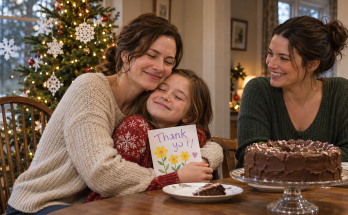
When I arrived at the bungalow, Laya opened the door.
She saw the cake immediately.
“You remembered!”
“Of course I did.”
Monica laughed from the kitchen.
A small Christmas tree stood beside the bay window.
There were handmade decorations hanging from its branches.
Several paper snowflakes had been taped against the glass.
One was slightly crooked.
I remembered Laya pressing a loose snowflake against the wall of the community center.
I remembered her mother talking about needing an opportunity to get back on her feet.
That afternoon, the three of us ate dinner together.
Monica had cooked more food than we needed.
Laya helped carry the plates to the table.
Afterward, we cut the chocolate cake.
She asked whether she could have a piece with extra frosting.
Monica agreed.
I watched her carefully lift it onto her plate.
Then she remembered something.
She disappeared into her bedroom and returned holding a folded piece of paper.
It was a Christmas card she had made for me.
There were yellow flowers drawn across the front.
Inside, she had written a short message thanking me for helping her and her mother have somewhere to celebrate Christmas.
I read it twice.
Then I hugged her.
I didn't need another word.
That evening, when I returned to my apartment, I placed the card beside my little Christmas tree.
Grandpa's letter was still safely stored in its box.
I took it out and read it once more.
He had wanted me to have choices.
I finally understood why that mattered so much.
A year earlier, I had believed love meant making life easier for everybody around me.
Even when doing so made my own life harder.
Even when nobody noticed.
Even when the people receiving my kindness couldn't make room for me at their Christmas table.
I didn't believe that anymore.
I could love my parents without giving them everything they expected.
I could forgive certain things without pretending they had never happened.
I could help my sister without becoming responsible for her future.
And I could offer something meaningful to people who needed it without making their gratitude the reason I felt worthwhile.
I put Grandpa's letter away.
Then I returned to the living room.
The apartment was quiet.
But it didn't feel empty.
My phone rested on the coffee table.
There were no urgent messages.
No demands.
No unfinished arrangements requiring my attention.
I thought about Dad telling me that Christmas had been more comfortable without me.
At the time, I had heard those words as evidence that something was wrong with me.
Now I understood that he had been uncomfortable with the person I was becoming.
Someone who asked questions.
Someone who expected honesty.
Someone who could say no.
He had wanted an easier Christmas.
I had wanted a family that wanted me.
Those were very different things.
I couldn't change what happened the previous Christmas.
I couldn't return to that grocery store and spare myself the pain of hearing his answer.
But I could decide what happened afterward.
And I had.
The bungalow still belonged to me.
Monica and Laya had received the stability they needed to begin rebuilding their lives.
Grandpa's intentions had finally been acknowledged.
My family was learning to live without treating my generosity as something guaranteed.
And I was learning to enjoy what I had worked so hard to create.
I switched off the Christmas tree and carried my empty coffee cup into the kitchen.
Tomorrow, I would wash the remaining dishes.
Perhaps I would call Patricia.
Perhaps I would go for a walk.
There was no particular place I needed to be.
Nobody was expecting me to solve anything.
For once, that didn't make me feel unwanted.
It made me feel free.
The End
Read more original stories on Feel Every Story.
I Had Spent Years Trying to Make My Parents Happy, but One Christmas Morning Made Me Question Everything I Had Done
Part 10 of 10

One Comment on “PART 10 – By the Following Christmas, the Bungalow Had Become a Home, and I Finally Understood That Being Loved Should Never Require Giving Everything Away”