I opened the last envelope after lunch.
The house was quiet.
Sunlight rested across the kitchen table.
I could hear the clock ticking above the refrigerator.
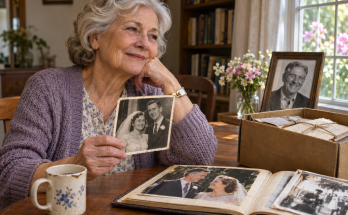
Inside the envelope was a photograph.
I recognized it before I had fully removed it.
Henry and I were standing together outside the church several months before our wedding.
We were smiling.
Henry looked impossibly young.
So did I.
I touched the edge of the photograph.
For years, I had avoided looking at pictures from that period.
I hadn't wanted to see the happiness I had once taken for granted.
Now I studied the young woman beside Henry.
She looked hopeful.
She looked certain.
She had no idea what was coming.
I felt sorry for her.
But I also felt proud of her.
She would eventually leave everything familiar behind.
She would work exhausting hours.
She would learn to trust again.
She would marry a man who loved her.
She would raise three children.
She would welcome six grandchildren into her home.
There was an entire lifetime ahead of that young woman.
She simply didn't know it yet.
I placed the photograph on the table.
Behind it was another letter.
Henry had written the date at the top.
It was from shortly before his death.
His handwriting was difficult to read.
I moved closer to the window.
By now, you know the circumstances that frightened me into leaving.*
You also know that those circumstances cannot excuse the years that followed.*
I hope you understand that I am not asking you to forgive me.*
I stopped.
That surprised me.
I had expected the final letter to contain some request.
Perhaps he wanted me to think kindly of him.
Perhaps he wanted reassurance that he hadn't wasted his life.
Perhaps he wanted me to remember our relationship differently.
Instead, he continued.
You do not owe me comfort.*
You do not owe me affection.*
You do not owe me an answer.*
I am giving you these letters because the truth was always yours to know.*
I swallowed.
Something about those words felt different from the earlier letters.
Henry was no longer explaining his fear.
He wasn't describing his loneliness.
He wasn't asking me to consider the pain he had experienced.
He was acknowledging mine.
I continued reading.
When I learned that you had married Robert, I understood that someone else had been given the opportunity I had thrown away.*
Over the years, I learned that he had been a good husband and father.*
I am grateful that you found someone who knew how to stay.*
My eyes filled with tears.
I thought about Robert.
He had never needed to describe himself as loyal.
His loyalty had been present in the ordinary things he did.
He had shown up.
He had listened.
He had remained beside me when life became difficult.
Those things mattered more than beautiful promises.
I looked at Henry's photograph again.
The young man in it probably hadn't understood that.
Perhaps the older man who wrote these letters finally did.
Please don't confuse my regret with a claim on your happiness.*
The life you built belongs to you and the people who shared it.*
Nothing I have written should take anything away from them.*
I placed the letter down.
For the first time since Daniel had arrived, I cried without trying to stop myself.
I cried for the young woman sitting alone on the church steps.
I cried for the years she had spent wondering what was wrong with her.
I cried because the man who could have ended that uncertainty had waited until he was dying.
And I cried because Robert was no longer there to sit beside me.
I missed him terribly.
I wanted to tell him that I finally understood what had happened.
I wanted him to know that nothing I had learned changed what our marriage meant to me.
I could almost imagine him listening quietly while I spoke.
Then he would have asked whether I wanted another cup of coffee.
That was the kind of man Robert had been.
He knew that difficult conversations didn't always require complicated answers.
Sometimes they required someone willing to remain in the room.
I wiped my eyes and continued reading.
Henry described his final months.
He had sorted through old belongings.
He had discovered that the letters remained exactly where he had stored them.
For years, he had considered destroying them.
He had believed that allowing the past to disappear might be kinder.
Eventually, he had changed his mind.
Destroying them would have been another decision I made for you.*
I have made enough of those.*
I nodded slowly.
“Yes,” I said.
“You have.”
I wasn't speaking with bitterness.
Not entirely.
There was something satisfying about finally having the truth acknowledged.
Henry had recognized the mistake beneath all his other mistakes.
He had repeatedly decided what I should know, what I should feel, and what I should be allowed to choose.
Now he was finally leaving a decision in my hands.
I could keep the letters.
I could destroy them.
I could tell my children.
I could never mention Henry again.
Whatever I decided, it would be mine.
The letter ended with a simple apology.
I am sorry for leaving you at the altar.*
I am sorry for allowing others to blame you.*
I am sorry that you carried a question I could have answered.*
I hope the years ahead bring you peace.*
Henry.*
I sat for a long time after reading his name.
Then I carefully returned the photograph to its envelope.
I didn't put the envelope back into the box.
Not immediately.
Instead, I carried it into the living room and sat beside the photograph of Robert.
I looked at my husband's smiling face.
“You wouldn't believe the morning I've had.”
I smiled despite myself.
Then I began telling him everything.
I spoke softly.
There was nobody there to hear me.
But after four years of widowhood, I had grown accustomed to speaking to Robert's photograph occasionally.
I told him about Daniel.
I told him about the cardboard box.
I told him about Henry's father and the debts.
I told him about the fifty letters.
Finally, I told him what I had needed to hear for half a century.
“It wasn't because of me.”
Saying those words aloud felt different from reading them.
I repeated them.
“It wasn't because of me.”
For years, I had understood that intellectually.
Robert had helped me believe that I deserved love.
My children and grandchildren had filled my life with happiness.
But some small part of me had continued wondering whether Henry had discovered something about me that made him run.
That part of me could finally rest.
I remained beside Robert's photograph until the afternoon began to fade.
Then I called my eldest child.
“Do you have a little time?”
“Of course, Mom. What's wrong?”
“Nothing's wrong. Something unexpected happened yesterday.”
I explained that an attorney had visited me.
I mentioned Henry's name.
There was a brief silence.
My children knew that I had been engaged before meeting their father.
They knew the wedding hadn't happened.
But I had rarely discussed the details.
“He sent you letters?”
“Yes.”
“After all this time?”
“Yes.”
“Are you all right?”
I thought about the question.
“I think I am.”
My child offered to come over.
I accepted.
An hour later, we were sitting together at the kitchen table.
I showed the photograph.
Then I explained what Henry's letters had revealed.
My child listened carefully.
There were questions about the debts and Henry's disappearance.
I answered what I could.
Eventually, the conversation turned to Robert.
“Did Dad know how much the wedding hurt you?”
“He did.”
“Was he ever bothered by it?”
“Your father understood that I had lived a life before meeting him.”
I smiled.
“He never treated my past as something I needed to apologize for.”
My child reached across the table and took my hand.
“Dad loved you so much.”
“I know.”
That was the beautiful thing about Robert's love.
I didn't have to search through old letters to discover it.
I had experienced it every day.
My child looked at Henry's box.
“What are you going to do with all of this?”
“I haven't decided.”
“Are you going to forgive him?”
I considered the question.
I had always imagined forgiveness as something dramatic.
A conversation.
An embrace.
A declaration that everything was all right.
But Henry was dead.
There would be no conversation.
There would be no embrace.
And everything wasn't all right.
What happened had been cruel.
The rumors had been unfair.
The decades of silence had been unnecessary.
Forgiveness couldn't change any of those things.
“I don't think forgiveness means pretending someone didn't hurt you,” I said.
My child nodded.
“Then what does it mean?”
“Perhaps it means deciding that you don't want their mistakes to have any more power over you.”
I looked at the letters.
“I think I've carried this long enough.”
We sat together until evening.
Before leaving, my child helped me put the remaining papers into their bundles.
We didn't throw anything away.
I wasn't ready to make that decision.
And for once, I didn't feel pressured to make it.
After closing the front door, I returned to the kitchen.
I placed Henry's final letter inside the box.
Then I replaced the cardboard lid.
The box looked exactly as it had when Daniel first carried it into my house.
But it no longer contained an unknown truth.
It contained a history I finally understood.
I carried it into the bedroom and placed it inside the closet.
Then I returned to the living room.
Robert's photograph was still waiting on the shelf.
I straightened its frame.
Outside, the last light disappeared.
I turned on a lamp and settled into my chair.
For fifty years, I had remembered the sound of Henry's footsteps leaving the church.
That evening, another memory came to me.
Robert walking through our front door after work.
Our children running toward him.
His laughter filling the hallway.
I closed my eyes.
Those were the footsteps I wanted to remember.
The footsteps of someone coming home.
Click here to continue reading: PART 9: I Returned to the Town Where Henry Had Left Me and Finally Stopped Feeling Ashamed of the Woman I Had Been
I Had Sewn Every Stitch of My Wedding Dress Myself, Never Imagining I Would Leave the Church Without a Husband
Part 8 of 10