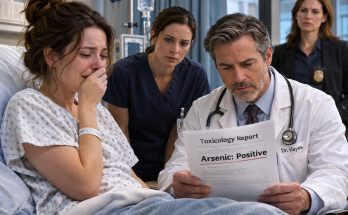
The message was still glowing on my phone.
Ethan knew where I was.
He said he and Margaret were coming.
And he didn't want me accepting anything from the hospital staff.
I kept looking at those words.
I had spent seven days trying to convince him that my headache was serious.
Now that I had finally reached a doctor, he was giving me another reason not to trust the help I needed.
I didn't understand it.
I didn't understand why he had been so determined to keep me away from a hospital.
I didn't understand why Margaret had agreed with him.
And I certainly didn't understand why Dr. Hayes had called the police.
I looked down at my wrist.
Four bruises.
That was what the doctor had noticed first.
They were dark and oval, arranged in a line along the inside of my left wrist.
I had explained that Ethan was helping me when I nearly fell.
I hadn't thought that answer would cause alarm.
But Dr. Hayes hadn't looked reassured.
Then he had examined my fingernails.
There were thin white bands across them.
Every single one.
I turned my hand slightly, studying the marks.
They were small enough that I hadn't treated them as important.
Now I wondered how long they had been there.
I couldn't remember when I first noticed them.
That frightened me.
I had been paying so much attention to the pain inside my head that I had barely considered what the rest of my body might be telling me.
My feet had been numb for months.
Not days.
Months.
I had told Dr. Hayes that during the examination.
He had asked the question plainly, and I had answered it.
There was nothing complicated about the truth.
I had been losing feeling in my feet long before the seven days of headaches began.
Yet I had allowed myself to believe that grief could explain everything.
My parents had died six months earlier in a highway accident.
I was still trying to live with that loss.
Ethan knew how deeply it affected me.
Margaret knew too.
That was why their explanations had seemed believable.
When Ethan told me my symptoms were probably connected to stress, I wanted him to be right.
I wanted my body to be reacting to sorrow rather than something dangerous.
It was easier to accept an explanation that didn't require medical tests.
Easier to believe I would improve if I rested.
Easier to believe my husband understood what was happening.
But my feet hadn't improved.
My legs had become so weak that Dr. Hayes could barely get a response when he tested my knees.
And my headache had grown unbearable.
Those were facts.
I could no longer pretend they were small things.
I remembered the morning I left home.
I hadn't even been properly dressed.
I had pulled Ethan's sweatpants over my nightgown.
My feet were inside borrowed shower slippers.
I had searched through my bathrobe pocket for enough money to pay a taxi driver.
Loose coins.
Wrinkled bills.
Whatever I could find.
I hadn't stopped to think about how I looked.
The pain had become more important than my embarrassment.
For seven days, I had been told I didn't need a doctor.
On the seventh morning, I had finally decided otherwise.
It was such a simple decision.
Go to the hospital.
Ask for help.
Find out what was wrong.
Yet making it had felt enormous.
I thought about that while sitting in the examination room.
Why had I found it so difficult to seek treatment?
Why had I needed to leave alone?
Why had I continued listening when my body was getting worse?
I didn't have a complete answer.
But I knew part of it.
I trusted Ethan.
He was my husband.
I had expected him to help me when I was sick.
I trusted Margaret too.
She was my mother-in-law.
After my parents died, she had taken responsibility for several ordinary routines around the house.
She had prepared my evening tea.
She had reminded me to eat.
She had encouraged me to rest.
Those things had seemed kind.
I remembered her sitting across from me in the kitchen.
Her silver hair was neatly pinned.
Her cream blouse was buttoned to the neck.
The ginger tea sat beside my right hand.
She had placed a folded napkin underneath the mug.
She had even moved the sugar bowl out of the way.
I could picture that evening clearly.
My headache had started after dinner.
Every time I stood, the pressure behind my eyes became worse.
Margaret had noticed I wasn't feeling well.
She brought the tea.
She encouraged me to drink it.
I took a small sip.
That was all I could say for certain about that moment.
I didn't know whether the tea had anything to do with what Dr. Hayes had discovered.
I didn't know what the white marks on my fingernails meant.
I didn't know why the doctor had become so alarmed.
It would have been easy to take every strange detail and force it into one frightening explanation.
But I had no proof.
I had questions.
And questions were not the same as answers.
I looked at Ethan's message again.
He hadn't asked how I was feeling.
He had warned me about what the hospital might give me.
He had told me he was coming.
That was what his words said.
I couldn't know what he intended until I heard more.
Still, I felt uneasy.
I had spent months accepting explanations from him.
My feet were numb because I was grieving.
My body was exhausted because I was stressed.
My headaches didn't require medical care.
Each explanation had led to the same conclusion.
I should stay home.
I should rest.
I should stop worrying.
Now I was finally in the hospital, and his message seemed to point in the same direction.
Don't accept help.
I held the phone a little tighter.
I thought about the doctor.
Dr. Michael Hayes had entered my examination room looking tired but attentive.
He had spoken gently.
He had listened while I described the numbness.
He had tested my reflexes.
He had checked my eyes.
He had examined my hands.
He had noticed things I hadn't understood.
And then he had called for the police.
That frightened me.
But it also told me something important.
My symptoms had not been dismissed.
Someone had looked closely enough to become concerned.
I wanted to know why.
I wanted to hear the explanation.
I wanted to understand what the bruises and nail markings might mean before deciding what to believe.
There was another thought I couldn't avoid.
If I had stayed home that morning, none of this would have happened.
Dr. Hayes wouldn't have examined me.
He wouldn't have seen my wrist.
He wouldn't have looked at my fingernails.
And I would still have been listening to Ethan and Margaret tell me that everything was fine.
That possibility made me feel cold.
Not because I knew what the doctor had found.
I didn't.
It frightened me because I had almost allowed my uncertainty to keep me from getting help.
Again.
For seven days, I had waited.
Seven mornings.
Seven nights.
Seven days of pain that I could no longer manage.
And for months before that, I had lived with numbness that deserved an explanation.
I had treated my own discomfort as less important than keeping peace at home.
I didn't want to do that anymore.
I looked at the pale hospital floor.
Then I looked at my hands.
The marks were still there.
The phone remained in my lap.
Nothing had changed about the evidence in front of me.
But something had changed about the way I intended to respond.
I wasn't ready to accuse anyone.
I wasn't ready to decide what had caused my illness.
I was ready to listen to the doctor.
I was ready to answer his questions truthfully.
And I was ready to stop pretending that my symptoms were harmless simply because the people closest to me said they were.
Ethan was coming.
Margaret was coming with him.
The police had been called.
I didn't know what would happen when they arrived.
But I knew why I had come to the hospital.
I needed medical care.
That need hadn't disappeared because my husband sent me a message.
I kept my place on the examination bed.
For once, I wasn't going to let somebody else's certainty replace my own judgment.
Click here to continue reading: PART 8: I Had Spent Seven Days Believing My Husband, but the Doctor’s Reaction Made Me Realize How Much I Still Didn’t Know
I Had Another Headache That Night, and Margaret Was Already Waiting in the Kitchen With a Cup of Ginger Tea
Part 7 of 10