I had always believed that my son knew the difference between a favor and a gift.
Apparently, I had been wrong.
The house was not something David had inherited.
It was not something I had promised him.
And it was certainly not something Sarah had the right to claim because she wanted a larger place to raise a child.
Those facts should have been easy to understand.
Yet by the time Thomas began examining the records, David and Sarah had already told people a story that barely resembled my life.
According to them, I had decided to leave.
I had chosen to reduce my belongings.
I had agreed that David should take over the property.
And I was supposedly preparing for assisted living.
I kept thinking about that last part.
Assisted living.
I was sixty-seven years old.
I could still manage my finances.
I could still make decisions about my home.
I could still read a deed and understand whose name appeared on it.
But someone had begun describing me as though I had already lost the ability to speak for myself.
I found that more frightening than the missing furniture.
Furniture could be returned.
Money could be traced.
But how was I supposed to repair the damage if my own family convinced people that I could no longer be trusted?
Thomas had warned me to remain careful.
I tried to follow his advice.
I saved the messages.
I kept the bank records together.
I made sure the photograph of the red notice remained on my phone.
And I refused to sign anything.
Sometimes those small actions felt almost ridiculous.
I had raised David.
I knew how he liked his coffee.
I knew what frightened him when he was little.
I knew the particular expression he made when he was trying to avoid a difficult conversation.
Now I was preserving evidence in case his explanations became part of a legal dispute.
There were moments when I felt ashamed that our relationship had reached that point.
Then I remembered the locked door.
And I remembered whose decision it had been.
It was not mine.
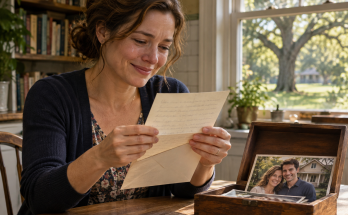
One afternoon, I took out the photograph Martha had given me.
Robert stood beside the grandfather clock with the wooden anniversary box in his hands.
I sat looking at his face.
He had always believed that a person should be careful about promises.
If he said he would help, he helped.
If he agreed to lend something, he expected it returned.
He had been generous with David, but he had never believed generosity should require a person to surrender their dignity.
I thought about the letter he had written our son.
It had been dated two years before Robert died.
That detail bothered me.
Why had he felt the need to explain something so basic?
Perhaps he had simply been offering ordinary fatherly advice.
Perhaps he had seen the way David sometimes relied on us financially.
I did not know.
And I would not invent an answer just because I wished Robert were there to provide one.
What I knew was that the letter existed.
Its meaning was plain.
David could ask for help.
He could not assume everything belonged to him.
I laid the letter beside the photograph.
For years, my husband had been the person I spoke to when David worried me.
Now I had to make decisions without him.
That was another part of widowhood I had not expected.
People spoke about missing a familiar voice.
They spoke about empty chairs and quiet evenings.
But nobody had warned me how difficult it would be to face a family conflict without the person who knew the entire history.
Robert would have remembered every conversation.
He would have understood why I hesitated.
He would also have recognized when hesitation was becoming dangerous.
I put the photograph away.
Then I reviewed the financial documents again.
Thomas had already identified transactions involving a storage company.
A contractor.
Two furniture stores.
And larger transfers that still needed explanations.
The preliminary figure was approximately twenty-three thousand dollars.
I wrote it on a sheet of paper.
Twenty-three thousand.
I kept staring at the number.
It was not an abstract figure to me.
I could imagine how many ordinary household bills it represented.
How many months Robert and I had saved rather than buying something we wanted.
How many times we had agreed to repair an item instead of replacing it.
I wondered whether David had thought about any of that when the money was spent.
I wondered whether Sarah had.
Then I reminded myself that wondering would not establish what happened.
The records would.
Thomas had been clear that the investigation needed to distinguish authorized expenses from improper transactions.
I respected that.
I did not want to claim that every payment was theft simply because I had not approved the renovations.
But I wanted an answer for every dollar.
That was not cruelty.
That was accountability.
There was also the loan inquiry.
I found myself returning to that detail more often than the others.
Thomas had not said a loan existed.
He had said there was evidence of an inquiry involving my property address and personal information.
That meant the question remained open.
I followed his advice about protecting my financial information.
I also made sure he had the documents concerning the homeowner's insurance.
The redirected correspondence bothered me.
Sarah's post office box was not my address.
I had not authorized her to receive those records.
And someone had attempted to add David as an authorized contact.
Taken separately, each action might have come with an explanation.
David and Sarah seemed to have plenty of explanations.
Security.
Convenience.
Improvements.
Concern for my well-being.
But taken together, the changes told me something was seriously wrong.
They had begun making decisions about my house as though I no longer needed to be consulted.
I thought back to the message containing the photograph of my front door.
The white envelope remained clearly visible when I enlarged the picture.
LAST CHANCE TO SIGN.
Those words haunted me.
I did not know exactly what was inside the envelope.
I would not pretend otherwise.
But I knew I had not asked anyone to prepare papers transferring my home.
I also knew that someone was trying to make me afraid of refusing.
That was enough to make me cautious.
Martha continued checking on me.
She never pushed me to forgive David.
She never encouraged me to punish him either.
She simply asked whether I had eaten and whether I needed anything.
One evening, we sat together with coffee.
I told her I had been thinking about the baby.
She understood immediately.
“You're worried they'll keep the child away.”
I nodded.
I could still hear Sarah's voicemail.
Her threat had been carefully delivered.
She had not said I would never see the child.
She had suggested that my choices now would determine what kind of grandmother I would be allowed to become.
That was worse in some ways.
It left me wondering how much I would have to surrender before she considered me acceptable.
Martha looked at me.
“What would Robert say?”
I gave a tired little laugh.
“He'd tell me not to bargain with something that isn't theirs to trade.”
She nodded.
I thought about that afterward.
A grandchild was not a reward for obedience.
A home was not payment for family affection.
I could hope for a relationship with the baby without agreeing to be mistreated.
Those things were not opposites.
I wanted to believe David understood that.
But during our last conversation, he had used the pregnancy immediately after I challenged his decisions.
The timing mattered.
He had not called to share happy news.
He had mentioned the baby while defending his use of my house.
That memory made me sad.
I should have been planning a celebration.
Instead, I was trying to protect the property where David himself had grown up.
I thought about the old maple tree.
Robert had planted it when our son was born.
Every year, it grew a little taller.
There had been a time when David was small enough to stand beneath its branches without touching a leaf.
Later, he had been tall enough to help Robert trim it.
I wondered whether he ever looked at that tree now.
Did he remember his father planting it?
Did he remember how proud Robert had been of our home?
Or had it all become something he measured in rooms and money?
I did not know.
And I was beginning to accept that I might not like the answer.
Thomas and I continued preparing the records.
He wanted everything preserved properly.
The ownership documents.
The messages about temporary accommodation.
The financial statements.
The insurance correspondence.
The recordings.
I placed them in separate sections of the folder.
I had once used that folder for ordinary household business.
Taxes.
Repair receipts.
Insurance renewals.
Now it contained the evidence of a dispute with my only child.
The thought made me feel old in a way my birthday never had.
Not because I was unable to manage.
Because I was tired of fighting someone I had spent my life protecting.
I remembered a sentence David had used during our argument.
He said they were only trying to make life easier.
I kept turning it over in my head.
Easier for whom?
Certainly not for me.
I was sleeping in Martha's guest room.
My furniture had been removed.
My money was being examined.
My home was locked against me.
And people were repeating claims that I intended to move into assisted living.
Nothing about my life had become easier.
David and Sarah, however, had occupied the rooms they wanted.
They had changed the interior.
They had purchased furniture.
They had begun treating the house as a place where their own future would unfold.
I felt the difference sharply.
They had gained control.
I had lost access.
That was not an arrangement I had accepted.
It was a situation they had created.
One afternoon, I took Robert's letter out again.
I read it without rushing.
He had written directly to David about seeking help from me when necessary.
But he had also drawn a line between receiving kindness and taking advantage of it.
I wondered whether I had failed to draw that line clearly enough while Robert was alive.
I had always wanted our son to know he could come to us.
Perhaps I had answered too quickly when he needed money.
Perhaps I had made excuses for him when he struggled.
Perhaps I had been so concerned about being a loving mother that I had avoided being a firm one.
Those were uncomfortable thoughts.
I did not dismiss them.
But I also refused to accept responsibility for decisions David made as an adult.
I had not ordered new furniture.
I had not directed anyone to put my belongings in storage.
I had not changed my insurance address.
And I had never agreed to transfer the deed.
Whatever mistakes I had made while raising him, those decisions belonged to David and Sarah.
I closed the folder.
I knew what I needed to do next.
Thomas had located the storage information connected with my belongings.
The company was called Coastal Storage Solutions.
The unit was numbered 412.
Its account was registered in Sarah's name.
I had already made arrangements and paid to secure access.
Now we needed to see what was actually inside.
I thought about Robert's clock.
The photograph showed it standing in the dining room where it had always belonged.
I had not heard its familiar chimes since returning home.
I wanted to know whether it was safe.
I wanted to know whether my mother's china cabinet had survived the move.
I wanted to know where the family photographs had gone.
I also wanted answers about things I could not replace.
Letters.
Cards.
The small objects people leave behind after they die.
Thomas agreed to accompany me.
We arranged to meet at the storage facility two days later.
That evening, I placed Robert's photograph back inside the folder.
I did not know what I would find at Unit 412.
I hoped it would answer at least some of my questions.
And for the first time since Christmas, I was preparing to look directly at what David and Sarah had done with the possessions they had removed from my house.
Click here to continue reading: PART 4: Behind My Husband’s Grandfather Clock in Storage Unit 412, I Found the Paperwork That Explained Why They Needed My Signature
After Spending Christmas Outside My Own Home, I Walked Into Martha’s Office Carrying the Papers That Could Finally Prove Everything
Part 3 of 10