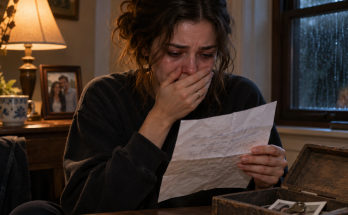
Jillian kept looking at the document as if another reading might change it.
It didn't.
The same vehicle information remained at the top.
The same owner's name remained below.
I watched her move her finger along the printed lines.
She stopped at the vehicle identification number.
Then she looked toward the section identifying the owner.
I didn't interrupt.
She had asked what the document meant.
I had told her.
Now she seemed to be deciding whether she believed the answer.
"Mom, you know what I meant about the financing."
I nodded once.
"I heard what you said."
"You helped me because of my credit."
"That's what you told me."
She pressed her lips together.
I could see she didn't like the distinction I was making.
But I couldn't make the distinction disappear.
Helping somebody qualify for financing was one thing.
Being named as the legal owner of the vehicle was another.
The paper in front of us was an ownership record.
I wasn't asking her to rely on a vague memory.
I was asking her to read a document that identified an actual vehicle and an actual person.
She looked down at it again.
David shifted slightly beside her.
He seemed ready to speak, then decided against it.
Mitchell remained across from Jillian.
His gaze moved between us.
I wondered what the conversation sounded like to someone who hadn't been inside my daughter's understanding of the purchase.
Maybe it sounded like a disagreement about wording.
Maybe it sounded like two people remembering the same event differently.
I couldn't tell.
All I knew was that Jillian had called my involvement help.
And the record identified me as the owner.
That was where the disagreement stood.
I didn't need to raise my voice to explain it.
I didn't need to tell her what she should feel.
I simply needed to stop treating the difference as though it didn't matter.
Jillian lifted the paper by one corner.
"Why does this have your whole name?"
"Because that's my legal name."
"I know that."
"Then you know whose name you're reading."
Her eyes returned to the page.
I watched her expression carefully.
There was confusion in it.
And something else.
I couldn't say exactly what.
I had known Jillian long enough to understand that she disliked being caught off guard.
This document had done that.
But I wasn't sitting there to enjoy her discomfort.
I wanted a simple fact recognized.
Nothing more than that.
The paper had not appeared from nowhere.
It had come from the credit union.
It carried the identifying information for the gray SUV.
The name was clear.
Edith Margaret Wilson.
I had read it before placing it on the table.
I had checked the details myself.
I knew what I was showing her.
Yet sitting across from my daughter, I found myself feeling almost reluctant to say it again.
Not because the record was unclear.
Because the person questioning it was Jillian.
My daughter.
I looked at her hands.
One rested beside the plate.
The other held the document.
For a moment, I remembered how easily our conversation had moved from an ordinary meal to a question neither of us could ignore.
There was no argument about the make of the vehicle.
No argument about its color.
No argument about which SUV the document described.
The only difficulty was the name attached to it.
She looked toward David.
"You're seeing this, right?"
David leaned a little closer to the page.
I gave him room to look.
The record was not complicated.
There was no need to interpret a long explanation.
It was a straightforward identification of ownership.
I wanted the others to see that for themselves.
I had already answered Jillian.
Repeating my answer wouldn't make it stronger.
She set the paper down carefully.
"I thought you were helping me get approved."
I studied her.
"You've told me that."
She seemed irritated by how little I was saying.
But I didn't want the conversation to become an argument over who could speak the longest.
The document needed to remain the center of it.
Not my tone.
Not her embarrassment.
Not what either of us wished were true.
I looked at the untouched dessert.
The fork had not moved.
It was such a small thing to notice.
Yet I kept noticing it.
Perhaps because everything else in the room felt unsettled.
The dinner table was still the dinner table.
The plates were still in front of us.
Mitchell and David were still sitting in the same chairs.
But the paper had changed what we were talking about.
Jillian read the owner's name one more time.
She didn't say it aloud.
I wondered whether she was beginning to understand why I had chosen to show her the record instead of simply telling her what it contained.
A spoken claim could be disputed.
A printed record could be examined.
She could read it herself.
David could read it.
Mitchell could read it.
There was nothing hidden in the wording.
I moved my hands from my lap and rested them near the edge of the table.
Jillian noticed.
For a second, our eyes met.
I didn't smile.
I didn't look away.
I had spent enough time watching her struggle with the page.
I was ready to hear what she thought it meant.
But I wasn't ready to change what it said.
Click here to continue reading: PART 3: With Mitchell and David Watching, I Let the Document Speak Instead of Arguing About What Jillian Thought She Remembered
My Daughter Looked at the Credit Union Paper and Asked Why My Name Was Listed on Her Vehicle
Part 2 of 10