I had taken one photograph that morning.
Four people.
My husband and our three sons.
I hadn't known how much that picture would come to mean.
It was supposed to be an ordinary family photograph.
Something I could look at later and smile.
The boys were preparing for their fishing trip.
They were excited.
They had been waiting for that weekend.
Daniel took them every summer.
It was their time together.
A few days away from home.
Fishing rods.
Coolers.
The same familiar arguments over who would sit where.
I remembered standing in the driveway.
I remembered watching them load the truck.
I remembered how ordinary everything felt.
That was the part I struggled with most.
There had been no warning I understood.
No reason for me to think I would never see them again.
I had lifted the camera and asked them to stand together.
They had done it.
Then the morning continued.
The truck was packed.
The boys were ready.
And Daniel drove away with them.
I had spent six years wishing I could return to those few minutes.
Not to change the photograph.
Not to ask them to smile differently.
Just to stop them.
I knew how useless that wish was.
I hadn't known anything was wrong.
And I couldn't punish myself for failing to recognize a danger I hadn't been shown.
But grief didn't always listen to reason.
Sometimes it returned to the same moment until the memory felt worn thin.
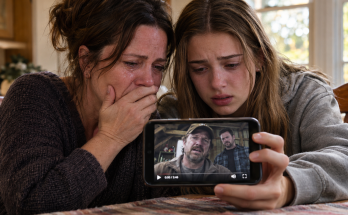
I looked down at the old cellphone.
Daniel had claimed to have lost it years earlier.
That detail had seemed unimportant at the time.
Phones went missing.
People replaced them.
We had bought him another device and continued with our lives.
I hadn't questioned it.
Why would I?
Now I knew the old phone had been among his belongings all along.
And it held a recording made just before his disappearance.
I couldn't stop thinking about that.
He had used a phone I believed was gone.
He had recorded himself inside a storage shed I knew.
And he had spoken about a mistake he feared would affect our family.
The questions were becoming difficult to separate.
Why use that phone?
Why make the recording?
Why hide it?
Had he intended for me to find it?
Or had he placed it there because he didn't want someone else to see it?
I didn't know.
I wanted to be careful with those questions.
The recording didn't explain every decision he made.
It couldn't tell me what had been in his mind when he put the phone away.
I could only see the result.
Six years later, Sophie had found it.
And we were hearing his voice again.
Sophie sat quietly beside me.
I watched her for a moment.
She was our oldest daughter.
She had been the one who suggested we sort through the belongings.
I wondered how much courage that decision had required.
For years, I had kept the boys' clothes folded.
Daniel's coats still hung in the closet.
The fishing supplies were stored away.
I told myself I was keeping things organized.
But the truth was harder to admit.
I wasn't ready to let them go.
Every object had become a way of pretending the house was waiting for them.
Their clothes were ready.
Their belongings were there.
Nothing had been disturbed.
Sometimes that made it easier to get through a day.
Other times it made the house feel empty in a way I couldn't describe.
Sophie had approached the subject gently.
She hadn't told me to throw anything away.
She had suggested donating some belongings to our church.
A small beginning.
Something useful that might come from what we no longer needed.
I had agreed because I trusted her.
And because I knew I couldn't keep everything untouched forever.
I hadn't expected her to find Daniel's old phone.
I hadn't expected to hear him speaking from the shed.
I certainly hadn't expected him to warn us about someone close to our family.
I looked toward the kitchen doorway.
That was where Sophie had stood when she came to tell me what she found.
Her face had been pale.
She held the phone as though she was afraid to drop it.
I remembered asking what was wrong.
She had looked down at the screen.
Then she told me about the recording.
I had felt my heart begin to race.
The phone itself had been enough to upset me.
I recognized it immediately.
It belonged to a part of our lives that existed before the boys disappeared.
Before police officers came to our house.
Before rescue workers found the damaged boat.
Before I became a mother who had to explain why four people weren't coming home.
I looked at Sophie.
"Did you know what phone it was when you found it?"
She nodded.
"I remembered it."
That answer made my chest ache.
She remembered more than I had realized.
The girls had been younger when Daniel disappeared.
But they hadn't forgotten him.
They hadn't forgotten the boys.
They hadn't forgotten the things that belonged to them.
I reached for her hand again.
"I'm glad you found it."
She looked at me.
For a moment, neither of us spoke.
I thought about the police search.
The truck had been found near the boat ramp.
The trailer was still attached.
The boat was missing.
Those details had become part of the story everyone knew.
The next discovery had been the damaged boat.
It had washed ashore across the lake.
I remembered hearing that news.
I remembered waiting for the next sentence.
I thought someone would tell me they had found Daniel.
Or one of the boys.
But no one had.
They were all missing.
The search continued.
Days passed.
Then weeks.
I lived in the space between hope and fear.
Each time someone contacted me, I felt my stomach tighten.
Every day I wanted news.
Every day I dreaded what that news might be.
Eventually, investigators concluded that a boating accident was the most likely explanation.
The currents had probably taken the bodies away.
That was what we were told.
It was an explanation.
But it wasn't the certainty I needed.
No one had brought Daniel home.
No one had brought the boys home.
There had been no goodbye.
Only the damaged boat and the empty place they left behind.
I looked at the recording.
Daniel had looked toward the shed door more than once.
His face was tired.
His voice was strained.
He had said the boys were innocent.
I kept returning to that.
If the disappearance had been an ordinary accident, why had he felt the need to defend them the day before?
I couldn't answer.
But I couldn't ignore the question.
I thought about Daniel preparing for fishing trips.
He always took safety seriously.
He checked the weather.
He kept emergency supplies.
He watched the fuel level.
He had known that lake well.
I had trusted him with our sons because I knew he would try to protect them.
That was one reason the accident explanation had always troubled me.
Even careful people could have accidents.
I understood that.
I wasn't claiming Daniel was incapable of making a mistake.
But the recording showed that he had already been worried about something before the trip.
And that changed how I looked at the event.
I no longer had only my memories of his careful habits.
I had his own voice telling me that something was wrong.
It didn't prove what happened on the lake.
But it gave me a reason to question whether we had understood the whole story.
I sat back in the chair.
Sophie watched me.
I could see that she wanted to say something.
I waited.
She looked toward the phone.
I remembered her first words in the kitchen.
She had said she believed she finally knew what happened.
I hadn't forgotten.
I was still trying to understand how she had reached that conclusion.
But I wasn't going to force an answer out of her before she was ready.
The recording was difficult enough for both of us.
I looked at the wooden shed behind Daniel.
It had been part of his fishing routine.
A place for equipment.
A place I had never expected to become important to our family's history.
Now every familiar object seemed to carry a question.
The window.
The cabinet.
The calendar.
Nothing looked remarkable.
And yet the room had become the setting for the last recording I knew Daniel had made.
I wondered whether he had stood in that shed before countless fishing trips.
Whether he had opened the cabinet and taken out something he needed.
Whether he had thought of our sons while preparing for their weekends.
Those ordinary images were easier to imagine than the frightened man on the screen.
But I couldn't return to the old picture of him.
Not completely.
I had seen his fear.
I had heard his regret.
And I had learned that he had kept something serious from me.
I looked at Sophie.
"We need to remember what we actually know."
She nodded.
I spoke slowly.
"Your dad made this recording before the trip."
"Yes."
"He was worried about something."
"Yes."
"And he wanted us to know your brothers hadn't done anything wrong."
Sophie lowered her eyes.
I paused.
"That's what he told us. We can't pretend he explained more than he did."
She looked up.
"I know, Mom."
I believed her.
But saying those things aloud helped me, too.
I had spent six years trying to build an explanation from fragments.
I didn't want to repeat that mistake.
I wanted the truth.
Even if it was painful.
Even if it changed the way I remembered people I trusted.
I looked at Daniel's face one more time.
Then I thought about the photograph in the driveway.
Four people standing together before a fishing trip.
A family that expected to be together again on Sunday.
The photograph showed me how that morning had looked.
The recording showed me that Daniel had been carrying a fear I never saw.
And I understood that both things could be true.
Click here to continue reading: PART 7: Dean Had Always Told Me to Accept the Accident, but My Daughter’s Discovery Made His Words Harder to Forget
After Six Years Without My Husband, I Finally Saw His Face Again in a Recording I Never Knew Existed
Part 6 of 10