I had never been afraid of telling Adam no.
At least, that was what I used to believe.
But standing in my hallway that morning, looking at my grown son, I realized how many times I had avoided disappointing him.
I had softened things.
I had explained things.
I had tried to make difficult decisions sound easier than they were.
And sometimes I had said nothing at all.
The wet footprints were still on the floor.
Adam stood a few feet away from me.
His telephone hung at his side.
Neither of us seemed quite ready to begin.
Finally, I gestured toward the kitchen.
"Would you like some coffee?"
He shook his head.
"Mom, I need to understand why you did this."
I looked at him.
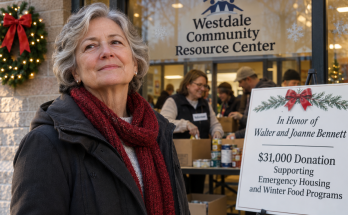
"I told you. I wanted to help the center."
"With all of it?"
"Yes."
He rubbed his forehead.
"That's a lot of money."
"I know how much it is."
"I'm not saying you don't."
"Then what are you saying?"
He didn't answer immediately.
I could hear the refrigerator running.
My coffee was still sitting on the kitchen counter.
I had barely touched it before he arrived.
Adam looked toward the kitchen table.
"Can we sit down?"
I nodded.
He followed me.
I pulled out my usual chair.
He sat opposite me.
For a moment, he seemed younger than he was.
Not because of his appearance.
Because I recognized the way he was struggling to say something he thought I wouldn't want to hear.
I had seen that expression many times.
When he was a boy.
When he was a teenager.
Even after he became a husband and father.
I waited.
He finally spoke.
"Renee and I have been looking at houses for almost a year."
"I know."
"It's been difficult."
"I know that, too."
He glanced at me.
"Then you know what thirty-one thousand dollars could have meant."
There it was.
The down payment.
The conversation I had remembered while he stood at the door.
I put my hands around my coffee cup.
The ceramic was still warm.
"Adam, did you believe I was giving you that money?"
He looked uncomfortable.
"You said it could help."
"I said it could make a down payment."
"Right."
"That wasn't a promise."
He looked away.
For a few seconds, neither of us spoke.
Then he said something quietly.
"I thought you understood what we were hoping for."
I felt a small ache in my chest.
Not because he'd asked for help.
Because he hadn't asked.
He'd turned an ordinary conversation into an expectation.
And somewhere along the way, that expectation had become something he believed I was taking away.
I looked at him.
"Why didn't you tell me you were counting on it?"
He moved his hands across the table.
"I didn't want to pressure you."
"But you came here at seven fifteen in the morning because I donated it."
He lowered his eyes.
I regretted how sharply I'd said it.
But I didn't take it back.
There was nothing cruel about the question.
It was simply true.
He had come to my house because money he'd never been promised was no longer available.
That was the uncomfortable part.
I had raised Adam to work hard.
I had helped him when I could.
Walter had done the same.
We wanted our son to have a stable life.
We wanted him to build a home for his own family.
And I still wanted those things.
But wanting to help someone wasn't the same as handing over every resource you possessed.
Especially when that resource carried a history of its own.
I thought about Walter's labeled binders.
The years he'd spent searching flea markets.
The photographs.
The old tickets.
The vintage programs.
The equipment he had carefully preserved.
Thirty years.
That collection had occupied a large part of his life.
It wasn't simply money that had been sitting in a bank account waiting for Adam to claim it.
It was Walter's work.
His interest.
His patience.
His enjoyment.
And after his death, deciding what to do with it had become my responsibility.
I looked at Adam again.
"Do you remember how much your father loved that collection?"
He nodded.
"Of course."
"Do you remember how long he spent putting it together?"
"Mom, I know."
"Then you should understand why I wanted the money to mean something."
He leaned back.
"I never said it shouldn't."
"But you're upset because I chose something different from what you expected."
He didn't argue.
I wasn't trying to shame him.
I wanted him to see the difference.
The money had been mine to decide about.
And I'd made that decision carefully.
I told him about my conversation with Clare.
About the emergency housing program.
About families waiting for assistance.
About people who needed rent payments or security deposits.
He listened.
I explained that the center could also use the donation for winter food programs.
I told him I'd asked what the money could accomplish before writing the check.
I told him Clare had encouraged me to think carefully.
And I told him I already had.
For months.
"This wasn't something I decided because Renee upset me," I said.
He looked up.
I continued.
"I was thinking about donating money to the center during the summer."
"Why didn't you tell me?"
"I didn't know the amount yet."
He looked at the table.
I could see that he was trying to reconcile what I'd said with what he had assumed.
I didn't expect that to happen immediately.
People rarely abandoned an expectation simply because someone explained why it had been mistaken.
I knew that from experience.
I had expectations of my own.
One of them had been Christmas lunch.
And that had ended in a grocery store beside two packages of thyme.
I looked toward the kitchen calendar.
The crossed-out appointment was still there.
Christmas lunch at Adam's house.
A line through it.
And beneath it, the name of the community center.
Adam followed my gaze.
"What are you looking at?"
"The calendar."
He turned in his chair.
I watched him read the entry.
I had written the original plan after Thanksgiving.
He had given me the time himself.
Noon.
I remembered how certain I'd felt when I wrote it.
I had thought the invitation meant I would be with my family.
I hadn't expected that to change.
Adam turned back.
"Mom, Christmas isn't the same thing as the money."
"I know."
"Then why are we talking about it?"
"Because you came here asking me why I made a decision without discussing it with you."
He became quiet.
I waited a moment.
Then I asked him something I had wanted to ask since Renee answered his telephone.
"Why didn't you discuss Christmas with me?"
His expression changed.
He looked down.
I could tell he hadn't expected that question.
Or perhaps he had expected it and hoped we wouldn't reach it.
I didn't know.
But I needed an answer.
"You invited me," I said.
"I know."
"You told me to come at noon."
"I remember."
"I bought groceries because I thought I was coming."
He nodded slightly.
I thought about the cranberry sauce.
The clementines.
The mustard.
All those small purchases that had seemed so ordinary.
I hadn't bought them to make Adam feel obligated.
I'd bought them because I knew what my family liked.
I had wanted to contribute.
I had wanted to be included.
And when Renee told me I wasn't invited, I had been embarrassed.
Not furious.
Not desperate for revenge.
Embarrassed.
I hated admitting that.
Even to myself.
"Your wife told me her relatives were coming," I said.
Adam listened.
"She told me the meal was still happening."
He nodded again.
"She also told me you had agreed I shouldn't be there."
He looked uncomfortable.
I waited.
He finally spoke.
"Renee's mother has had a difficult year."
"I understand that."
"We thought it would be easier to keep Christmas simple."
I looked at him.
"Simple for whom?"
He didn't answer.
I hadn't intended the question to sound harsh.
But there was no gentler way to ask it without losing its meaning.
Someone had made Christmas easier by removing me from it.
And I was the person expected not to make a fuss.
That was what hurt.
Not the menu.
Not the location.
Not even the change of plans itself.
The assumption that I would accept being excluded without needing consideration.
I looked at Adam.
"Did you think I wouldn't mind?"
He shook his head.
"I didn't think you'd be happy."
"Then why did you let Renee tell me?"
He looked toward the window.
I could see him searching for an answer.
I remembered the telephone call from the evening before.
His impatience.
His request that I not turn it into an argument.
I had accepted the explanation.
I hadn't demanded an invitation.
I hadn't asked him to make Renee change her mind.
But I had wanted him to acknowledge that he'd hurt me.
That was all.
I didn't need him to say his wife was wrong about everything.
I didn't need him to choose between us.
I needed him to recognize that I wasn't a problem to be removed from Christmas.
I was his mother.
And I was a person who had made plans based on his word.
"Adam, I wasn't asking to control your holiday."
He looked at me.
"I just wanted you to tell me yourself."
His face softened.
A little.
"I should have called."
I nodded.
"Yes."
There was no reason to make the answer bigger than it was.
He should have called.
He knew it.
I knew it.
We sat quietly.
Outside, the morning continued.
Cars passed along the street.
The house was warm.
My coffee had cooled.
I thought about Clare's office.
The photograph of Walter laughing.
The little paper snowflake hanging from his old storage cabinet.
And the families who would receive help because of the donation.
I couldn't know exactly how their lives would change.
But I knew the money had a purpose.
That was enough for me.
Adam finally spoke again.
"I wish you'd talked to me before giving all of it away."
I considered that.
Then I answered.
"I can understand why you wish that."
He watched me.
"But I didn't owe you a decision you could approve or reject."
He said nothing.
I continued.
"I might have told you sooner. But the choice still would have been mine."
He looked at his hands.
"I know."
I wanted to believe he meant it.
I also knew understanding something and accepting it were different.
I didn't expect him to be happy about losing a possibility he'd imagined.
Even if that possibility had never been promised.
I could sympathize with disappointment.
I was experiencing some myself.
But I couldn't restore the money.
And I wouldn't ask Clare to undo a donation simply because Adam had hoped for it.
The check had been written.
The paperwork was complete.
The center had already announced the gift with my permission.
There was no misunderstanding to correct.
He asked whether the donation could be changed.
I shook my head.
"No, Adam."
He looked disappointed.
I let him feel that.
It was difficult.
I was accustomed to wanting to make things easier for him.
But not every disappointment was mine to prevent.
He had a wife.
Two children.
Plans for a house.
A life that belonged to him.
And I had a life that still belonged to me.
Walter was gone.
That didn't mean every decision I'd make afterward had to be justified to someone else.
I thought about saying that aloud.
Instead, I kept it simple.
"I made the donation because I wanted to."
He looked up.
"That's really all there is?"
"That's the most important part."
He nodded slowly.
I could see that our conversation had reached a place where neither of us had much left to argue about.
The facts were clear.
He had expected money I hadn't promised.
I had made a donation I'd been considering for months.
He had allowed me to be excluded from Christmas without speaking to me first.
And I had been hurt by that.
None of those things disappeared because we finally talked.
But we had stopped pretending they were something else.
Adam stood.
I stood too.
We walked toward the hallway.
The wet footprints were still visible.
I looked at them.
Then at him.
For a brief moment, I almost said something about his boots.
But I didn't.
He had come into my home upset.
He was leaving with an explanation.
That was enough for one morning.
At the door, he turned.
"Mom?"
"Yes?"
"I'm sorry I didn't call you about Christmas."
I looked at him.
It wasn't an apology for everything.
It wasn't a promise that the family would suddenly change.
But it was something honest.
And I had spent enough time that week listening to people explain away their choices.
I appreciated hearing him admit one.
"Thank you," I said.
He looked as though he wanted to add something.
Then he stopped.
I didn't push.
He left.
I closed the door.
The house became quiet again.
I stood in the hallway and looked down.
The wet marks were beginning to dry.
I fetched the mop.
There was no reason to leave the floor dirty.
I cleaned it slowly.
One mark after another.
And when I finished, I went back to the kitchen.
The calendar was still on the wall.
Christmas lunch was still crossed out.
The community center was still written beneath it.
I didn't change either entry.
Click here to continue reading: PART 10: I Spent Christmas Where Walter Had Once Given His Time, and My Son Finally Had to Accept That My Life Still Belonged to Me
My Son Arrived at My Front Door With His Phone in His Hand, and I Knew He Had Finally Seen What I Had Done
Part 9 of 10