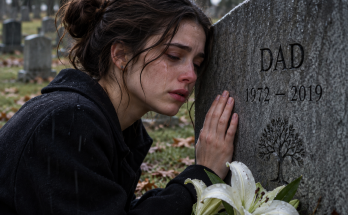
I kept thinking about how ordinary the Christmas discussion should have been.
Dinner.
A cabin deposit.
A present for Chloe.
None of those things should have required a lie.
Families talked about holiday expenses all the time.
People shared costs.
Sometimes one person covered more than another.
Sometimes plans had to change because money was tight.
There was nothing shameful about that.
But my family hadn't been discussing how to divide the expenses fairly.
They had been discussing how to get me to pay more.
And the method they chose was what I couldn't forgive in my own mind.
Dad's health.
I returned to that detail again and again.
My father was not merely a name in the conversation.
He was the person they intended to use as the reason I should be worried.
Sarah expected that another medical scare would make me less likely to question the request.
I wondered how she had become so confident about that.
Then I thought about my own behavior.
Whenever my mother mentioned Dad being unwell, I took her seriously.
I didn't want to imagine something happening to him while I was worrying about money.
I didn't want to be the daughter who hesitated when her father needed help.
Those feelings were powerful.
I could admit that now.
My family understood them.
At least, Sarah and my mother did.
And the messages suggested David understood them, too.
He had remembered my earlier request for a hospital bill.
That little detail wouldn't leave me alone.
It was proof that I had tried to ask a sensible question before.
And it showed me how the others viewed that question.
Not as something I deserved to have answered.
As something their story needed to overcome.
I thought about the difference.
If the situation had been genuine, the bill would have helped me understand it.
A real expense could be explained.
A genuine need could be discussed.
But they were preparing to tell me about a health problem in order to cover unrelated Christmas costs.
That made my previous request for documentation inconvenient.
I couldn't know exactly what had happened during every earlier medical request.
The messages didn't establish that.
I didn't want my anger to make me careless about what I claimed.
But the new plan was unmistakable.
They were willing to create fear where honesty would have allowed me to decide for myself.
I had never considered my concern for Dad a weakness.
I thought it was part of being his daughter.
I still believed that.
What changed was my understanding of how someone could exploit it.
The same fear that might make me hurry to help during a genuine emergency could also make me easier to mislead.
That was the uncomfortable truth.
I didn't have to stop caring about my father to recognize it.
I only had to stop believing that every person invoking his health was necessarily telling me the truth.
I hated that distinction.
I hated needing it.
I wanted to be able to hear my mother's voice and believe her without checking anything.
I wanted the relationship I had thought we had.
But the messages made that kind of trust impossible to maintain unchanged.
Once I knew she was willing to invent a scare, I couldn't simply decide that the knowledge didn't matter.
I thought about the cabin deposit.
The amount wasn't given in the conversation I had seen.
I wasn't going to pretend I knew what it cost.
But I knew what the expense was for.
A Christmas plan.
Something the family wanted.
Not a hospital emergency.
Not an urgent medical procedure.
Not a treatment that couldn't wait.
A deposit.
Then there was Chloe's gift.
That, too, had been presented as an expense they still needed covered.
I wondered what Chloe thought about the plan.
She had participated in the conversation.
She had also asked the question about whether I understood why they kept me around.
But I couldn't say from those words exactly what she knew about every detail of the proposed lie.
I didn't need to exaggerate her role.
What she had written was hurtful enough.
She understood that my money mattered to the way the family treated me.
And she felt comfortable discussing that idea openly.
I thought about Christmas dinner again.
That was the part I had agreed to pay.
I had expected to help make the holiday easier.
I hadn't expected my agreement to become the starting point for further demands.
That was the pattern that troubled me.
A favor wasn't being treated as a favor.
It was being treated as evidence that I could be persuaded to do more.
And because I had agreed once, they seemed confident they could find another reason to ask again.
My mother had already decided she knew what to say.
I could almost hear the certainty in her words.
She didn't need advice about how to approach me.
She understood me.
Not in the way I had always wanted a mother to understand her daughter.
She understood which fears would make me act.
That was a painful kind of knowledge to find in someone I loved.
I began questioning something I had never questioned before.
Had I mistaken familiarity for care?
A person could know your habits without respecting you.
They could know what frightened you without wanting to protect you.
They could remember the things you worried about and use those same things when they wanted something.
I wished that realization had come from anyone other than my mother.
I had trusted her to know the difference.
For years, I had believed she would never deliberately make me frightened for Dad just to obtain money.
Now I had a written conversation showing she was willing to do exactly that.
I didn't need to imagine her making the call.
The plan itself was enough.
I could see the decision she had already made.
She would approach me.
She would know how to phrase the request.
And she expected I would respond.
I felt something change in the way I thought about responsibility.
Until then, I had assumed that if my family needed something and I could provide it, the choice was obvious.
Help.
That was it.
But what if the need wasn't genuine?
What if the people asking had decided what I should believe before speaking to me?
What if the urgency was designed to stop me from asking questions?
Those possibilities made the old rule seem dangerously incomplete.
I still wanted to help people I loved.
I still believed family members should care for one another.
But I no longer wanted fear to make every decision for me.
That was the part I had to learn.
There was nothing cruel about asking what an expense was for.
There was nothing disloyal about wanting a clear explanation.
And there was nothing selfish about recognizing that my money belonged to me until I chose to give it.
Those ideas sounded simple.
Yet I had struggled to practice them with my own family.
I had allowed concern to become obligation.
Then I had allowed obligation to become expectation.
And eventually, that expectation had become so normal that my relatives could discuss it openly without seeming to feel ashamed.
I looked again at Sarah's suggestion.
She wasn't asking whether using Dad's health was appropriate.
She was offering it as the answer to a financial problem.
David wasn't asking whether I deserved the truth.
He was worrying about how convincing the explanation needed to be.
And my mother wasn't asking whether they should involve me honestly.
She was assuring them that she knew how to handle me.
Three different messages.
One shared understanding.
They expected my concern to produce money.
That was the part I couldn't explain away.
I didn't have to know every detail of every earlier request.
I didn't have to decide how much each family member truly cared about me.
I only had to accept what this conversation showed.
They were willing to lie.
They believed the lie would work.
And they were comfortable using my father's health to make it work.
I had spent so long trying to prove that I would be there when my family needed me.
Now I understood that I had to be able to tell the difference between someone needing me and someone using the knowledge that I cared.
That realization didn't make Christmas feel any less painful.
It made the situation clearer.
And clarity was something I had been missing for a very long time.
Click here to continue reading: PART 7: I Wanted to Believe Chloe Had Been Cruel Without Meaning It, but My Mother’s Answer Left Me With No Easy Excuse
I Thought My Family Needed My Help Until I Saw What They Were Saying About Me Behind My Back
Part 6 of 10