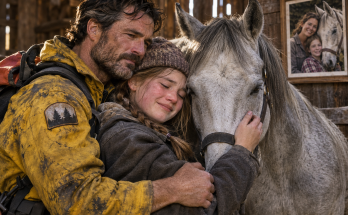
I used to believe that leaving money behind meant I was taking care of my family.
I was wrong.
I learned that at five in the morning, standing inside a freezing barn, looking at my twelve-year-old daughter curled against a horse that was slowly starving.
My name is Cormac Healy.
I was forty-four years old, and I worked as a wildland firefighter on a hotshot crew based out of Missoula, Montana.
I knew what danger looked like.
I'd walked through smoke so thick I couldn't see the man ten feet ahead of me.
I'd watched flames climb hillsides faster than trucks could move.
I'd spent nights wondering whether the wind would change before we could get everyone out.
But nothing I'd seen on a fire line prepared me for what I found at home.
I wasn't supposed to be there that morning.
That was the first thing my daughter said when she opened her eyes.
And looking back, those words told me almost everything.
Six days.
I had come home six days earlier than anyone expected.
Our crew had been working a fire in central Idaho that October.
The assignment was supposed to last longer.
Then the weather shifted, containment lines held, and we were released ahead of schedule.
Most men would have been happy about the extra time.
I was more than happy.
I had a daughter waiting at home.
At least, that was what I believed.
I drove through the night because I wanted to surprise her.
I imagined walking into the kitchen while she was getting ready for school.
I imagined her dropping whatever she was holding and running toward me.
I could almost hear her calling me Dad.
That was the picture I carried through the darkness.
It kept me awake when I was tired.
It made the miles feel shorter.
I didn't know that while I was thinking about surprising her, she was trying to keep an animal alive.
Her mother had been dead for four years.
Siobhan.
Even after all that time, saying her name could catch me off guard.
We had been married long enough that I could usually tell what she was thinking before she spoke.
She grew up around horses.
She understood them in a way I never really did.
When Siobhan was young, she raised a gray mare from a foal.
She called her Pepper.
Pepper wasn't a fancy show horse.
She wasn't something Siobhan kept because she expected to make money.
She was part of Siobhan's life.
And eventually, part of ours.
When our daughter Mabel was born, Pepper was already there.
Mabel grew up knowing the sound of that horse moving around the barn.
She knew the smell of hay.
She knew how Pepper breathed when she was relaxed.
Those were ordinary things in our house.
I never thought much about them then.
Now I wish I had.
When Mabel was eight, Siobhan suffered a stroke.
We lost her.
I still remember trying to explain death to a child who believed every problem could be fixed if an adult tried hard enough.
Mabel kept asking questions.
When would Mom come home?
Could the doctors do something else?
What if we waited another day?
I had no answers that made anything better.
I could only hold her.
After the funeral, Mabel spent more time with Pepper.
Sometimes she brushed that mare until her arms got tired.
Sometimes she stood beside her without speaking.
I let her.
There were days when I couldn't find the right words either.
One morning, Mabel told me Pepper still carried her mother's smell.
She said it as if she was telling me something obvious.
I didn't argue.
I didn't ask her to explain.
I just watched my little girl press her face against the gray horse's neck.
From then on, Pepper belonged to Mabel.
Not simply because I said so.
Because Siobhan had left something behind that our daughter could still touch.
Mabel took that responsibility seriously.
Every morning before school, she brushed Pepper.
It became part of her routine.
Breakfast.
School clothes.
A visit to the barn.
And Pepper.
Some mornings Mabel came back with dust on her sleeves.
Sometimes her hair smelled like a stable.
Siobhan would have laughed at that.
I usually reminded her to wash her hands before eating.
That was our life.
It wasn't perfect.
But we were managing.
Two years after Siobhan died, I married Becca.
I believed I was giving Mabel a chance to have another caring adult in her life.
That sentence is difficult for me now.
Because I was so sure I was doing something good.
Becca seemed gentle when I first knew her.
She told me she liked children.
She told me animals had always been important to her.
When I explained how much Pepper meant to Mabel, she acted as if she understood.
I wanted to believe her.
So I did.
I didn't expect Becca to become another Siobhan.
Nobody could.
I only wanted her to respect the things my daughter loved.
That didn't seem like too much to ask.
My work meant I was away for long stretches during the summer and fall.
Sometimes a job lasted days.
Sometimes weeks.
There were times when I couldn't call home.
There were times when I could talk for only a minute.
But I always tried.
I knew Mabel had already lost one parent.
I didn't want her to feel as if she had lost the other whenever fire season started.
Before leaving for Idaho, I made sure the household had money.
Groceries.
Utilities.
Ordinary bills.
And Pepper's feed.
The hay alone cost about four hundred dollars each month.
That wasn't a small amount.
I knew it.
But Pepper was our responsibility.
And more than that, she was Mabel's horse.
I wasn't going to treat her as disposable because she was getting older.
I gave Becca the money and trusted that she'd use it for what we had discussed.
I never imagined I'd have to question that.
While I was in Idaho, I called whenever I could.
Sometimes Becca answered quickly.
Sometimes I had only enough time to ask about Mabel and Pepper before getting back to work.
Her answers were always reassuring.
Mabel was doing fine.
She was spending time with friends.
Pepper was eating well.
Everything at home was under control.
I heard what I wanted to hear.
That is the part I have to admit.
I didn't ask enough questions.
I didn't insist on hearing Mabel's voice every time.
I thought I was respecting the routine at home.
Instead, I was depending on somebody else's version of it.
And that person had every reason to keep me from knowing the truth.
The night I drove home, I was tired.
My work clothes still smelled faintly of smoke.
My shoulders ached from carrying equipment.
But I kept driving.
I wanted to sleep in my own bed.
I wanted to see my daughter.
I wanted one ordinary morning with my family before the next assignment came.
When I finally turned into our driveway, the clock showed about five.
The house was dark.
That made sense.
Nobody was expecting me.
I turned off the engine.
For a moment, I stayed in the truck and looked toward the house.
It was quiet.
I should have gone straight inside.
I almost did.
Then I noticed the barn light.
It was on.
Something about that bothered me.
Maybe somebody had forgotten to turn it off.
That would have been the easy explanation.
But Pepper was out there.
And after weeks away, I wanted to check on her.
So I walked toward the barn.
The air was bitterly cold.
Fourteen degrees Fahrenheit.
Cold enough that I could feel it through my work clothes.
The ground was hard beneath my boots.
I remember being surprised at how quiet everything was.
No ordinary movement from the stall.
No familiar sound of a healthy horse shifting around as I approached.
I opened the barn door.
Pepper was standing with her head lowered.
At first I thought the light was playing tricks on me.
Then I got closer.
Her body was wrong.
There was no other way to describe it.
Her hip bones stood out beneath her blanket.
Her ribs showed along her sides.
I had seen that horse nearly every day for years.
I knew what she was supposed to look like.
This wasn't age.
This wasn't a little weight loss.
Pepper was terribly thin.
I stood there staring.
For a few seconds, I couldn't move.
Then I looked at the hay rack.
Empty.
I checked the water bucket.
Ice had formed across the top.
I touched it.
Hard.
Cold.
The kind of water a horse couldn't simply drink without somebody taking care of it.
I turned back toward Pepper.
She barely lifted her head.
I felt something begin to tighten inside my chest.
I hadn't yet seen the worst of it.
I moved closer to the stall.
There were blankets piled in one corner.
Three saddle blankets, pulled together against the wall.
At first, I thought somebody had dropped them there.
Then I saw a strand of hair.
I stopped.
There was a small face beneath the blankets.
Red cheeks.
Closed eyes.
My daughter.
Mabel was lying against Pepper's legs.
She had curled herself into the smallest shape she could manage.
For one terrible moment, I couldn't tell whether she was breathing.
I dropped down beside her.
I said her name.
Nothing.
I leaned closer.
Then I saw the small movement of her breathing.
Relief hit me so suddenly that I almost couldn't speak.
I touched her shoulder.
She was freezing.
I said her name again.
This time she stirred.
Her eyes opened slowly.
She stared at me as if she couldn't decide whether I was really there.
Then she whispered that I wasn't supposed to be home yet.
I had imagined her running into my arms.
I had imagined a happy surprise.
Instead, I was kneeling in a stall beside a starving horse, trying to understand why my daughter was sleeping in fourteen-degree weather.
And before I could ask another question, Mabel began to cry.
Click here to continue reading: PART 2: My Daughter Finally Told Me What Happened While I Was Away, and Every Word Made My Wife’s Reassuring Phone Calls Feel Like Lies
I Returned Home Before Anyone Expected Me and Found My Daughter Sleeping Somewhere No Child Should Ever Have to Spend the Night
Part 1 of 10