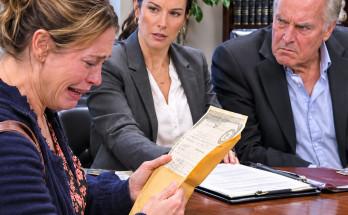
When Linda said there was more to explain, I almost laughed.
Not because anything was funny.
Because I had heard that sentence in one form or another for most of my life.
There was always something I didn't understand.
There was always a good reason.
And somehow, that reason always ended with Emma getting what she wanted.
I was thirty-one years old that Christmas.
Old enough to know the difference between a difficult family and a family that made decisions without considering me.
But I had spent so many years explaining things away that I still found myself searching for an innocent answer.
Maybe the keys had been misplaced.
Maybe Margaret's arrangements had become complicated.
Maybe the paperwork wasn't finished.
I wanted there to be another explanation.
Looking back, I think that was the saddest part.
I still wanted to believe my father wouldn't deliberately hurt me.
My mother died when I was seven.
I remember pieces of her.
Her hands fastening my coat.
Her voice telling me to slow down when I ran through the house.
The way she made me feel safe without needing to explain why.
After she died, the house changed.
My father became quieter.
He worked more.
He told me we had to keep going.
I tried to do exactly that.
Two years later, he married Linda.
At first, I wanted her to like me.
I wanted to be an easy child.
I cleaned my room.
I did my homework.
I said thank you.
I tried not to ask for things.
Linda seemed pleased with that.
She told people I was mature for my age.
Responsible.
Independent.
Those words sounded like compliments when I was nine.
I didn't understand they would eventually become reasons to give me less.
Emma was born into a very different arrangement.
By then, Linda had made herself the center of our household.
She decided what we bought.
Where we went.
How money was spent.
My father earned money and generally agreed with her decisions.
Emma never had to wonder whether she was included.
I did.
When Emma wanted piano lessons, Linda arranged them.
Every week, someone drove her to a teacher who charged more than I could imagine spending on a hobby.
I once asked whether I could take art classes.
Linda told me I needed to concentrate on useful subjects.
I didn't argue.
When Emma started school, Linda took her shopping for new clothes.
She chose outfits carefully.
Matching shoes.
Pretty jackets.
Everything coordinated.
I usually got clothes from the clearance section.
There was nothing wrong with discounted clothing.
I still shop that way.
But I remember the explanation.
"Lydia doesn't care about labels. She's sensible."
I cared.
I just knew asking wouldn't change anything.
By the time I was a teenager, I had learned what questions were worth asking.
Very few.
At sixteen, Emma received a car.
It had a large bow on it.
There were photographs.
Linda cried.
My father hugged Emma and told her she deserved something special.
When I turned sixteen, I was allowed to borrow Linda's minivan.
In theory.
In practice, it was rarely available.
Sometimes Linda needed it.
Sometimes Emma had something important happening.
Sometimes my father said it wasn't convenient.
I learned to arrange rides.
Then I learned to manage without them.
I told myself that was adulthood.
I didn't call it unfairness.
Not then.
When I started college, I worked.
I studied.
I watched every dollar.
I earned my nursing degree without taking on student debt because I knew there wasn't a financial safety net waiting for me.
I finished magna cum laude.
I still remember the ceremony.
The sound of my name being called.
The heavy feeling of the graduation gown.
The way my hands shook a little when I accepted what I had worked so hard to earn.
My father said he was proud.
Linda said I had always been good at school.
Afterward, we went to Applebee's.
I was grateful for dinner.
I told them so.
And I meant it.
But later, when Emma finished high school, Linda organized a party so elaborate that I struggled to understand why a graduation required that much money.
There were decorations.
Guests.
Food prepared for a crowd.
My father's friends came.
Linda talked about Emma's future as though she had already accomplished something extraordinary.
I smiled for photographs.
I congratulated my sister.
Then I went home.
I had learned not to compare.
At least, that was what I told myself.
The comparisons were always there.
They just stayed inside my head.
When I became a mother, I hoped things might change.
Danny was innocent.
He didn't know anything about the years before he was born.
He didn't know his grandmother had a habit of treating one daughter differently from another.
He didn't know what I had spent my childhood trying to earn.
He only knew which relatives showed up.
And which ones didn't.
I was raising him alone.
That meant making decisions with nobody else to share the consequences.
I found an affordable rental.
Affordable was a generous word.
The apartment was cramped.
There wasn't a proper second bedroom.
Danny slept in a corner of the living room.
I hung a curtain to give him privacy.
Behind it was his little bed.
His favorite blanket.
A few books.
His dinosaurs.
He called it his room.
I never corrected him.
I bought secondhand furniture because new furniture cost money we needed for other things.
I worked long shifts at the hospital.
I picked up extra hours whenever I could.
Some nights, my feet hurt so badly that I sat on the edge of my bed before I could bring myself to stand again.
Danny sometimes asked why I worked so much.
I told him I was helping children get better.
That was true.
But there was another truth.
Rent didn't care how tired I was.
Neither did the electricity bill.
Neither did the grocery store.
I counted money carefully.
I knew which week a payment was due.
I knew how much could be spent without creating trouble later.
Linda called me organized.
My father called me strong.
Emma said she couldn't imagine living the way I did.
I usually changed the subject.
I didn't want Danny growing up hearing me complain about being poor.
I wanted him to remember that we had managed.
That I had loved him.
That our little home had been enough because we were together.
But sometimes I watched him pull that curtain closed and wished I could give him something more.
A door.
A real bedroom.
Space for his books.
A place where he didn't have to hear me moving around the living room after a late shift.
That was all.
Nothing extravagant.
Just a little more room.
Aunt Margaret understood that.
She was my father's sister.
She had known me before Linda arrived.
She remembered my mother.
And she never seemed to forget that I was somebody's daughter, even when everyone else treated me as though I had already raised myself.
Margaret didn't make grand speeches about fairness.
She simply showed up.
She remembered my birthday every year.
She called to ask about my shifts.
She remembered Danny's interests.
If he liked dinosaurs one month, she asked about dinosaurs the next time she saw him.
She bought him books.
Sometimes she came over with food.
Not because she wanted to inspect my apartment.
Not because she needed to tell me what I was doing wrong.
She came because she wanted to see us.
I remember one evening when I was exhausted.
Danny had finally fallen asleep.
Margaret sat at my small kitchen table while I tried to finish a cup of tea.
I told her I was worried I wasn't doing enough.
She listened.
Then she told me Danny had a mother who cared about him every single day.
She didn't pretend things were easy.
She didn't tell me to work harder.
She just reminded me that I was doing something important.
I cried after she left.
Quietly.
Not because she'd said anything particularly dramatic.
Because she hadn't made me defend myself.
That was rare in my family.
I had never needed to prove my worth to Margaret.
When she became sick, I remembered every time she'd made room for me.
And I decided I would do the same for her.
I didn't make an announcement.
I didn't ask my father to approve.
I simply started going.
That decision changed our relationship.
It also explained why Margaret had wanted to do something so extraordinary for my birthday.
But at Christmas dinner, my father and Linda seemed determined to keep me from understanding that.
I was still sitting in my chair, holding the keychain, while Linda spoke about practical arrangements.
Emma kept looking at her mother.
My father remained silent.
And for the first time, I began questioning the one word my family had used to describe me since childhood.
Independent.
I had always been proud of it.
Now I wondered how much it had cost me.
Click here to continue reading: PART 3: I Spent Six Months Helping My Aunt Through Cancer, Never Knowing the Birthday Surprise She Planned Would Expose My Family
I Thanked My Aunt for a Small Birthday Gift at Christmas Dinner, and the Silence Around the Table Told Me Something Was Wrong
Part 2 of 10