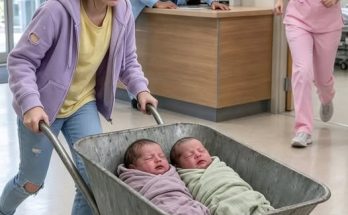
I had worked in emergency rooms long enough to know that the worst emergencies did not always arrive with sirens.
Sometimes they came through the front entrance without making much noise.
That was something I knew.
But on one Tuesday morning in October, I forgot it.
My name is Martha Vance, and I worked at the reception counter of Oak Ridge Community Hospital in Ohio.
I was sorting patient paperwork when I heard something scraping across the entrance floor.
At first, I thought a maintenance worker had brought equipment inside.
Then I heard a metal rattle.
A pause.
Another rattle.
I looked toward the automatic doors.
A little girl was pushing a red wheelbarrow into our emergency department.
She was so small that the handles came almost to her shoulders.
Her green sweatshirt was too big for her.
Her white sneakers were covered in mud.
And both of her hands were wrapped so tightly around the handles that I could see how hard she was working.
I remember looking at the clock.
7:15 in the morning.
I remember the coffee beside my computer.
Cold already.
I remember thinking that somebody must have left the child outside while unloading supplies.
Looking back, that assumption still bothers me.
Because the girl was alone.
And there was something inside that wheelbarrow.
I stepped away from the counter.
"Sweetheart, are you looking for somebody?"
She did not answer.
She kept pushing.
The single wheel rolled unevenly across the floor.
Something near the axle clicked each time it turned.
The girl passed the waiting chairs without looking at them.
She was staring at the treatment desk ahead.
Then the front of the wheelbarrow struck the large plant beside the triage counter.
She stopped.
Not because somebody told her to.
Because she had finally reached a place where she could not push any farther.
Karen Hayes was working at triage that morning.
Karen was fifty-one, experienced, and not easily surprised.
She looked up from her clipboard.
Then she saw the wheelbarrow.
She came around her desk and bent down beside it.
I was only a few steps behind her.
There were towels in the metal tray.
Two of them.
Old cotton towels arranged around something small.
Karen moved one corner aside.
And I heard a sound I will never forget.
A baby trying to cry.
The noise was so weak that I almost missed it.
Karen pulled the towel back farther.
Two newborn babies were lying together.
A boy and a girl.
Their faces were pale.
Their little bodies hardly moved.
For a moment, I could not make myself understand what I was seeing.
Two infants.
In a rusty wheelbarrow.
Brought into a hospital by a child who looked barely old enough to start school.
Karen touched the smaller baby's neck.
Her expression changed.
"Martha, get Dr. Ross."
That was all she needed to say.
I went straight to the telephone.
My fingers felt clumsy as I called the treatment area.
"Emergency at the front entrance. Two infants. We need the doctor and warming equipment."
The nurse on the other end asked a question.
I do not remember what it was.
I was already putting down the receiver.
Karen remained beside the wheelbarrow.
The little girl stood behind it.
She had a cereal box tucked under one arm.
Yellow cardboard.
Bent at the corners.
I noticed that before I noticed her face.
That sounds terrible now.
But when something frightening happens, the mind sometimes holds on to an ordinary object.
A box.
A shoe.
A sound.
The girl watched Karen examine the babies.
She did not ask whether they were all right.
She did not complain about being tired.
She simply waited.
Karen looked up.
"Where's your mother, honey?"
The girl swallowed.
"At home."
"Is she coming?"
A small shake of the head.
"She's in bed."
Karen glanced at me.
I knew what that look meant.
Something was wrong beyond the two babies in front of us.
"What are their names?" Karen asked.
The girl looked into the wheelbarrow.
"Mommy hasn't named them."
I felt something tighten in my chest.
Before I could speak, Dr. David Ross came through the treatment doors.
He was forty-four, with the worn expression of a man who had worked too many hours without proper sleep.
He looked at the babies.
Then at Karen.
Then at the child.
He did not waste time asking how they had arrived.
He lifted the infants carefully, keeping their towels around them.
"Get room three ready. I need fluids, oxygen, and neonatal supplies."
Karen followed him.
The treatment doors closed.
And the girl was left standing beside an empty wheelbarrow.
I looked down at her hands.
She was still holding the handles.
I had to ask her twice before she loosened her grip.
I crouched in front of her.
"I'm Martha. What's your name?"
"Chloe."
"Hello, Chloe."
She looked at me briefly.
Her eyes were dark and tired.
"How old are you?"
"Six."
She hesitated.
"My birthday was in September."
I tried to smile.
"Did someone bring you here?"
She shook her head.
I looked toward the entrance.
"Did you come by yourself?"
"Yes."
My stomach turned.
"Where did you come from?"
"Our house."
"Is it nearby?"
She did not seem sure how to answer.
So I asked whether she had walked along the highway.
"No."
"Where did you walk?"
"Behind the corn."
I stared at her.
She explained that there was a path where tractors had gone through the fields.
She had followed the old tracks.
"Why didn't you use the road?"
She rubbed one sleeve with her free hand.
"So the cars couldn't see me."
There was no drama in her voice.
She was telling me what she had done.
Nothing more.
I knew the area west of town.
Route 4 passed several farms before reaching the hospital.
Some houses sat far back from the highway.
The ground between them was uneven.
After heavy autumn rain, those old tractor lanes turned into long strips of mud.
I looked at Chloe's shoes again.
The mud had dried around the laces.
Pieces of corn stalk were caught along the soles.
"Was the wheelbarrow hard to push?"
She nodded.
"The wheel got stuck."
"Where?"
"In the weeds."
She said she had pulled it backward until the wheel came loose.
Then she had continued.
I could picture it.
A six-year-old child.
Cold morning air.
Two babies lying in towels.
A wheelbarrow catching on roots and wet ground.
I did not yet know the distance.
But I already knew it was too far.
"Why didn't your mother drive you?"
Chloe looked toward the closed treatment doors.
"The car stayed home."
"Was it broken?"
She shook her head.
"It needs the keys."
That answer troubled me.
I had expected her to say there was no car.
Or that her mother could not drive.
Instead, she had given me a reason the car could not be used.
The keys.
I wanted to ask more.
But before I could, Ben Jenkins entered from the ambulance bay.
Ben was a thirty-eight-year-old paramedic who knew nearly every back road in the county.
He stopped when he saw the wheelbarrow.
"What's happened here?"
I pointed toward Chloe.
"She brought two babies in that."
Ben looked from the empty tray to the child.
"From where?"
"Route 4, apparently."
He crouched beside her.
"Hi, Chloe. I'm Ben."
She looked at his uniform.
"Do you drive the big ambulance?"
"I do."
She nodded.
For the first time, I saw a little interest in her face.
Ben kept his voice gentle.
"Your babies are with the doctor now."
She pressed the cereal box against her stomach.
"We need to find your mother too. Can you tell us where she is?"
Chloe stared at the floor.
"Upstairs."
"At your house?"
She nodded.
"In the big bed."
"Was she sleeping when you left?"
"Yes."
"How long has she been sleeping?"
Chloe held up three fingers.
I thought she meant hours.
Ben understood before I did.
"Three days?"
She nodded again.
My mouth went dry.
"Does she wake up to eat?"
"No."
"Does she talk to you?"
Chloe looked at me.
"Not anymore."
I remember the silence after that.
The telephone behind the reception desk rang.
Somewhere down the hallway, a cart bumped against a doorway.
Normal hospital sounds.
But I could only hear what Chloe had said.
Not anymore.
Ben asked whether her mother had fed the babies.
Chloe shook her head.
"She's too tired."
"Have you been feeding them?"
She glanced at the cereal box.
"I tried."
I did not ask what she had tried to give them.
I was afraid I already knew.
She had spent three days in a house with a mother who would not wake up and two newborn babies who needed milk.
She was six.
Six.
I had to repeat that number to myself.
Ben took his radio from his belt.
He called for an ambulance response to a possible unconscious adult at a rural property on Route 4.
He requested assistance locating the house.
Chloe listened without speaking.
Then she reached inside the collar of her sweatshirt.
She pulled out a dirty blue string.
A small brass key hung from it.
She lifted the string over her head.
"Mommy told me not to lose this."
Ben held out his hand.
"Can I borrow it?"
Chloe hesitated.
Then she placed the key in his palm.
"Use it to get her."
I watched Ben close his fingers around it.
He asked her to tell him about the house and the way in.
She described the driveway, the fields, and the gate.
The details came out slowly.
She knew where the tractors traveled.
She knew which way the road turned.
She knew the house could be difficult to see from the highway.
Ben repeated the directions into his radio.
Then he left.
I watched him hurry toward the ambulance bay.
Chloe remained with me.
Her shoulders had started to shake.
At first, I thought she was crying.
But there were no tears.
She was cold.
I took a blanket from the supply cupboard and wrapped it around her.
She did not resist.
Then I helped her into a chair.
Her feet did not reach the floor.
That detail has stayed with me.
She had pushed two infants through miles of rough ground.
And she was still small enough that her feet swung above the tiles when she sat down.
I brought her water.
She drank carefully.
Then she asked whether she could see the babies.
I took her to room three.
Dr. Ross and Karen were working beside two small hospital cribs.
Thin tubes were attached to the infants.
The little boy looked particularly fragile.
Dr. Ross told me their blood sugar was dangerously low.
Both babies needed careful warming and fluids.
The neonatal unit was being contacted.
I looked at Chloe.
She watched the doctor with a seriousness no child should have needed.
"Are they going home?" she asked.
"Not yet," I told her.
She looked down.
I knew what she wanted to ask next.
But she could not seem to say it.
So I asked whether she was hungry.
She nodded.
I brought oatmeal.
It had cooled by the time she started eating.
She took three spoonfuls.
Then she stopped.
"Mommy's hands were cold," she said.
Dr. Ross looked over.
"Did she take any medicine before she went to sleep?"
Chloe shook her head.
"She was wearing her boots."
I pictured a woman lying in bed in work clothes.
Too weak to remove her shoes.
Too weak to feed her newborn children.
Possibly unconscious for days.
I felt ashamed of how quickly I had first assumed the girl was with a maintenance worker.
Chloe had been asking for help from the moment she entered.
She just had not used words.
I sat beside her while Dr. Ross continued treating the twins.
Every few minutes, she looked toward the door.
I knew she was waiting for her mother.
I was waiting too.
At 8:45, I returned to reception to check the incoming emergency records.
Rachel Thorne from social services was standing by my desk.
She had a tablet in one hand and a concerned expression.
"I've been looking for the mother's emergency contacts," she told me.
"Did you find anyone?"
"Not locally."
"What about family?"
Rachel turned the tablet toward me.
The mother's name was Sarah Miller.
There was no nearby parent or sibling listed.
Only one other adult appeared in the property records.
Her former husband.
Alan Miller.
Rachel explained that the divorce had been completed eighteen months earlier.
I looked at the name.
Then I looked toward the corridor where Chloe was sitting with the babies.
"Has anybody spoken to him?"
"Not yet."
I asked Rachel to make the call.
She nodded.
But I could not forget that Chloe had walked three miles rather than ask somebody to telephone her father.
She had spoken about her mother.
She had spoken about the babies.
She had spoken about the car keys.
Not once had she mentioned him.
At that moment, I did not know what it meant.
I only knew that I wanted somebody to find Sarah before it was too late.
And I wanted Chloe to have one adult beside her who would listen carefully to every word she said.
Click here to continue reading: PART 2: Her Father Arrived in a Clean Wool Coat, but the Little Girl’s Reaction Made Me Question Everything He Told Us
I Thought It Was Another Ordinary Morning Until a Six-Year-Old Girl Pushed a Rusty Wheelbarrow Through Our Emergency Room Doors
Part 1 of 10