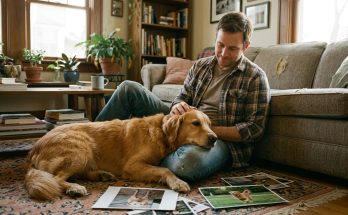
I had imagined taking Hope to the park long before I knew whether she would ever be strong enough to enjoy it.
At first, it was only a thought I kept returning to when the days felt difficult.
I pictured her standing on grass instead of the hard ground at the landfill.
I imagined her feeling the wind without being frightened by every unfamiliar sound.
Mostly, I wanted to see her move without struggling.
For months, nearly everything in her life had revolved around recovery.
Appointments.
Medication.
Careful meals.
Rest.
There had been very little room for anything else.
But as her strength returned, I began to think about what came after survival.
A dog needed more than a safe place to sleep.
She deserved a life.
I waited until her health had improved enough for the veterinarian to be comfortable with her doing more. I didn't want my excitement to push her beyond what her body could manage.
By then, Hope had changed so much that strangers would never have guessed what she had looked like when I found her.
Her fur had grown back thick and golden.
Her body had filled out.
The tiredness that once seemed to live permanently in her eyes had given way to a brighter, more alert expression.
She still had the same quiet manner.
But she no longer looked defeated.
The day we went to the park, I watched her carefully as we arrived.
She stood beside me, taking in the unfamiliar surroundings.
There were people moving in the distance and sounds coming from different directions. The ground beneath her paws was different from the floors she knew at home.
I wondered how she would react.
Would she stay close to me?
Would she be frightened?
Would she want to explore?
I gave her time to look around.
Hope lowered her head toward the grass.
She sniffed it, then lifted her face again.
I smiled.
It was such an ordinary thing for a dog to do.
That was what made it feel important.
She was finally able to experience something ordinary without the immediate struggle of staying alive.
We moved farther into the park at an easy pace.
I kept my attention on her, ready to slow down if she showed signs of tiring. I didn't want the first outing to become more than she could handle.
For a while, she walked beside me.
Then something caught her attention.
She moved ahead.
I watched her take a few quicker steps.
Then she began to run.
I stopped.
For a second, I wasn't sure I had seen it correctly.
Hope was running across the grass, her legs moving freely beneath her. Her tail was raised, and her ears bounced as she went.
She wasn't simply moving from one place to another.
She was enjoying herself.
I stood there watching, unable to stop smiling.
The dog I had carried out of the landfill had once been so weak that even lifting her head seemed to take everything she had.
Now she was running because she wanted to.
She chased a squirrel for a short distance before turning away from it. Then she came back toward me, panting, her expression bright and eager.
I crouched as she approached.
She stood in front of me, looking pleased with herself.
I rubbed her head.
"Well, that was something."
Her tail wagged.
I laughed, and then I realized my eyes were filling with tears.
I wasn't sad.
I was relieved.
For months, I had carried the memory of her first day with me. It had followed me through the veterinary visits, the bills, the nights spent worrying, and the mornings when I had wondered whether she was getting better.
I had tried not to think too far ahead because I was afraid of disappointment.
Standing in that park, I finally let myself see how far she had come.
She was alive.
She was healthy enough to run.
And she had returned to me because she wanted to share the moment.
I didn't feel like a hero.
I felt lucky.
Lucky that I had noticed her.
Lucky that I had stopped.
Lucky that the veterinarian had been able to help her and that Hope had been strong enough to keep fighting.
I knew I hadn't done everything alone.
The people at the clinic had worked hard to treat her. I had followed their guidance, made difficult choices, and tried to give her the care she needed.
But Hope had done the hardest part.
She had survived.
When we returned home, she settled down to rest.
I sat nearby, still thinking about the park.
I could hardly believe how different our lives had become in a matter of months.
The place where I found her had been filled with things other people no longer wanted.
My home had become a place where she was wanted every day.
I thought about how easily I might have missed her that morning.
If I had been looking at my phone, I might have walked past.
If I had been in a hurry, I might have decided that somebody else would help.
If I had been more concerned about the cost, I might have kept walking.
I didn't like thinking about those possibilities.
But I couldn't deny them, either.
I had not stopped because I was especially brave.
I had stopped because I saw her tail move.
Sometimes the difference between walking away and changing a life was smaller than people wanted to believe.
The veterinarian later told me that Hope's recovery had been remarkable.
She had treated animals for decades, and Hope's condition when she arrived had been among the most severe she had seen.
The fact that Hope had regained her health was something worth celebrating.
I thanked her.
I also told her how much her care had meant to me.
I had spent many hours in that clinic feeling frightened and helpless. The staff had continued treating Hope when I was too worried to think clearly.
I would never forget that.
As time went on, Hope became a steady part of my everyday life.
She followed me around the house whenever she could.
When I sat down to work, she often settled nearby.
At night, she slept at the foot of my bed.
When I felt low, she would come close and rest her head on my lap.
She never needed to do anything extraordinary.
Her presence was enough.
I had once believed that helping her was a simple matter of rescuing an animal in trouble.
I had not expected how much the experience would change the way I looked at my own life.
Hope reminded me to pay attention.
She reminded me that small improvements mattered, even when the bigger picture felt uncertain.
She reminded me that care was not a feeling that appeared once and solved everything.
It was something you did repeatedly.
Even when you were tired.
Even when you were worried.
Even when nobody else could see how much effort it took.
A year after I found her, I received a letter from the veterinary clinic.
I opened it at home, standing near the table where I usually sorted my bills.
At first, I thought it might be another routine notice.
Then I began reading.
The clinic had nominated Hope for an award called Miracle Pet of the Year.
They wanted to recognize her recovery and share her story.
I read the letter twice.
My first reaction was surprise.
Hope had become healthy enough to run through a park, sleep comfortably at home, and follow me around the house.
To me, those things had become part of our everyday life.
I had almost forgotten how impossible they had once seemed.
The letter brought the early days back into focus.
I remembered her lying beneath the garbage, her skin damaged and her body weak.
I remembered the emergency clinic and the veterinarian telling me how serious her condition was.
I remembered the financial worries and the nights when I listened to make sure she was still breathing comfortably.
Then I looked at Hope.
She was lying nearby, watching me with calm, curious eyes.
I reached down and stroked her head.
"You've come a long way."
Her tail moved against the floor.
I wasn't interested in making her famous.
An award couldn't change what had happened to her, and public attention couldn't erase the suffering she had endured.
But I thought about the people who might hear her story.
Maybe someone would remember to help an animal they would otherwise have ignored.
Maybe someone would understand that a neglected dog was not beyond saving simply because she looked frighteningly ill.
Maybe someone would realize that the cost of caring for an animal was real, but so was the value of giving that animal a chance.
I decided to accept the nomination.
Not because I believed Hope needed a trophy.
Because her story deserved to be told.
The ceremony would give me a chance to explain what had happened, and I wanted people to understand that the dog sitting beside me had not always looked the way she did now.
I wanted them to know about the landfill.
About the rope.
About the towel in my truck.
About the small movement that had made me stop.
Most of all, I wanted them to know that Hope had never been the worthless thing someone had treated her as.
She had been a living creature who needed help.
She had been frightened, sick, and terribly weak.
But she had still been capable of trusting someone.
I had been the person who found her.
I had also been the person who had almost walked past.
That part mattered to me.
It kept me from turning the story into something it wasn't.
Hope hadn't needed a perfect person to rescue her.
She had needed someone to stop, recognize that she was suffering, and decide that her life mattered.
I hoped that was what people would remember.
Not my sacrifices.
Not the award.
The dog.
The dog who had been thrown away, yet had found a reason to keep living.
And the person who had finally noticed her.
Click here to continue reading: PART 5: I Thought the Hardest Part Was Getting Hope Out of the Landfill, Until I Realized How Much Her Story Still Had to Give
I Almost Left the Landfill Without Looking Twice, Until Something Buried in the Garbage Moved and Made Me Stop
Part 4 of 10