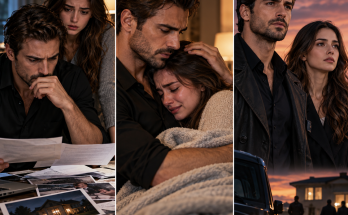
I closed my eyes. Ten weeks of fear. Ten weeks of hiding it from me. Ten weeks with a man stepping on her foot under the table to remind her who was boss.
They took us to the hospital. Mrs. Higgins wanted to come, but I asked her to stay and watch the apartment. Before closing the door, I saw her pick up the piece of paper written in black eyeliner from the floor. She slipped it into a plastic baggie. “This is evidence too, Martha,” she said. “We don’t throw anything away.”
In the ER, Danielle wouldn’t leave my side. A female doctor spoke to her gently, explaining that they needed to examine both her and the baby. I waited behind a curtain, listening to the monitor, the rolling of stretchers, a child crying, the cruel hum of hospitals where life and tragedy sit together on the same bench.
Finally, the doctor came out. “The pregnancy is stable. She’ll need follow-ups, bed rest, and a psychological evaluation. But for now, there is a heartbeat.”
Danielle covered her face. So did I. I didn’t know if I was crying out of relief, rage, or pure exhaustion.
Later, staff from the District Attorney’s office arrived. A detective explained that, given the presence of a weapon, threats, domestic abuse, and pregnancy, the case would be handled with emergency protective orders. She mentioned the Family Justice Center, and psychological, legal, and social support. Words I had heard on the news, on subway campaigns, on posters in clinics, but never imagined I’d need for my own daughter.
Danielle gave a brief statement. But enough. She explained that she met Evan through a workplace consulting firm. That he helped her when she wanted to quit her job due to harassment. That at first, he accompanied her everywhere “for her safety.” Then he asked for her passwords. Then he checked her messages. Then he told her I was a bad influence.
“He told me you wanted to see me end up alone,” she whispered. “That no mother wants her daughter to be happy if she wasn’t happy herself.”
I felt a pang in my chest. I had been a young widow. It was hard to raise her. There were nights I cried at the stove because I didn’t know if I had enough to pay the gas bill. But I never wanted Danielle to inherit my loneliness.
“I wanted you to be free,” I told her. She looked at me with red eyes. “I forgot what that was.”
The detective asked about the gun. Danielle said Evan kept it in his nightstand and carried it whenever he thought someone might “disrespect him.” She also told them about the civil wedding. He took her to a courthouse one morning with two of his own witnesses, without telling me. He told her that if she didn’t sign the papers, he was going to leak intimate videos recorded without her consent.
I clenched my fists. “Videos?”
Danielle lowered her head. “He recorded me when I didn’t know.”
The detective didn’t look surprised. That hurt me. That there were women trained to hear horrors without being shocked.
At four in the morning, they transferred us to the Family Justice Center. The city outside was still half-awake: food trucks closing up, garbage trucks, police cruisers, streets slick from a brief rain. Dallas could be enormous and brutal, but that night, every flashing red police light felt to me like a candle lit against the fear.
At dinner, I said, “Can’t wait for the family reunion.”
Part 2 of 2