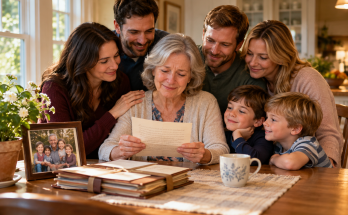
By early afternoon, the coffee had gone cold.
Kayla reheated a pot while Danny took Noah upstairs for his nap.
Jenna helped Stephanie clear the breakfast dishes.
Michael stayed at the table with me, sorting the papers into separate piles.
We had not discovered a secret that explained everything.
Instead, we had found pieces of ordinary life.
A bank receipt.
A list of dates.
Notes about conversations none of us remembered in quite the same way.
They were small things.
Yet each one showed that Walt had been making decisions while the rest of us went on believing we understood what was happening.
Michael placed a stack of receipts beside the folder.
"I can scan these tonight."
"You don't have to do that," I told him.
"I know."
He glanced at me.
"I want to."
I accepted the offer without arguing.
That was another small change.
For years, I had mistaken refusing help for being considerate.
I thought I was saving my children the trouble.
Sometimes I was only making it harder for them to come close.
Stephanie returned to the table with two cups of tea.
She placed one beside me and sat down.
"Mom, can I ask you something?"
"Of course."
She looked toward the kitchen doorway to make sure the others were out of earshot.
"Did you ever feel left out of your own marriage?"
The question was so direct that I couldn't answer immediately.
I wrapped both hands around the cup.
"Yes," I finally said.
Stephanie's expression softened.
"I thought you might."
"Why?"
"Because you always seemed to be the last person to know when Dad had made up his mind about something."
I looked down at the tea.
She wasn't wrong.
Walt had been decisive.
When he believed something needed to be done, he often acted first and explained later.
Sometimes there was no explanation at all.
He would say that he was handling it.
I would believe him.
At the time, that had seemed like trust.
Looking back, I could see how often it had also been convenience.
"I loved your father," I said.
"I know."
"He took care of us in many ways. He was dependable. He worked hard. When things went wrong, he was usually the person who figured out what to do."
Stephanie listened without interrupting.
"But he could make me feel as if I were standing outside a room he had locked from the inside."
She looked at me.
"Did you tell him that?"
"Not in those words."
"Why not?"
I thought about it.
Because I didn't want to start an argument.
Because he was tired.
Because the children needed something.
Because there was always another day to discuss it.
Those excuses had sounded reasonable when I made them.
Together, they had filled decades.
"I told myself it wasn't important enough to fight about," I said.
Stephanie stirred her tea.
"That's what I did with you sometimes."
I frowned.
"What do you mean?"
"When Dad made decisions I didn't like, I came to you. You listened, but you usually told me he meant well."
I remembered those conversations.
Stephanie had been upset when Walt refused to discuss helping her pay for graduate school.
She had been hurt when he missed a ceremony because of a business meeting.
She had complained that he never explained why he expected her to make certain choices.
I had comforted her.
Then I had told her that her father loved her.
I had believed that was enough.
"I thought I was keeping the peace," I said.
"You were."
Stephanie looked at me with a sadness I hadn't expected.
"But sometimes keeping the peace meant nobody talked about what was wrong."
I couldn't argue with her.
I reached for her hand.
"I'm sorry."
She looked surprised.
"You don't have to apologize for everything."
"I'm not apologizing for everything. I'm apologizing for the times you needed me to hear you, and I tried to make you feel better instead."
Her eyes filled with tears.
She blinked them away.
"I didn't know you remembered those conversations."
"I remember more than you think."
For a while, we sat quietly.
Then Stephanie squeezed my fingers.
"I don't want us to become a family that only tells the truth after somebody dies."
The words settled between us.
I looked toward the folder.
Neither of us could change what Walt had chosen to keep to himself.
But we could decide what to do with the truth we had found.
"I don't want that either," I said.
Michael came back into the room carrying his phone.
"Sorry. I was answering a message."
He stopped when he saw our faces.
"Did I miss something?"
"Just a conversation," Stephanie said.
Michael studied us.
"Was it about Dad?"
"Partly," I answered.
He pulled out his chair.
"Then maybe I should listen."
Stephanie looked at him.
"You don't have to join every conversation."
"I know."
He put his phone facedown on the table.
"But I want to hear this one."
I watched my children settle around me.
They were adults with homes, jobs, marriages, and worries I could not solve for them.
I had spent years trying to protect them from disappointment.
Walt had done the same thing in his own way.
Neither of us had understood that protection could become a wall.
I told Michael what Stephanie had asked me.
He looked uncomfortable.
"Did you feel that way often?"
"More often than I admitted."
Michael rubbed his jaw.
"I thought you and Dad always agreed."
"We didn't."
"You never argued in front of us."
"That doesn't mean we never argued."
He looked genuinely surprised.
I almost laughed.
We had hidden so much from our children that they had mistaken quietness for certainty.
"When your father and I disagreed," I explained, "we usually waited until you were asleep. We thought we were keeping our problems away from you."
"Did it work?" Stephanie asked.
I smiled sadly.
"Not as well as we imagined."
Michael leaned forward.
"Maybe that's why I thought a good marriage meant keeping your problems to yourself."
Jenna, who had returned with the tea, heard him.
She sat beside him.
"Sometimes I think that, too," she said.
Michael turned toward her.
"Really?"
"You don't tell me when something is bothering you until you've already decided what you're going to do about it."
He looked down.
"I didn't realize I did that."
"You do."
She said it gently.
That made it harder for him to dismiss.
Michael reached for her hand.
"I'll try to do better."
Jenna smiled.
"That's all I'm asking."
I watched them and thought about how much family behavior passed from one generation to another without anyone deliberately choosing it.
A habit could begin as a way to avoid pain.
Then it could become a rule.
Eventually, people would follow it without remembering why it existed.
Walt had kept his worries to himself.
I had learned not to press him.
Our children had learned to hide their disappointments.
Now their own families were beginning to feel the effects.
I didn't blame Walt for everything.
I didn't blame myself for everything, either.
But I could finally see that love did not excuse every choice made in its name.
Sometimes love required a difficult conversation.
Sometimes it required admitting that you had been wrong.
And sometimes it required sitting at a kitchen table with the people you loved, allowing them to tell you how they had experienced a life you thought you had shared.
Before we left the table, Stephanie opened her handbag and took out a small notebook.
"I want to write down the questions we still have."
Michael raised an eyebrow.
"Questions?"
"Yes. We have plenty of those."
She wrote the first one.
Why did Dad keep these records?
Then she wrote another.
What did he mean by making sure nobody was left without a choice?
Danny came downstairs just as she finished the second question.
He read the page over her shoulder.
"Add one more."
Stephanie handed him the pen.
He thought for a moment.
Then he wrote:
What did we never ask him because we assumed we already knew the answer?
Nobody spoke for several seconds.
I looked at the sentence.
It was the most difficult question on the page.
It was also the one I knew we would have to live with long after the folder was empty.
Click here to continue reading: PART 12: We Returned to the Study Where Walt Had Kept His Papers, Hoping the Room Might Explain What His Letters Could Not
After Burying My Husband, I Made Three Calls That Revealed What My Children Truly Thought I Was Worth
Part 11 of 20