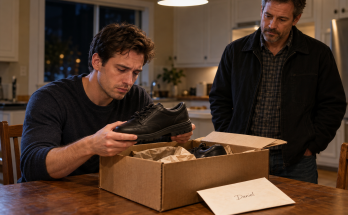
I sat quietly for another moment.
The box was still open.
The shoes remained beside it, and the envelope was within reach.
I had been looking at those things for so long that I could have described every visible detail without thinking.
The black leather.
The thick soles.
The size label.
My name across the envelope.
Yet describing them was easier than understanding what I felt about them.
I had expected something more definite.
I wanted the box to give me a clear reason for why my father had arranged for it to reach me.
I wanted to know whether he had been trying to tell me something important.
I wanted to know whether the letter was his way of saying what he had never been able to say aloud.
But wanting those answers did not make them available.
I could not make the objects speak.
I could not ask Marcus to speak for my father.
And I could not rely on my memories alone to fill the gaps.
That left me with a choice.
I could keep searching for certainty in every detail, or I could accept that some details might remain unclear.
I had spent enough years doing the first.
I wanted to try the second.
I picked up one of the shoes and held it for a moment.
It felt solid in my hands.
There was nothing unusual about its weight.
I turned it slightly, looking at the leather and the sole.
I couldn't remember the last time I had thought so carefully about an ordinary object.
Usually, I judged things by whether they worked.
Shoes were meant to be worn.
If they fit and held together, they served their purpose.
I had learned that practical way of looking at things partly from my father.
He had always seemed to prefer what was useful over what was said.
I had found that frustrating when I wanted him to talk.
Now I wondered whether I had understood only one side of that habit.
Perhaps practical gestures had been easier for him than difficult conversations.
Perhaps not.
I couldn't know.
I put the shoe back beside its pair.
I wasn't going to decide what it meant simply because I could imagine an explanation.
The envelope was easier to leave alone.
I had already read the letter, and I didn't need to prove to myself that it existed.
I knew it did.
I knew my father had written it.
I knew he had wanted me to receive it.
Those facts mattered, even if they didn't settle everything.
I rested my hand beside the envelope.
For years, I had treated my father's silence as something I needed to solve.
I had gone back through old conversations looking for a reason.
I had wondered whether I had asked the wrong questions or chosen the wrong moments.
I had sometimes blamed myself for expecting more from him.
Other times, I had blamed him for never giving me what I needed.
The truth might have been more complicated than either explanation.
I didn't have to decide that tonight.
That was becoming easier to say.
I wasn't sure it was becoming easier to believe.
Marcus remained across from me.
I was grateful that he hadn't tried to turn the evening into a lesson.
He hadn't told me to forgive my father.
He hadn't told me to be angry.
He hadn't suggested that the shoes or the letter proved anything beyond their existence.
He had simply brought the box and stayed while I examined it.
That had been enough.
I looked around the kitchen.
The room seemed ordinary again, although I knew I would remember the evening whenever I saw the table.
I would remember the box sitting between us.
I would remember the first moment I recognized my father's handwriting.
I would remember how I had stared at the shoes because the size was mine.
Those memories would remain, regardless of what I eventually decided about my father.
Perhaps that was another thing I needed to accept.
Understanding did not require me to erase the uncertainty I felt at the beginning.
I could remember the confusion without treating it as failure.
I could remember the anger without allowing it to decide everything that came afterward.
I could remember the hope I had felt when Marcus placed the box on the table, even if I remained cautious about what that hope meant.
I was allowed to have conflicting feelings.
I had always known that in theory.
I had not always allowed myself to live that way.
I looked at the envelope.
Part of me wanted to put it somewhere safe and leave it there until I felt ready to think about it again.
Another part wanted to keep it close because it was the only letter from my father I could remember receiving in this way.
I didn't need to choose between those feelings immediately.
I could protect the letter without deciding what it meant.
I could keep the shoes without promising myself I would wear them.
I could continue examining the box without knowing whether the remaining contents would answer anything.
The choices were ordinary.
That made them manageable.
I shifted in my chair and took another breath.
For the first time that evening, I wasn't waiting for a revelation.
I wasn't waiting for Marcus to tell me something that changed everything.
I wasn't waiting for the letter to become more than the words I had read.
I was simply sitting with what I had.
That might not sound like much.
For me, it was different.
I had spent years believing that the only way to move forward was to understand the past completely.
I was beginning to see that I could move forward while some of the past remained unclear.
That didn't mean I had stopped caring.
It meant I was tired of making my life depend on answers I might never receive.
I looked at the shoes and envelope one last time before turning back to the box.
I was ready to continue looking.
I didn't need to know what every detail meant before I took the next step.
Click here to continue reading: PART 16: I Could Not Ask My Father to Explain Himself Anymore, So I Had to Learn to Face What He Left Without Pretending I Knew Everything
I Thought My Father Had Left Me Nothing, Until One Ordinary Box Forced Me to Question Everything I Remembered About Him
Part 15 of 20