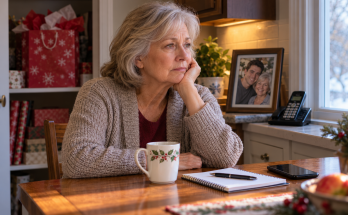
The following morning, I woke with a headache.
It was not severe, but it sat behind my eyes and made the kitchen light feel too bright.
I took my time getting ready.
I made tea instead of coffee and ate a piece of toast.
Then I sat by the window until the headache eased.
I had spent so many days thinking about Daniel that I had neglected the simplest things.
I had not been sleeping well.
I had been eating whenever I remembered.
I had walked through the house with my mind somewhere else.
I was not going to solve our relationship by wearing myself down.
That morning, I decided to take a short walk.
I put on my coat and shoes and stepped outside.
The air was cold enough to make me pull the collar up around my neck.
The sidewalk was mostly clear.
A few patches of snow remained in the shade beside the houses.
I walked slowly, keeping my hands in my pockets.
I did not go far.
I passed two houses and turned at the corner.
The movement helped me feel less trapped inside my thoughts.
As I walked, I thought about the word unconditional.
I had used it many times when talking about a parent's love.
A mother loved her child through mistakes, disappointments, and difficult years.
A mother did not stop caring because her child became impatient or selfish.
I still believed that.
I did not want to become someone who loved Daniel only when he behaved the way I wanted.
I did not want to make affection a reward.
But unconditional love did not mean unconditional access to my time, money, or peace.
It did not mean that he could say anything to me and expect me to act as if it had not happened.
It did not mean that I had to keep offering help while quietly resenting the way he treated me.
I had never thought about those differences clearly before.
I had believed that setting a boundary meant withdrawing love.
Now I could see that a boundary could protect the relationship from becoming something bitter.
If I continued giving beyond what I could afford, I might eventually become angry.
If I kept hiding my hurt, I might begin to resent every visit.
If I agreed to things because I was afraid Daniel would stop calling, I might never know whether our time together was freely chosen.
I did not want that kind of relationship.
I wanted to be able to help him because I wanted to help him.
I wanted to be able to say no when I needed to.
I wanted to sit at his table without wondering whether my presence was welcome only when I brought something useful.
Those were not unreasonable wishes.
I finished my walk and returned home.
When I took off my coat, I noticed a little moisture along the hem.
I hung it near the door and went to the kitchen.
The notebook was in the drawer.
I took it out and opened it to the page where I had written my thoughts about money.
I added another line.
Love is not the same as saying yes.
I read it slowly.
The words reminded me of something I had known during my years at Jefferson Elementary.
Caring for a child did not mean allowing every behavior.
Sometimes the most caring thing a person could do was say no clearly and calmly.
I had understood that with other people's children.
I had understood it with parents who were upset.
I had understood it at work when someone wanted me to ignore a rule because following it was inconvenient.
Yet with Daniel, I had often treated any refusal as a threat to our closeness.
I had been afraid that if I said no, he would think I did not care.
Perhaps he would.
I could not control every conclusion he might draw.
But I could make my intentions clear.
I could tell him that I loved him and still could not afford a particular expense.
I could tell him that I wanted to see him but needed more notice.
I could tell him that I was willing to talk about Christmas Eve but would not pretend it had not hurt.
Those things could exist together.
I did not have to choose between being loving and being honest.
Later, I called Helen again.
I told her that I had been thinking about boundaries.
She said that the word sounded harsh to many people, especially those who had spent their lives taking care of others.
I agreed.
I had imagined a boundary as a wall.
Something cold.
Something that kept people away.
Helen suggested that it could also be a clear line that showed people where a person stood.
I thought about that for a while.
I did not want a wall between Daniel and me.
I wanted a way to stand in the relationship without losing myself.
I wanted to know that I could tell him the truth and remain his mother.
I wanted to know that he could be disappointed in me without making me feel that I had failed him.
I wanted both of us to be adults who could speak honestly.
"Do you think he'll understand?" I asked Helen.
"I don't know," she said. "But you can understand yourself."
That answer stayed with me after the call.
I had spent so much time trying to anticipate Daniel's reaction that I had rarely considered what I actually believed.
I knew I loved him.
I knew I wanted him in my life.
I knew I wanted to see the children and share ordinary moments with them.
I also knew I could not continue helping financially without looking at my own needs.
I knew I could not accept being spoken to as though I were an inconvenience.
I knew I needed to say those things plainly.
I did not know whether Daniel would agree.
For once, I decided that his agreement was not required for me to recognize my own feelings.
That afternoon, I went through a small stack of household bills.
I paid the ones that were due and filed the receipts.
I checked my account balance and made a note of the next property tax payment.
It was ordinary work.
It was also a way of returning my attention to the life I had to manage.
I could not leave my own responsibilities unattended while worrying about Daniel's.
I needed to know what I could afford before anyone asked me for help again.
I also needed to stop assuming that every request was an emergency.
Sometimes a person could wait.
Sometimes another solution existed.
Sometimes the answer had to be no.
I had learned that over a lifetime.
I had simply forgotten it when I was afraid of disappointing my son.
When I finished, I put the papers in their folder and returned the folder to the cabinet.
The kitchen looked neat.
The counters were clear.
The bills were handled.
I felt a small sense of relief.
Not happiness.
Not forgiveness.
Just relief at having taken care of something within my control.
In the evening, I thought about Daniel's children.
I wondered whether they had asked about me after Christmas.
I wondered whether they had noticed that I had not visited.
I hoped they had not been confused by what happened at the door.
I did not want them to believe that love meant pretending people could treat one another however they wished.
But I also did not want to put them in the middle of a disagreement between adults.
If I spoke with them, I would be warm.
I would not ask them to report what their father had said.
I would not ask them to choose sides.
They deserved to enjoy their relationship with their grandmother without carrying my disappointment.
That was one boundary I understood clearly.
Whatever happened between Daniel and me, the children were not responsible for repairing it.
I could keep loving them.
I could hope to see them again.
I could send them birthday cards and remember the things they liked.
But I would not use those gestures to pressure Daniel.
I would not make the children messengers.
I would let the adults deal with the adult problem.
Before bed, I returned to the notebook.
The page was beginning to fill with short sentences.
I could love Daniel without paying for every opportunity to be near him.
I was allowed to say no.
Love was not the same as saying yes.
I looked at the words and felt embarrassed by how much I needed to remind myself of them.
Then I thought about all the people who had learned to ignore their own needs because they were afraid of being difficult.
I had spent years telling others to take care of themselves.
It was time to offer myself the same advice.
I closed the notebook and put it away.
I still missed my son.
I still wanted him to call.
I still wished Christmas Eve had ended differently.
None of those feelings had disappeared.
But I was no longer treating my hurt as evidence that I needed to give more.
I was no longer assuming that the way to regain Daniel's affection was to make myself smaller.
I could be generous without being endlessly available.
I could be patient without remaining silent forever.
I could forgive him if I reached that point without pretending that what he had done was acceptable.
I did not know how long any of that would take.
I only knew that I had to begin somewhere.
And for the first time, I understood that a mother's love could be unconditional while her choices still had limits.
Click here to continue reading: PART 15: I Had Prepared Myself to Hear Nothing From Daniel, but I Was Not Prepared for How Much I Still Wanted His Voice
I Thought Bringing Christmas Dinner to My Son Would Make Him Happy, Until I Saw the Look on His Face at the Door
Part 14 of 20