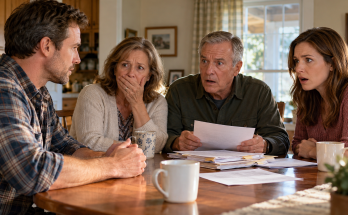
I used to think being underestimated was harmless.
Then I heard my father ask a question that made me realize my own family might have been lying to me for years.
It happened three days after I sold my farm.
Thirty-nine million dollars.
That was the amount sitting in my account, and I still hadn't told my parents or my sister.
I hadn't bought a new truck.
I hadn't moved into a mansion.
I hadn't even replaced the work boots sitting beside my back door.
To anyone passing me on the road, I was still the same man I'd been for years.
Thirty-seven years old.
An old pickup with more than two hundred thousand miles on it.
Faded flannel shirts.
Hands that rarely looked clean, no matter how often I washed them.
I was fine with that.
Or at least, I had convinced myself I was.
My family had a different opinion of me.
For fifteen years, they'd treated me like someone who couldn't quite get his life together.
My father never said those exact words.
He didn't have to.
At family dinners, he'd glance through the window toward my truck, then turn back to the table as if he were looking at a problem he had already given up trying to solve.
Sometimes he'd ask whether I was still working on the farm.
Sometimes he'd ask whether I had considered finding something more stable.
And sometimes he'd simply shake his head.
That was worse than the questions.
I had spent most of my adult life working outside before sunrise, tending land that demanded attention whether I felt tired or not.
Weather didn't care about family opinions.
Neither did a broken fence.
When equipment failed, I fixed it.
When crops needed attention, I stayed until the work was done.
There were years when the money was tight enough that I counted every expense twice.
There were other years when things went better.
But I never saw a reason to announce every improvement to people who had already decided what kind of man I was.
My sister seemed especially certain that I needed help.
She had a way of talking about me as if I weren't in the room.
She could turn an ordinary conversation into a discussion about my future, my finances, and the choices she believed I should have made years earlier.
I used to defend myself.
Then I got tired of doing it.
Eventually, I learned that silence was easier than arguing with someone who had already chosen not to believe me.
That habit followed me into the day I sold the farm.
The sale had been handled quietly.
I didn't announce it to relatives.
I didn't call my parents to tell them the amount.
I signed what needed signing, completed the necessary arrangements, and kept my personal business to myself.
Thirty-nine million dollars was not the kind of number I could casually bring up at Sunday dinner.
Besides, I wanted time to understand what my life would look like after the sale.
The farm had occupied so much of my attention for so long that imagining a future without it felt strange.
I was relieved.
I was also unsettled.
For years, I'd measured my days by the work waiting outside my door.
Now there was a bank balance I had never imagined seeing beside my name, and I still woke up early out of habit.
The money hadn't changed the way I moved through the world.
At least, not yet.
Three days after the sale, I decided to visit my parents.
It wasn't a special occasion.
I had stopped at a grocery store and picked up two bags of food they could use during the week.
I thought my mother might appreciate it.
My father had never been one to ask for anything, even when he needed it.
Bringing groceries seemed like a simple thing to do.
I placed the bags in the passenger seat of my truck and drove over.
The familiar road passed beneath my tires.
I remember thinking that I should probably tell my parents about the sale eventually.
Not because they were entitled to know.
Because they were my parents, and a part of me still wanted them to be proud of me.
I wanted one ordinary conversation where I didn't have to explain why I had chosen my life.
I wanted to sit at their kitchen table without feeling as though I were being quietly evaluated.
That was all.
When I pulled into their driveway, everything looked the same as it always had.
The house.
The front steps.
The windows that caught the afternoon light.
I carried both grocery bags from the truck.
The plastic handles stretched against my fingers as I walked toward the porch.
I was almost at the door when I heard my sister speaking inside.
I recognized her voice immediately.
She sounded comfortable.
Certain.
Like someone explaining something everyone else should already understand.
I stopped before reaching for the handle.
I hadn't intended to listen.
But then I heard her mention me.
"He still can't manage on his own."
I stood there with the bags hanging from my hands.
For a moment, I thought I had misunderstood her.
Maybe she was talking about someone else.
Maybe she'd said something different.
Then she continued, and there was no mistaking whom she meant.
She was telling my parents that I still couldn't support myself.
I looked down at the groceries.
One bag held bread, vegetables, and a few things my mother liked to keep in the kitchen.
The other held basic supplies.
Nothing expensive.
Nothing that should have made me feel embarrassed.
Yet standing outside that door, I suddenly felt foolish for bringing them.
Not because I couldn't afford them.
Because I had come there hoping to do something kind, and inside, my sister was describing me as a burden.
I could have knocked.
I could have walked in and asked her to repeat herself.
I could have told her about the sale and watched her expression change.
Instead, I remained still.
Then my father spoke.
His voice was quieter than my sister's, but the words reached me clearly.
"How much have we already given her for Fay?"
I stopped breathing for a second.
Fay.
I knew the name.
But I didn't understand what he meant by giving her money.
My sister answered, though I couldn't make out every word.
My father asked another question.
He wanted to know how much had already been handed over.
There was something in his tone that made the conversation sound familiar to him.
This wasn't a new subject.
They had discussed it before.
More than once, perhaps.
I stood on the porch, holding two bags of groceries, trying to make sense of what I had just heard.
My parents had given money for Fay.
Apparently, enough money that my father wanted an accounting of it.
And my sister had been speaking about my inability to support myself as though the two subjects belonged together.
I waited for someone to mention my name.
I waited for my mother to ask whether I had received anything.
I waited for my father to clarify what he meant.
No one did.
The longer I stood there, the more obvious one fact became.
I had never received a dollar from my parents.
Not for the farm.
Not for my bills.
Not for food.
Not for any emergency.
Whatever money they were discussing, it hadn't come to me.
I looked at the door.
My hand was close enough to knock.
All I had to do was make a sound, step inside, and demand an explanation.
But something held me back.
Maybe I was afraid of what they'd say.
Maybe I was afraid they'd offer an excuse so ordinary that I'd have to decide whether to accept it.
Or maybe I already understood that the conversation had exposed something I couldn't pretend not to hear.
I wasn't ready to face them.
Not yet.
So I turned around.
The grocery bags rustled as I walked back across the porch.
I kept my eyes on the steps.
I didn't look through the windows.
I didn't wait to hear what my sister said next.
I carried the bags back to my truck and placed them on the passenger seat.
Then I closed the door.
For several seconds, I sat behind the steering wheel without starting the engine.
The house stood in front of me, familiar and unchanged.
I had arrived hoping to share a small kindness.
I was leaving with a question I couldn't put down.
What money had my parents been giving away in my name?
I took my phone from my pocket.
There was a message on the screen that I hadn't paid much attention to earlier.
I opened it.
And for the first time that afternoon, I stopped thinking about the thirty-nine million dollars in my account.
Something else mattered more.
Click here to continue reading: PART 2: The Old Pickup, the Faded Shirts, and the Family Story Everyone Believed Without Ever Asking Me
My Family Thought I Was Broke, Until I Heard My Father Ask Where the Money for My Sister Had Gone
Part 1 of 20