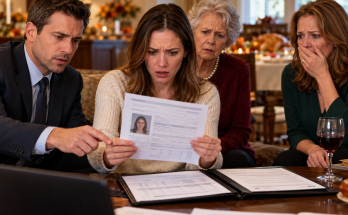
I had never imagined that my family would try to make people doubt my mind.
The possibility had not even occurred to me before that night.
I had worried about arguments.
I had worried about being misunderstood.
I had worried about my mother telling relatives that I was difficult.
But this was different.
My family had gone to the police together and claimed I was mentally unstable.
They had chosen a description that could follow me into every conversation about what had happened.
If someone believed them, they might not need to consider my account very carefully.
They could decide I was confused before I finished speaking.
They could interpret my fear as proof that I couldn't be trusted.
They could treat my distress as the explanation for everything.
I was frightened because I understood how easily that could happen.
People often wanted a simple explanation.
They wanted to know who was reasonable and who was not.
They wanted to decide which person sounded believable.
And once they made that decision, they might interpret everything else through it.
My family had given them a reason to doubt me before I had a chance to explain.
I couldn't change that.
But I could refuse to accept their description as a fact about myself.
Being frightened did not mean I was incapable of understanding what had happened.
Having gaps in my memory did not mean every part of my account was false.
And being distressed after a frightening experience did not mean I deserved to be dismissed.
I had to remind myself of those things because my family's accusation had found its way into my thoughts.
I would begin thinking about the night, then wonder whether someone else would believe me.
I would remember my sister's laughter, then ask myself how I could prove what I had seen.
I would remember waking outside, then imagine my mother telling someone that I had misunderstood everything.
Before long, I would be arguing against a version of events I had never even heard in full.
I was exhausting myself.
I needed to stop giving my family's imagined responses control over my thoughts.
I couldn't know exactly what they had said.
I couldn't know what the police believed.
I couldn't know whether anyone had questioned their account.
I could only know that my family had made the accusation.
I had to work from there.
I decided to focus on the events I could describe clearly.
I would not allow the discussion to become a contest over which person appeared calmer.
I would not try to prove that I had never been angry or frightened.
I was human.
I had feelings.
I had been hurt.
None of those things made my memories automatically meaningless.
I could explain what I remembered without pretending to be unaffected.
I could say I was frightened.
I could admit that I was confused about parts of the night.
I could acknowledge that losing consciousness had left gaps.
Honesty did not require me to present myself as perfectly composed.
It required me to be clear about what I knew.
I kept returning to that distinction.
My mother and sister might try to make my reactions the main issue.
I could not stop them from doing that.
But I could keep bringing the discussion back to what had happened.
I had been hurt.
I had asked for help.
My sister had watched.
I had lost consciousness.
And I had later found myself outside in the cold.
Those facts deserved attention regardless of whether I cried while describing them.
I had spent too long believing that I needed to remain calm enough to earn the right to be taken seriously.
That belief had made me afraid of my own emotions.
If I became angry, I worried that I had ruined my chance to be heard.
If I cried, I worried that someone would think I was exaggerating.
If I struggled to find a word, I worried that the pause would be used against me.
I couldn't live under those rules anymore.
I could try to explain myself clearly without treating every human reaction as a mistake.
I could take my time.
I could admit when I didn't remember something.
And I could ask for help when I needed it.
My family had already made a claim about me.
I didn't have to prove them wrong by pretending the night had left me untouched.
The night had affected me.
I was afraid.
I was hurt.
I was struggling to understand how my own family had treated me.
Those feelings made sense.
They did not erase what I remembered.
I thought about my sister's phone again.
That image remained one of the clearest things in my mind.
I remembered looking toward her and hoping she would stop what was happening.
I remembered asking her to call for help.
I remembered that she laughed.
I couldn't explain her thoughts.
I couldn't know what she had intended to do afterward.
But I didn't need to know those things to describe what I had seen.
I had to stop demanding impossible certainty from myself.
I could not read my sister's mind.
I could not reconstruct the moments I had lost.
I could not control what my mother told the police.
I could describe the events I remembered and preserve the evidence I had hidden.
That was enough for the next step.
I also had to accept that the process might be slow.
I wanted someone to understand immediately.
I wanted the accusation against me to lose its power as soon as I spoke.
But I couldn't guarantee how people would respond.
Some might listen carefully.
Others might need time.
Some might believe my family because they had heard their version first.
I couldn't make every person fair.
I could make sure I didn't give up before I had a chance to be heard.
That became important whenever the fear returned.
I had spent years withdrawing from difficult conversations because I believed nothing good would come from continuing.
Sometimes leaving an argument had been the right choice.
But silence had also become a way of avoiding the possibility that someone might reject what I had to say.
Now I had to risk that rejection.
I had to accept that someone might not believe me at first.
I had to accept that explaining the truth might be uncomfortable.
And I had to accept that my family might become angry when I stopped protecting their version of events.
None of those possibilities meant I should remain silent.
I didn't know how everything would end.
I didn't know whether my family would admit what had happened.
I didn't know what the evidence would establish.
But I knew I could no longer allow their accusation to decide whether I was entitled to speak.
I had a voice.
I had memories.
I had something I had deliberately kept safe.
And I had a reason to keep going.
That was where I chose to begin.
Click here to continue reading: PART 11: I Stopped Rehearsing Arguments With My Mother and Began Preparing to Tell the Truth Without Letting Her Decide What It Meant
I Woke Up Freezing in an Alley, With No Shoes and No Memory of How My Own Family Had Left Me There
Part 10 of 20