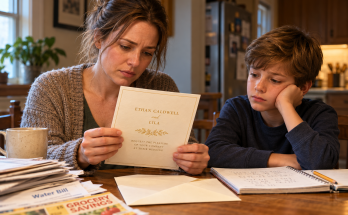
My father arrived the next morning carrying his old black notebook and a folder of blank paper.
He had called before leaving home.
He had also reminded me not to send Landon any financial information until we understood what the request involved.
I had spent most of the night thinking about that instruction.
It still bothered me.
I wanted to believe that the divorce had drawn a clean line between our lives.
The legal documents were signed.
The judge had approved the arrangement.
Landon had walked away.
Surely, I thought, the practical part should now be simple.
But the more I reviewed the accounts, the more I understood that a marriage did not operate like a single contract.
It was a collection of habits, permissions, signatures, and decisions.
Some had been made together.
Others had been made by Landon and accepted by me.
My father set his folder on the kitchen table.
“Let's start with what you know.”
I brought my laptop over.
We sat across from each other, with the screen between us.
I showed him the accounts I had checked and the cards I had frozen.
He asked which accounts were mine, which were connected to the business, and which had allowed Landon to make purchases or manage expenses.
I answered as clearly as I could.
When I knew something, I told him.
When I was uncertain, I said so.
He did not criticize me for the gaps.
That made it easier to admit how many there were.
He wrote down each account on a separate line.
Then he asked me to explain the old black card.
I reached for my wallet and took it out.
It was heavier than it looked, with a dark finish that had worn slightly around the edges.
Landon had always liked using it.
He would hold it between two fingers and make a joke about how useful it was to have someone in the family who knew how to arrange things properly.
I used to smile when he said that.
Sometimes I even felt proud.
My father turned the card over.
“Who is the primary account holder?”
“Me.”
“And Landon?”
“He had access.”
“What kind?”
I thought about it.
“I don't know the exact terminology. He was allowed to use it.”
My father put the card down.
“Then that's one of the things we need to establish.”
I felt my face grow warm.
“I should know this.”
“You should know it now.”
“That isn't the same thing.”
“No,” he said. “It isn't.”
He made a note and moved to the next account.
We went through the personal cards first.
I explained which ones I used for everyday expenses and which ones had been kept for emergencies.
We checked the business account next.
That took longer.
I understood how the account was used, but I could not explain every permission attached to it.
My father did not assume that an unfamiliar entry meant something improper.
He asked what it was for.
I told him what I knew.
Then he marked the items that needed verification.
We were not trying to prove Landon had done something wrong.
We were trying to establish the facts.
The distinction made the process slower, but it also kept me from jumping to conclusions.
At one point, I became frustrated and closed the laptop.
“Maybe there's nothing here.”
My father rested his hands on the table.
“That is possible.”
“Then why are we spending hours doing this?”
“Because you need to be able to say that you checked.”
I looked at him.
He continued in the same calm voice.
“If everything is in order, the records will help you establish that. If something isn't, the records will help you understand what needs attention.”
I opened the laptop again.
We continued.
The hardest questions were not about balances.
They were about decisions.
My father asked me when Landon had been given access to certain accounts.
I could not remember the exact dates.
He asked whether I had reviewed the agreements.
I remembered seeing some of them.
I could not say that I had read every page.
He asked whether I understood the terms.
I admitted that I had relied on Landon's explanations.
Each answer made me feel as though I were describing someone I should have known better than to become.
I had always considered myself sensible.
I worked hard.
I paid attention to my responsibilities.
I could manage a household and make difficult decisions when I needed to.
Yet when it came to money, I had allowed confidence to stand in for knowledge.
Landon had never needed to order me to step aside.
He had made stepping aside sound like a favor.
He would tell me that he had already reviewed the paperwork.
He would say he understood the terms.
He would explain that the arrangement was common and that there was no reason to make it more complicated.
And I would let the matter go.
I had not thought of that as surrendering control.
I had thought of it as being married.
My father seemed to understand what I was remembering.
He did not tell me that he had warned me before.
He could have.
There had been conversations over the years when he asked whether I understood a particular agreement or whether I had kept copies of the documents.
I had assured him that everything was handled.
Sometimes I had even teased him for treating ordinary family finances like a courtroom investigation.
Looking back, I wished I had been more patient with those questions.
But regret did not help us understand the accounts in front of us.
We kept working.
By lunchtime, we had a clearer list of the accounts and the access arrangements I needed to verify.
We also had a list of documents I had not yet located.
My father suggested that I request complete statements and account histories from the relevant institutions.
He told me to keep copies of the requests and to avoid making assumptions about entries I did not recognize.
I wrote everything down.
Then I noticed the notebook beside his hand.
“You've been thinking about this for a while, haven't you?”
He looked at the notebook.
“I've been thinking about whether you understood your financial arrangements.”
“Since when?”
“Long enough to know I should have asked more questions.”
I stared at him.
“You think you should have done something?”
“I think I could have pushed harder for you to understand the paperwork.”
I had expected him to defend himself.
Instead, he was accepting a share of the discomfort without claiming responsibility for my decisions.
That made me feel worse.
“You tried,” I said.
“Maybe. But I accepted your answers when you told me everything was fine.”
I looked down at the notes.
I had spent years assuring people that Landon and I were doing well.
We had a home.
We had accounts.
We had plans.
From the outside, our lives had looked organized.
I had not realized how much of that appearance depended on Landon being the person who explained it.
My father closed the notebook.
“We can't change the way you handled things before today.”
“I know.”
“But you can decide how you handle them from now on.”
I nodded.
It sounded simple.
It was not.
Every account we reviewed reminded me of another time I had accepted an answer without asking for proof.
I remembered the black card at restaurants.
I remembered the way Landon would take my phone to complete a payment because he said he could do it faster.
I remembered signing documents while he stood beside me, telling me where to put my initials.
None of those memories proved that he had done anything improper.
They did, however, show me how comfortable I had become with not knowing.
My father suggested we take a break.
I stood and walked to the sink.
The kitchen window was open slightly, and I could hear traffic moving along the street.
I filled a glass with water.
My hand was shaking.
I had thought that losing my marriage meant I had to learn how to live without Landon.
Now I was beginning to understand that I also had to learn how to live without depending on his explanations.
It was a different kind of loss.
It was also a responsibility I could no longer avoid.
When I returned to the table, my father had arranged the notes into a neat stack.
He handed me the top page.
“These are the records to request first.”
I read through the list.
There were several accounts, the business expense arrangements, and the agreements connected to the cards.
Nothing on the page accused Landon of anything.
It simply set out what we needed to know.
I took the page and placed it beside my laptop.
Then I opened a new document and began recording the steps we had completed.
My father watched me type.
“What are you doing?”
“Keeping track of what we've checked.”
He nodded.
“Good.”
That small word meant more to me than it should have.
For the rest of the afternoon, I handled the requests I could make myself.
I saved the confirmations.
I wrote down the dates.
I made sure the records remained available rather than relying on what I thought I remembered.
By the time my father left, I had a clear list of what was known, what was uncertain, and what still needed to be checked.
I walked him to the door.
“Do you think Landon knows we're doing this?”
My father considered the question.
“He knows you changed the cards. Beyond that, I can't tell you what he knows.”
I thought about the message he had sent after the divorce.
The request for information about the final transfer.
It had seemed ordinary at the time.
Now I wanted to understand precisely what he was asking for before I responded.
My father picked up his coat.
“Don't turn uncertainty into an accusation,” he said. “But don't turn familiarity into proof that everything is safe, either.”
I repeated the words to myself after he left.
Then I returned to the kitchen table.
The black card lay beside the stack of notes.
For years, it had represented convenience.
Now it reminded me of every time I had allowed someone else to decide what I needed to know.
I picked it up and placed it in a separate envelope with the account information.
I was not ready to decide what the card meant.
I was ready to find out.
Click here to continue reading: PART 4: Landon’s Request Had Sounded Routine Until I Compared It With the Boundaries I Had Finally Started Putting in Place
My Marriage Had Just Ended, but My Father Was Already Looking at the Money I Had Forgotten to Protect
Part 3 of 20