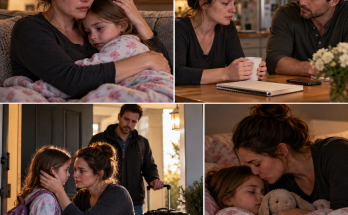
We spent nearly an hour going through the document.
The tea grew cold.
Graham moved his cup aside so he could spread the pages across the table.
I kept my notebook open beside me.
Whenever something wasn't clear, I wrote it down.
He seemed irritated by that at first.
Then he stopped commenting on it.
I asked him to explain the purpose of each section.
Some answers were straightforward.
Others led to more questions.
I didn't pretend to understand something just because he used confident words.
That was one of the habits I had decided to break.
For years, I had allowed Graham to explain complicated things to me and then nodded before I was certain I understood.
Sometimes he was right.
Sometimes I had simply been too embarrassed to ask him to repeat himself.
I had mistaken that embarrassment for respect.
It wasn't respect.
It was fear of appearing foolish in front of my own child.
I didn't want to feel that way anymore.
When we reached the last page, I placed the papers on the table.
"I need more time with this."
Graham pressed his lips together.
"How much time?"
"I don't know yet."
"We can't leave everything unresolved indefinitely."
"I'm not asking you to."
He rubbed his forehead.
"I just want us to move forward."
"Then we need to agree on what moving forward means."
He looked at the notebook.
"You're writing everything down?"
"I'm writing down the things I need to understand."
"Why?"
"Because I don't want to forget what we've discussed."
He seemed about to respond.
Then he stopped.
I wondered whether he had finally understood how little confidence I had in our conversations.
Not in my memory.
In the conversations themselves.
Too often, I had left a discussion feeling that I had agreed to something when I had only agreed to stop arguing.
I wasn't going to do that again.
Graham gathered a few loose pages into a neat stack.
"You could have just told me you weren't comfortable with it."
"I did."
"Not at first."
I looked at him.
"At first, you brought me a document and expected me to sign it."
He looked away.
I felt a pang of sadness.
I didn't enjoy reminding him of his mistakes.
I had never enjoyed it.
When Graham was young, I used to lie awake worrying that I had been too strict with him.
If I corrected him, I wondered whether I had hurt his feelings.
If I let something go, I worried that I had failed to teach him responsibility.
There was no perfect answer.
I had done the best I could.
But somewhere along the way, I had begun treating his discomfort as evidence that I had done something wrong.
That was unfair to both of us.
He needed to be able to hear a difficult answer.
I needed to be able to give one.
"Mother," he said, "I know you don't like being pressured."
I almost smiled.
"Nobody likes being pressured."
"I didn't mean it that way."
"I know."
He looked at me as though he expected me to continue.
I didn't.
Sometimes I had spent so much time explaining what I meant that I had given other people permission to ignore what I actually said.
I was learning to stop.
Graham finally put the folder back together.
"Can I take these with me and bring them back after we've made a few adjustments?"
"Yes, as long as I receive a complete copy of the revised version."
He nodded.
"Of course."
I watched him slide the papers into the folder.
There was a time when I would have been satisfied with that promise.
I would have thanked him and assumed everything would be handled properly.
Now I wanted the promise to become something concrete.
"When you have the revised copy, send it to me before we arrange another meeting."
He looked up.
"All right."
"And I want enough time to read it."
"Yes."
We sat quietly for a moment.
Then Graham asked whether I had been enjoying the warmer weather.
It was such an ordinary question that I almost didn't know how to answer.
I told him I had been walking in the garden in the mornings.
He asked whether the plants were doing well.
I showed him the view from the window.
For a few minutes, we talked like mother and son again.
He remembered a plant his father had bought years earlier.
He asked whether it was still alive.
I told him it was.
He smiled.
"That thing survived everything."
"So did I," I said.
The words came out before I could stop them.
His smile faded.
I hadn't meant them as a joke.
I hadn't meant them as an accusation, either.
I had simply spoken the truth as I felt it.
Graham looked down at his hands.
"I know you've had a hard time since Dad died."
I nodded.
"It wasn't easy."
"I should have been around more."
I looked at him.
He had never said that so plainly before.
For a moment, I wanted to reach across the table and tell him not to worry.
I wanted to say that he had been busy, that he had his own family, and that I had managed.
Those things were all true.
But they weren't the whole truth.
"You could have called more," I said.
He nodded slowly.
"I know."
The room became very quiet.
I could hear a car passing outside.
The clock on the wall ticked steadily.
I didn't know whether he would say anything else.
I didn't want to force him.
After a while, he stood.
"I should get going."
I rose with him.
At the door, he hesitated.
"I'll send you the revised papers."
"Thank you."
He hugged me.
This time, the embrace lasted long enough for me to feel that he was actually there.
I held him for a moment.
Then I stepped back.
He left.
I watched him walk to his car.
He looked tired.
I wondered whether he had spent as much time worrying about our relationship as I had.
Probably not.
But perhaps he had begun to think about it.
I wanted to believe that.
I closed the door and returned to the living room.
The two tea cups were still on the table.
I carried them into the kitchen and washed them.
Then I opened my notebook and read what I had written.
I had a list of questions.
I had a promise that revised papers would be sent.
I had a memory of Graham admitting that he should have called more often.
It wasn't much.
But it was more than I had had a few days earlier.
That evening, I took the old photograph of Graham and his father from the cabinet.
I placed it on the table beside the notebook.
I looked at the boy in the photograph.
He had been so earnest.
He wanted to do things correctly.
He wanted his father to be proud of him.
I had always assumed that the desire would stay with him.
Perhaps it had changed shape.
Perhaps he now measured himself by the people he worked with, the responsibilities he carried, and the things he believed he needed to achieve.
I couldn't know.
I only knew that the boy in the photograph would never have wanted me to feel frightened of asking him a question.
I returned the photograph to the cabinet.
Then I made dinner.
Nothing special.
Soup and bread.
I ate at the kitchen table and listened to the radio.
For once, I didn't keep checking my phone.
I had said what I needed to say.
The next step belonged to Graham.
I couldn't make him take it.
I couldn't make him understand me.
I could only decide what I would accept.
That realization was uncomfortable.
It was also a relief.
Click here to continue reading: PART 7: Vanessa’s Next Conversation With Me Changed the Way I Understood Her Concern, and It Left Me Questioning What They Believed About Me
I Thought Spending Mother’s Day Alone Would Be the Hardest Part, Until My Son Made Me Feel Like a Stranger
Part 6 of 20