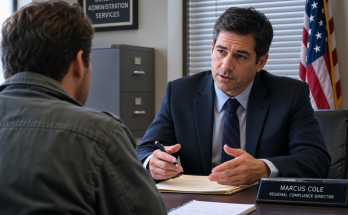
Six months after the first review, I stood in the conference room and listened to Elaine describe the program's progress.
The room was smaller than the boardroom where we discussed company acquisitions.
There were no polished presentation screens, only a laptop connected to an old monitor and a stack of printed reports.
Daniel sat beside Elaine.
Several staff members joined remotely.
The updated figures showed that fewer referrals were going to services that had no capacity.
The team had also reduced the number of applications delayed by missing or unnecessary documents.
The transportation fund had helped people attend appointments, though its budget was not large enough to meet every request.
Some cases remained unresolved.
Some people had declined further contact.
Some services still had waiting lists longer than anyone wanted.
Elaine did not hide those facts.
She explained what the team had learned and which changes they planned to test next.
When she finished, no one applauded.
We asked questions.
We examined the costs.
We discussed whether the additional verification work could be sustained without exhausting the staff responsible for it.
The review lasted nearly two hours.
By the end, we had agreed on a revised budget, a new schedule for checking partner capacity, and a plan to evaluate whether the document process was actually saving applicants time.
The decisions were ordinary.
They were also the reason I had called the meeting.
Afterward, I thanked the team.
Elaine gathered her papers.
“We'll know more after another quarter,” she said.
“I expect we will.”
“And there will still be things we can't measure.”
“Yes.”
She looked at me for a moment.
“You seem more comfortable saying that now.”
I thought about her question.
“I've learned that pretending to know doesn't make the answer more useful.”
She smiled.
“That's a start.”
When the room emptied, I stayed behind.
A forgotten paper clip lay near the table's edge.
I picked it up and placed it beside the folder.
The gesture was meaningless, but I noticed that I was no longer searching for a lesson in every small action.
Some things could simply be done.
That evening, Claire invited me to dinner.
She had made pasta and a salad, and the kitchen was crowded with the ordinary things people used when they lived in a home rather than prepared one for display.
There were shoes near the door.
A stack of mail sat beside the fruit bowl.
A dish towel hung crookedly from the oven handle.
I found the room more comforting than I expected.
Claire poured water into two glasses.
“How's the program?” she asked.
“Better in some ways.”
“And in others?”
“Still difficult.”
She nodded.
“You sound like you mean that.”
“I do.”
We ate without discussing work for a while.
Then she asked whether I was still thinking about Mara.
I set down my fork.
“Sometimes.”
“Do you still want to find her?”
The question was direct.
I did not try to soften my answer.
“Sometimes I want to know that she's all right. But I don't think that gives me the right to look for her.”
Claire considered that.
“Those are two different things.”
“Yes.”
“Wanting to know doesn't mean you have to act on it.”
“I know.”
I paused.
“I'm still getting used to knowing that.”
She reached for her glass.
“Most people are allowed to remain unknown to us.”
The words stayed with me.
I had spent much of my life treating access as a natural consequence of concern.
If I cared, I asked questions.
If I had the resources, I found answers.
If a situation remained uncertain, I searched for another way to make it clear.
But care did not always require access.
Sometimes it required accepting that another person had a life beyond the part I had seen.
Mara had not invited me into hers.
She had accepted the use of a bank card for one day and made her own decisions.
I could respect that without knowing how the story continued.
After dinner, Claire showed me a small repair she had made to a wooden shelf in her hallway.
One bracket had come loose, and she had fixed it herself.
I told her it looked good.
She laughed.
“I didn't need a professional for every problem.”
“I never said you did.”
“You didn't have to.”
I smiled because she was right.
We talked for another hour.
When I left, she packed some leftover pasta into a container for me.
I almost told her I could manage my own dinner.
Instead, I thanked her and carried it to the car.
At home, I placed the container in the refrigerator.
Then I took out the photograph of my father.
I had moved it from the kitchen counter to a shelf in the living room.
For months, I had looked at it whenever I wanted to understand how I had become the person I was.
I no longer believed the photograph could answer that question.
It showed one moment.
It could not tell me everything my father had felt, everything he had misunderstood, or everything he had wanted to say but never learned how to say.
I left it on the shelf.
I did not need to erase him to change what I had learned from him.
The next morning, I reviewed the final version of the program report.
It was accurate.
It was incomplete.
It showed where the process had improved and where the team still lacked answers.
I approved it.
Then I sent Elaine a note thanking her and the staff for the work they had done.
I did not tell them that the program had changed my life.
That was not their responsibility.
I did not say that their work proved I had become a better person.
That was not their purpose.
I told them to continue checking the results, protecting people's privacy, and bringing forward problems that the current process could not solve.
Then I closed the report.
Outside my office, the day continued as usual.
Phones rang.
People walked between meetings.
Someone laughed in the hallway.
The company was still a company, with its deadlines, budgets, and arguments about how best to spend money.
The program would not fix every problem it encountered.
It would not make every decision easy.
It would not give me a way to measure whether I had made up for every mistake I had made before.
I no longer expected it to.
I had once thought the most important part of helping someone was the moment when I decided to give.
Now I understood that the decision was only one part.
There was the question of whether the resource was useful.
There was the work of making sure it could actually be accessed.
There was the responsibility to be honest about its limits.
And there was the need to let the person receiving it remain the author of their own life.
I could work on those things.
I could make mistakes, listen when people pointed them out, and revise the process.
I could do that without knowing whether Mara would ever hear about the changes.
I could do it without asking her to return and tell me that I had understood the lesson.
The bank card had been returned.
The day had ended.
The rest of my life belonged to the choices I made afterward.
I switched off the monitor and picked up my coat.
There was no final message waiting for me.
No unexpected call.
No proof that every unanswered question had somehow led to a satisfying conclusion.
There was only the next day, and the work that would still need doing.
For once, I did not mistake that for an unfinished story.
The End
Read more original stories on Feel Every Story.
I Thought Money Could Solve Any Problem Until a Stranger Asked Me for Something I Could Never Buy Back
Part 20 of 20