
The silence lasted longer than I expected.
Alicia looked at Mark.
Mark looked at the brochure.
I looked at both of them.
For once, I wasn't the person trying to make everybody comfortable.
That felt strange.
Not unpleasant.
Just unfamiliar.
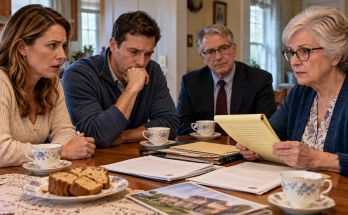
The fourth cup remained at the end of the table.
My reading glasses were still on my face.
The banana bread sat between us, untouched except for the small piece Alicia had taken earlier.
Nothing in my kitchen looked unusual.
But the conversation had stopped being ordinary.
Alicia was the first to speak.
“Dorothy, I really don't understand why you're being so cautious.”
I looked at her.
“I'm asking questions.”
She gave a small sigh.
“Of course. And questions are fine.”
I waited.
She glanced at Mark.
“We just don't want you upsetting yourself over things that haven't even happened.”
I considered that.
It was a clever way of putting things.
If I asked about the house, I was worrying unnecessarily.
If I asked about the documents, I was becoming upset.
If I wanted time to read, I was making a simple matter complicated.
She could describe every reasonable thing I did as a problem.
And if I accepted that description, I would eventually stop asking.
I had done that before.
Not this time.
“I'm not upset about asking questions,” I said.
Alicia pressed her lips together.
Mark reached toward the brochure.
Then he stopped.
I watched his hand return to his lap.
“Mom, maybe Alicia's right. We don't need to go through every detail today.”
I turned toward him.
“Then why did you bring the folder?”
His face changed.
There was no dramatic reaction.
He simply stopped moving.
Alicia looked at me quickly.
“What folder?”
I could have told her exactly what I had heard.
I could have repeated the conversation from the car.
I could have described the folder in the back seat and the brochure in the glove compartment.
But I wasn't ready to reveal that yet.
I looked at Mark.
“I assumed you brought information besides the brochure.”
He swallowed.
“Oh.”
That was all he said.
Oh.
I had heard that word from him many times.
When he was a little boy and discovered he had forgotten his homework.
When he was older and realized I knew he had broken something.
It was the sound he made when his mind was working faster than his mouth.
Alicia smiled.
“We did bring some information.”
I nodded.
“Then I'd like to see it.”
She looked at the brochure.
“Most of what matters is right here.”
I leaned forward slightly.
“Most?”
She didn't answer.
I waited.
The clock above the stove continued ticking.
I could hear a faint sound from outside.
Somewhere on the street, a car passed.
I wondered whether Eleanor had already moved to her kitchen window.
She had promised to be there.
I knew she would keep her word.
Thinking about her helped me remain calm.
For the first time since Raymond died, I had deliberately asked someone to stand beside me in a family disagreement.
I hadn't wanted to do it.
I had always believed these matters should remain inside the family.
But I was beginning to understand something.
Privacy could protect a family.
It could also protect the person doing something wrong.
The difference mattered.
Alicia shifted in her chair.
“We were hoping this would be a pleasant conversation.”
I looked at her.
“So was I.”
Her eyebrows rose.
I continued.
“I would have liked to hear about your concerns before you made arrangements.”
Mark rubbed his forehead.
“Mom, we're trying to help.”
“I know that's what you're saying.”
He looked up.
I held his gaze.
“But I'm asking what you've actually arranged.”
His eyes moved toward Alicia again.
There it was.
That little movement.
I had spent much of the morning watching it.
Every time I asked something difficult, he seemed to look to her before answering.
I remembered the boy who had once run into this kitchen without thinking.
He would tell me everything.
Sometimes more than I wanted to know.
He had talked about school.
Friends.
Trouble.
Small victories.
Things that frightened him.
Now he was a grown man sitting across from his mother, unable to answer a simple question without checking his wife's face.
I felt sorry for him.
Then I caught myself.
Feeling sorry for Mark was another habit.
He had made choices.
I needed to let him own them.
“Mark,” I said, “I'd like you to answer.”
He straightened slightly.
“What do you want to know?”
“Do you have papers you expect me to sign?”
He looked at Alicia.
I didn't follow his eyes this time.
I kept looking at him.
“Yes,” he said eventually.
The word settled between us.
Not loud.
Not dramatic.
Just yes.
I folded my hands.
“Thank you.”
He seemed confused.
“For what?”
“For answering.”
Alicia gave a short laugh.
“Dorothy, you're making this sound so serious.”
I turned toward her.
“It is serious.”
She opened her mouth.
Then closed it.
I continued.
“Anything involving where I live is serious to me. Anything involving my signature is serious too.”
Mark nodded.
“That makes sense.”
I wondered whether he believed it.
Perhaps he did.
Perhaps he had simply never considered how the conversation might sound from my side of the table.
That possibility hurt in a different way.
He knew how much Raymond and I had loved the house.
He knew what the mortgage meant to us.
He knew how hard we had worked to keep it.
Yet somehow, when Alicia began talking about Silver Meadows, my opinion had become something to manage.
Not something to seek.
Alicia picked up the brochure.
She turned a page.
“There are some lovely common areas.”
I looked at the picture she was showing me.
A room with chairs.
Windows.
Plants.
The sort of photograph meant to make a place feel welcoming.
It did look pleasant.
I had no reason to pretend otherwise.
“It's a nice photograph,” I said.
Alicia smiled.
“Exactly.”
I looked at her.
“But it doesn't tell me what I'm signing.”
The smile disappeared.
Mark looked down at his hands.
I didn't feel victorious.
I felt tired.
Not physically.
Something deeper.
I was tired of having to prove that my questions deserved answers.
I was tired of hearing concern used as a reason to avoid details.
I was tired of watching my son grow quiet whenever honesty would make his wife uncomfortable.
I reached for my tea.
It was still warm.
I drank slowly.
Alicia watched me over the top of her cup.
Then she said something that made me put mine down.
“We just want to make sure you don't end up overwhelmed.”
I looked at her.
“By what?”
“The paperwork. The choices. All of it.”
She glanced toward Mark.
“Sometimes these things are easier when family handles them.”
Family.
There was that word again.
I had loved the sound of it all my life.
Now I was listening carefully whenever Alicia used it.
“Family can help,” I said.
She nodded quickly.
“Exactly.”
“But help doesn't mean deciding for me.”
Mark looked up.
I turned toward him.
“Your father understood that.”
The room became still.
I hadn't planned to mention Raymond.
His name simply came out.
Mark's expression changed.
I saw something familiar pass across his face.
A sadness that didn't appear rehearsed.
I remembered how he had stood beside me after Raymond died.
How he had looked exhausted.
How the two of us had struggled to speak about the empty place at the table.
For a moment, we seemed closer to each other.
Then Alicia broke the silence.
“I'm sure Raymond would have wanted you comfortable.”
I looked at her.
She had known my husband.
She had eaten at this table while he was alive.
She had heard him laugh.
She had watched him repair things around the house.
But she hadn't shared the decades of decisions that made this place ours.
And she had no right to borrow his wishes for an argument he was no longer here to answer.
“Raymond wanted me to think for myself,” I said.
Alicia looked away.
I glanced toward his old chair.
Mark was sitting in it.
I could see the edge of the window behind his shoulder.
For a moment, I remembered Raymond reading the newspaper there.
His reading glasses balanced low on his nose.
A pencil beside his cup.
He believed a person should understand what they were agreeing to.
Especially when something important was at stake.
I turned back to Mark.
“Your father and I paid off this house in 1998.”
He nodded.
“I remember.”
“We were proud of that.”
“I know.”
“We didn't do it so someone else could decide what happened to it.”
He looked down.
I had not accused him directly.
Not yet.
But I wanted him to remember the history of the place he had begun treating like an asset.
Alicia shifted again.
“Nobody's trying to take anything away from you.”
I looked at her.
“Then there shouldn't be any problem showing me the papers.”
She was quiet.
I had learned something about Alicia during those minutes.
She was comfortable explaining.
Comfortable persuading.
Comfortable making suggestions.
But she became uneasy when I asked for something specific.
A document.
A clear answer.
A decision that belonged to me.
I reached for my glasses and adjusted them.
The movement was small.
But I saw Alicia notice.
I remembered her suggestion from the car.
Have the glasses taken away.
Make the print difficult.
Let Dorothy sign.
I felt a brief wave of anger.
Then I let it pass.
Anger wouldn't help me read.
It wouldn't help me remember.
And it wouldn't make Mark more honest.
I needed to stay steady.
“Please,” I said to him. “Bring the folder here.”
He hesitated.
Alicia turned toward him.
For a moment, neither spoke.
Then Mark pushed his chair back.
The sound of the legs moving across the kitchen floor seemed unusually loud.
He stood.
And I watched him prepare to bring me the papers he had hoped I would sign without understanding.
Click here to continue reading: PART 10: The Folder Finally Reached My Table, and I Remembered Why Raymond Had Always Insisted That Important Papers Deserved More Than a Quick Signature
When My Daughter-in-Law Called Before Breakfast, I Answered Without Knowing I Was About to Hear My Own Future Being Decided
Part 9 of 20

One Comment on “PART 9 – When Alicia Tried to Turn My Questions Into a Discussion About My Age, I Asked My Son to Explain the Papers Himself”