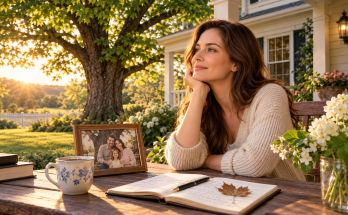
Two years after my father's death, I stopped checking the driveway for unfamiliar cars.
I stopped keeping the curtains closed.
I stopped sleeping with my phone beside my pillow.
I stopped wondering whether every knock at the door meant another secret had returned.
Life became ordinary.
At first, ordinary frightened me.
I had spent so long believing danger was hiding underneath everything that peace felt suspicious.
Then I learned to trust it.
The Hail Preservation Trust was gone.
The last properties had been sold, transferred, or returned where legally required.
The legitimate assets had been divided.
Creditors had been paid.
Former owners had received compensation where possible.
The foundation had received enough money to continue its work for years.
Nothing remained that could realistically become another family empire.
That had been intentional.
I kept the house.
Not because it was valuable.
Because it was home.
The maple tree remained too.
Mom insisted.
“I like it,” she said.
“You said it was too big.”
“It is too big.”
“You wanted it removed.”
“I changed my mind.”
I smiled.
“That sounds familiar.”
She pointed at me.
“Don't become sentimental.”
“I wouldn't dare.”
The foundation grew slowly.
Nora ran its legal program.
She helped people dealing with financial abuse, inheritance fraud, predatory contracts, and property disputes.
Sometimes I attended meetings.
Sometimes I didn't.
I had learned that helping people didn't mean taking responsibility for every problem in the world.
Samuel retired.
He sent me a letter on his final day of practice.
There was no legal language.
No hidden instructions.
Just congratulations.
He wrote that Walter had spent years preparing for the possibility that I would someday stand alone.
He had been wrong.
I hadn't stood alone.
I had built relationships that didn't depend on secrets.
That meant more to me than any inheritance.
Edward never came home permanently.
He occasionally sent photographs.
A mountain.
A lake.
A train station.
A small diner.
A handwritten note.
Never an address.
I stopped asking where he was.
The last photograph showed him sitting on a wooden bench overlooking a lake.
On the back, he had written:
Still alive.
Still learning.
That was enough.
William was even harder to trace.
The investigators never found anything that suggested he had returned to the old network.
He simply disappeared again.
Perhaps that was who he had always been.
A man who believed survival sometimes required becoming invisible.
I didn't resent him.
I didn't fully trust him either.
Both could be true.
Mom stayed with me.
She began telling stories about my father that had nothing to do with money.
She told me he once burned dinner because he was reading a book.
She told me he hated dancing but danced with her at their wedding.
She told me he used to sing badly when he thought nobody was listening.
She told me he cried when I was born.
Those stories were strangely precious.
For years, I had known my father through documents.
Now I was learning him through memories.
One evening, we sat beneath the maple tree.
The sun was going down.
Mom held a photograph.
It showed Walter holding me as a baby.
“I don't remember this,” I said.
“You wouldn't.”
“I look angry.”
“You were always angry.”
“I was a baby.”
“You were an opinionated baby.”
I laughed.
Then Mom became quiet.
“Do you forgive him?”
I knew exactly who she meant.
I looked at the tree.
“I don't know.”
She nodded.
“That's honest.”
“I don't think forgiveness means saying he was right.”
“No.”
“And I don't think anger means I stopped loving him.”
“No.”
“So maybe I don't have to choose.”
Mom smiled.
“You finally learned that.”
The words reminded me of the final line in my father's letter.
You owe yourself everything.
For a long time, I thought that meant freedom from him.
Now I understood it meant something more difficult.
It meant freedom from the need to define myself through him.
I wasn't Walter's daughter first.
I wasn't Mark's wife.
I wasn't the beneficiary of a trust.
I wasn't the owner of a collection of properties.
I wasn't the woman who survived a financial conspiracy.
I was Clare.
That was enough.
A few months later, the final legal case connected to the archive was closed.
Detective Ortiz called me.
“It's over.”
I smiled.
“Actually over?”
“Legally, yes.”
“What about the records?”
“They're preserved.”
“And the people?”
“The surviving witnesses have been contacted.”
“Then yes.”
I hung up.
That evening, I opened the box where I kept the few things I had chosen to save.
The photograph of the maple tree.
My father's final letter.
The picture of Edward and Walter as boys.
The photograph of me and my father beneath the tree.
And the silver key.
I turned it over in my hand.
Once, I would have believed every object contained a secret.
Now the key was simply a key.
I put it beside the photographs.
Then I closed the box.
I didn't lock it.
That felt important.
The next morning, I took the brass family seal to the museum where the historical documents had been preserved.
It was displayed beside the black ledger and copies of the original property records.
The plaque didn't glorify the Hail family.
It explained what had happened.
Fraud.
Concealment.
Property theft.
Complicity.
Fear.
Resistance.
Recovery.
The museum curator asked whether I wanted the family name emphasized.
“No.”
She looked surprised.
“What should it say?”
“The truth.”
She smiled.
“That may be the best title.”
I walked through the exhibit one final time.
The black ledger was behind glass.
The pages were open to the first entry that had led us toward the truth.
I remembered how frightened I had been when I first saw it.
I had thought the ledger contained my family's future.
It didn't.
It contained their past.
That distinction changed everything.
Outside the museum, the afternoon was bright.
People walked past me without knowing who I was.
A man hurried toward a bus.
A woman pushed a stroller.
Two teenagers argued about where to eat.
Nobody cared about the Hail family.
Nobody was watching me.
Nobody wanted my money.
Nobody wanted my father's secrets.
I stood there for a moment and realized how beautiful anonymity could be.
When I returned home, Mom was in the kitchen.
“What took you so long?”
“I went to the museum.”
“Why?”
“To see the seal.”
“And?”
“It looked smaller than I remembered.”
She laughed.
“Everything does once you stop being afraid of it.”
We ate dinner together.
Nothing dramatic happened.
No hidden message arrived.
No mysterious stranger appeared.
The phone didn't ring with another warning.
After dinner, I washed the dishes.
Mom dried them.
The ordinary rhythm of it felt almost sacred.
Later, I stepped outside.
The maple tree moved gently in the evening wind.
I placed my hand against its trunk.
There had been secrets beneath it.
Letters.
Documents.
Evidence.
Warnings.
But the tree had never been responsible for any of them.
It had simply grown.
Year after year.
Through storms.
Through drought.
Through winters.
Through everything my family had done.
And perhaps that was what I wanted for myself.
Not perfection.
Not control.
Not a carefully protected life.
Just the freedom to grow without carrying someone else's fear.
I went back inside.
Mom was sitting in the living room.
She looked at me.
“Are you happy?”
I thought about the question.
Once, I would have measured happiness in safety.
Then in money.
Then in certainty.
Now I measured it in smaller things.
A quiet house.
A shared meal.
A mother who was alive.
Friends I trusted.
Work that mattered.
A tree in the backyard.
A locked box I no longer needed to open.
“Yes,” I said.
Mom smiled.
“Good.”
I sat beside her.
For the first time, I didn't feel like I was waiting for the next chapter of my family's story.
There wasn't one.
The story had ended.
What came next belonged to me.
Mark had wanted my inheritance.
Bell had wanted my father's empire.
Diane had wanted security.
Edward had wanted justice.
My mother had wanted survival.
My father had wanted protection.
And I had spent years believing I had to choose between them.
I didn't.
I chose myself.
That was the inheritance no one had been able to steal.
Click here to continue reading: PART 25: THE LIFE AFTER:
Three Days After Dad’s Funeral, My Husband Made a Decision That Revealed How Long He Had Been Waiting for My Father to Die
Part 24 of 35