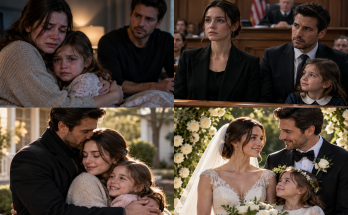
Milo took his first independent step three weeks before his birthday.
Julian missed it.
I sent him the video.
That mattered.
So did the fact that he missed it.
Both could remain true.
In the video, Milo stood beside my coffee table with one hand wrapped around the edge.
Lena sat on the floor behind him.
I was kneeling three feet away.
“Come here.”
Milo grinned.
He released the table.
One step.
A wobble.
Another step.
Then he collapsed into my arms.
My scream startled him.
He cried.
Lena laughed.
I cried too.
The entire clip lasted nineteen seconds.
Julian watched it from prison.
His reply arrived through the approved messaging system hours later.
I watched it twelve times. Tell him his father is proud of him.
I did.
Milo responded by chewing his sleeve.
Life rarely honors the emotional timing adults assign to it.
By his first birthday, his heart remained stable.
Surgery had not disappeared from the future.
Neither had uncertainty.
But we no longer treated every appointment as a doorway someone might use to take him.
Dr. Shah remained part of his care.
So did the cardiology team.
I had learned enough about medical records to be irritating.
I checked authorizations.
Asked who had access.
Requested copies.
Not because I believed everyone was dangerous.
Because informed consent had stopped being an abstract phrase.
It was one of the ways I loved my son.
We held Milo’s birthday at Claire’s house.
Not Sterling Vale.
Not Margaret’s estate.
Claire’s house.
That distinction had become important.
Elias helped decorate.
He insisted on dinosaur balloons despite Milo having no demonstrated interest in dinosaurs.
“He will.”
“You don’t know that.”
“I’m teaching him.”
Leo chose trains because Michael was coming.
The resulting decorations looked like a railway accident inside a prehistoric park.
Perfect.
Michael arrived with Laura.
He carried a wrapped box.
“Not whistle.”
“Thank God.”
He looked offended.
“Whistle good.”
“Milo disagreed.”
“Baby wrong.”
Inside the box was a wooden train with wheels large enough for small hands.
Milo immediately put one in his mouth.
Michael smiled.
“See?”
Laura laughed.
She no longer hovered around Michael.
Not as much.
She had learned to ask before helping.
Sometimes she forgot.
Michael reminded her.
Their relationship had not returned to what it might have been.
Nothing could.
They were creating something new.
Benjamin came next.
He brought one pan.
Not as a gift.
He had misunderstood Claire’s message about everyone bringing food and carried the entire pan from his apartment.
Inside were brownies.
Burned around the edges.
Caroline ate two.
Rebecca arrived with her.
Margaret came separately.
Invited.
That mattered too.
She stopped in the doorway when she saw everyone.
For decades she had imagined family gatherings as proof of order.
Correct names.
Correct marriages.
Correct heirs.
Correct photographs.
This room contained none of that order.
Michael, Thomas’s hidden son with Laura.
Benjamin, the twin declared dead.
Rebecca, Margaret’s daughter whose biological father was Daniel.
Elias, the grandson she had erased.
Milo, the child Daniel had tried to classify before birth.
Caroline, who had escaped.
Claire, who had refused to stay gaslit.
Me.
And Margaret.
No one arranged themselves to make the family tree look less complicated.
Good.
Eleanor arrived last.
She had initially declined.
Then Benjamin called her.
Apparently his argument was:
“Cake.”
It worked.
Eleanor stood face-to-face with Margaret for the first time.
They had spoken by video.
Never met in person.
Margaret looked at her.
“You have her eyes.”
“My mother?”
“My sister.”
Eleanor nodded.
“I have photographs.”
“I’d like to see them.”
“Maybe.”
Margaret smiled faintly.
“I’ve learned that word.”
Eleanor almost smiled back.
Progress.
Claire brought Elias downstairs.
He had changed shirts because frosting had somehow reached him before the cake was served.
Margaret noticed.
Said nothing.
A year earlier she might have corrected him.
Now Elias ran past her with one sock missing.
Civilization survived.
At noon, Claire received a call.
She stepped into the hallway.
When she returned, her eyes were wet.
Elias groaned.
“Mom.”
“Sorry.”
“What?”
Claire looked at me.
“St. Arden.”
My stomach tightened.
“Problem?”
She shook her head.
“No.”
The independent board had completed restructuring.
The old placement contracts linked to Haven were terminated.
St. Arden would continue operating, but families and residents received independent representation.
No Sterling-linked entity controlled it.
Elias listened.
“Can I still go?”
Claire smiled.
“Yes.”
“Good.”
That was his concern.
Not institutional reform.
His friends were there.
His history was there.
The place where he had been hidden was also a place where real people had cared for him.
We had learned not to flatten that contradiction.
Victor did not attend the party.
Neither did Nathan.
They had been invited separately.
Nathan chose not to come because he wanted distance from the Sterling family while rebuilding his relationship with his father.
Victor sent Michael a card.
Not Milo.
Michael.
It said:
I am glad you have your sister.
Michael kept it.
Victor’s legal consequences were complicated.
He had participated in harmful acts earlier.
He had also preserved records, blocked transfers, and ultimately helped expose Daniel.
Prosecutors declined several charges and reached an agreement requiring testimony, restitution assistance, and cooperation with the independent review.
Nathan still had not forgiven him.
Victor did not ask him to.
That seemed important.
Daniel was sentenced months after Julian.
Decades in prison.
The exact number mattered less to me than I expected.
Rebecca did not attend.
Neither did Eleanor.
Margaret did.
When asked why, she said:
“I wanted him to see that I would not hide what he did.”
Daniel looked at her during sentencing.
According to Rachel, he smiled once.
Not kindly.
Margaret did not react.
His story had finally stopped controlling hers.
Voss received prison time too.
His professional reputation disappeared faster than the system he helped create.
Medical boards reviewed old cases.
Several families reopened guardianships.
Civil suits multiplied.
Some would succeed.
Some would not.
No single verdict could clean decades of records.
The work continued without us at the center.
That was good.
The hidden people had never existed merely to complete our family story.
After lunch, Milo destroyed his cake.
There is no more precise description.
He put both hands into the frosting.
Squeezed.
Stared at his fingers.
Then slapped the tray.
Blue frosting landed on my shirt.
Elias cheered.
Michael laughed so hard he had to sit down.
Margaret got frosting on her sleeve.
For one terrifying second, everyone watched to see what she would do.
She looked at it.
Then at Milo.
“Was that necessary?”
Milo slapped the cake again.
Margaret laughed.
An actual laugh.
Not controlled.
Not polite.
Rebecca pointed at her.
“Meg messy.”
“Yes.”
Margaret looked at her sleeve.
“Apparently.”
Someone took a photograph.
Not an official photographer.
Claire.
The picture was crooked.
Benjamin’s eyes were closed.
Elias was moving.
Michael looked away.
Margaret had frosting on her sleeve.
Rebecca was laughing.
Milo was mostly cake.
It became my favorite photograph.
No one looked arranged.
No one had been removed.
After presents, Claire found me alone in the kitchen.
“You okay?”
“Yes.”
“You’re staring.”
I looked through the doorway.
At Elias and Leo arguing over a game.
At Michael showing Eleanor Milo’s train.
At Margaret listening while Rebecca explained something with both hands.
“Just thinking.”
“Dangerous.”
“I know.”
Claire leaned against the counter.
“Julian called this morning.”
I looked at her.
“He called Elias?”
“Yes.”
“How was it?”
“Awkward.”
“Good.”
She laughed.
“Elias told him he got Milo a dinosaur book.”
“Of course.”
“Then he told Julian he’s saving a brownie.”
“That seems unhygienic.”
“I’m not telling him.”
Julian had three months left if his release date held.
He had completed every required program available.
He wrote Elias once a week.
Not emotional essays.
Short letters.
A bad dinosaur fact.
A question about school.
Sometimes Elias answered.
Sometimes he did not.
Julian kept writing without demanding reciprocity.
He sent Milo letters too.
Those I saved.
Milo would decide later what they meant.
Claire asked:
“What are you going to do when he gets out?”
“I don’t know.”
“You still love him.”
I gave her a look.
“You’re annoyingly observant.”
“I’ve had practice.”
“Yes.”
I did love him.
That fact no longer frightened me.
Love had stopped being an instruction.
I could love Julian and refuse him.
Love him and try again.
Love him and wait.
Love did not decide custody.
It did not erase consent.
It did not cancel consequences.
It was simply one piece of information.
“What do you want?” Claire asked.
“For Milo to know his father safely.”
“That’s not what I asked.”
“I know.”
She waited.
I looked through the window.
The backyard was bright with late-afternoon sun.
“I want to meet whoever Julian is when he comes home.”
Claire nodded.
“Not the man from before?”
“No.”
“Not the man he promises to become?”
“No.”
“The actual one.”
“Yes.”
“That sounds reasonable.”
“Disappointing, isn’t it?”
“Terrible for storytelling.”
We laughed.
Then Elias yelled because Benjamin had eaten the brownie he claimed was for Julian.
Claire left to negotiate.
I stayed in the kitchen.
Margaret entered a moment later.
She stopped when she saw me.
“Can I speak with you?”
“You just did.”
A faint smile.
“I deserve that.”
“What?”
She held an envelope.
My body tightened automatically.
She noticed.
“It is not an agreement.”
“Good.”
“No conditions.”
“What is it?”
“A letter.”
“From you?”
“Yes.”
“To Milo?”
“To you.”
I did not take it immediately.
“What does it say?”
“Things I should have said without requiring you to read them.”
“Then say them.”
Margaret looked at me.
“I was prepared to help take your son from you.”
The kitchen became quiet.
“I told myself I was preparing options.”
She continued.
“I told myself Daniel was excessive, Voss was merely documenting risk, and Julian would eventually make the appropriate decision.”
Her mouth tightened.
“Those were lies I used because the truth was uglier.”
“What truth?”
“I believed I knew what kind of life was valuable.”
I said nothing.
“I believed money gave me better judgment.”
Still nothing.
“I believed disability was tragedy when the actual tragedy was what we did to people because we feared disability.”
She looked toward the living room.
Elias was laughing.
Michael was arguing with Benjamin about trains.
Rebecca was stealing frosting.
Margaret continued.
“I cannot apologize in a way that makes those choices smaller.”
“No.”
“I cannot give Claire eight years.”
“No.”
“Or Michael his childhood.”
“No.”
“Or Rebecca hers.”
“No.”
“Or you the pregnancy you should have been allowed to experience without surveillance.”
My throat tightened.
“No.”
Margaret placed the envelope on the counter.
“So I will not ask you to forgive me.”
“Good.”
She nodded.
“I wanted you to know that.”
Then she turned to leave.
“Margaret.”
She stopped.
“What are you doing with the estate?”
She looked back.
“Selling it.”
That surprised me.
“Why?”
“Too many rooms.”
“That never bothered you before.”
“No.”
A pause.
“Now it does.”
“What happens to the money?”
“Some goes to restitution. Some remains mine.”
I appreciated the honesty.
She was not pretending to renounce every comfort and become a saint.
“And where will you live?”
“A condominium.”
I almost laughed.
“You?”
“I have been told there is an elevator.”
“Terrifying.”
“Yes.”
She smiled.
Then left.
I read the letter later.
Not at the party.
At home.
It contained no revelation.
No secret ledger.
No hidden child.
Just an apology.
Specific.
Uncomfortable.
Without requests.
I put it in the same file where I kept Julian’s letters.
Not because they were equivalent.
Because both belonged to Milo’s history.
When he was old enough, he would receive truth.
Not a mythology.
Not villains simplified beyond recognition.
Not redeemed heroes.
People.
Choices.
Consequences.
The final legal order involving Milo came two weeks after his birthday.
Julian was confirmed as his biological father.
I retained primary physical custody.
Julian would receive structured parenting time after release, expanding only if consistent and safe.
No Sterling family trust could acquire guardianship authority over Milo.
No confidentiality provision.
No automatic succession arrangement.
No residential placement authority.
Rachel read the order twice.
Then smiled.
“He’s legally boring.”
I almost cried.
“Perfect.”
Milo Collins.
No D-nine.
No contingency.
No family classification.
A child.
That evening I called Julian.
He answered from the prison phone.
“How was the hearing?”
“Boring.”
“Rachel texted me that word.”
“It’s good.”
“I know.”
A pause.
“How’s Milo?”
“Sticky.”
“Specific cause?”
“Banana.”
“Serious.”
“Very.”
He laughed.
Then silence.
Not uncomfortable.
Just distance.
Three months still existed between us.
So did everything before it.
Julian finally said:
“Maya.”
“Yes?”
“When I get out, I don’t expect anything from you.”
“Good.”
“I mean it.”
“I know.”
“But I’d like to take you to coffee.”
I smiled despite myself.
“Coffee?”
“Yes.”
“That’s your grand plan?”
“I tried complicated plans.”
“They went badly.”
“Historically, yes.”
I looked at Milo asleep against my chest.
“Ask me when you get out.”
“Okay.”
“No reservations.”
“Okay.”
“No hotel bars.”
He laughed softly.
“Definitely not.”
“And Julian?”
“Yes?”
“If I say no?”
“Then I’ll see you at Milo’s next visit.”
There.
That was the answer.
Not I’ll convince you.
Not you’ll change your mind.
Not after everything I’ve done.
Then I’ll see you at Milo’s next visit.
Fatherhood separated from access to me.
Love separated from entitlement.
Maybe.
Enough.
After we hung up, I carried Milo to his crib.
The wooden train Michael had given him sat on the shelf.
Beside it was the dinosaur book Elias had chosen.
On the dresser was the crooked birthday photograph.
I looked at it again.
There were people missing.
Julian.
Nathan.
Victor.
People who had chosen not to come.
People who could not.
That did not make the picture incomplete.
For years, the Sterling family had tried to make photographs prove something.
Success.
Continuity.
Respectability.
Perfect heirs.
Our photograph proved nothing.
That was why I loved it.
Several months later, Julian came home.
I did not take Milo to the facility.
His attorney drove him.
Julian went first to Claire’s house because Elias had asked him to.
I learned later what happened.
Elias opened the door.
Julian stood outside carrying one duffel bag.
They stared at each other.
Then Elias said:
“You look weird.”
Julian laughed.
“I probably do.”
“You got my letters?”
“All of them.”
“I only sent four.”
“I know.”
“You sent lots.”
“I know.”
Elias looked at him.
“Come in.”
Julian did.
No embrace.
Not yet.
They spent two hours together.
When Julian left, Elias hugged him at the door.
Briefly.
Julian cried in his car.
He told me that part later.
Then he came to my apartment.
He arrived exactly on time.
No flowers.
No contract.
No envelope.
He knocked.
I opened the door.
For a second we simply looked at each other.
He was thinner.
His hair shorter.
His face familiar and changed in ways I could not name.
Milo stood holding the sofa.
Julian saw him.
Everything else disappeared from his expression.
“Hey.”
Milo stared.
Julian crouched.
He did not reach for him.
“Hi, buddy.”
Milo looked at me.
Then back at Julian.
He took three uneven steps.
Stopped.
Julian remained still.
Milo took another.
Then reached out and grabbed Julian’s nose.
Julian laughed and cried at the same time.
I looked away to give him whatever privacy was possible in my living room.
Later, after Milo fell asleep, Julian and I sat at the kitchen table.
Same table where we had discussed lawyers, threats, custody, prison.
He held a coffee mug.
“Can I ask now?”
I knew exactly what he meant.
“You can.”
“Coffee?”
I looked at his mug.
“This is coffee.”
“You know what I mean.”
“Yes.”
I studied him.
Not the man from the hotel bar.
Not the frightened son obeying Margaret.
Not the liar who signed Elias away.
Not the cooperating defendant.
Not the prisoner writing letters.
All of them.
And whoever came after.
“One coffee.”
Julian smiled.
“One.”
“No promises.”
“None.”
“No pretending this means forgiveness.”
“I understand.”
“No pretending we’re starting over.”
His smile faded into something more serious.
“We can’t.”
“No.”
“We start from here.”
I looked toward Milo’s room.
“From here.”
A week later, we went to a café in daylight.
Saturday.
Julian had once belonged to me only on carefully selected weekdays.
That old schedule seemed ridiculous now.
He arrived first.
No secret booth.
No false job description.
No wife he forgot to mention.
No mother supposedly dying somewhere.
He stood when I approached.
I sat.
We talked.
That was all.
Outside, people walked dogs.
A bus hissed at the curb.
Someone dropped a spoon.
Nothing dramatic happened.
I loved that.
Months passed.
Elias remained with Claire and Leo.
He continued visiting St. Arden because he wanted to.
He called Julian Dad more often.
Sometimes he refused Julian’s visits.
Julian respected that too.
Michael and I became siblings through repetition rather than revelation.
Phone calls.
Train museums.
Bad jokes.
Arguments about whether Milo liked trains.
Laura remained part of his life because he continued choosing her.
Benjamin helped other North Harbor residents obtain independent reviews.
Rebecca learned to take the city bus with support and became fiercely proud of paying her own fare.
Caroline stayed close without trying to manage everyone.
Eleanor testified until every page of the ledger had been accounted for.
Margaret moved into her condominium.
She hated the kitchen.
Loved the elevator.
Saw Rebecca when invited.
Saw Elias less often.
Accepted it.
Sterling Vale survived without the Sterling family controlling it.
No apocalypse followed.
The restitution process continued.
Some people found biological relatives.
Some refused contact.
Some changed their legal names back.
Others kept the names they had built lives under.
There was no single correct form of restoration.
That might have been the most important thing we learned.
One afternoon, almost two years after I first saw the positive pregnancy test, Milo fell asleep on the rug with his cheek against Michael’s wooden train.
Julian was sitting beside him.
We were not married.
We were not engaged.
We were trying.
Slowly.
Claire once asked whether I trusted him.
I said:
“More than before.”
She laughed.
“That’s romantic.”
“It’s accurate.”
Accuracy had become more valuable to me than romance.
Julian knew that.
He did not ask for more than I could honestly give.
Maybe someday trust would become ordinary.
Maybe some parts would always require attention.
Either way, Milo would not grow up inside a lie.
That was the promise I could actually make.
When he asked about his father, he would get the truth.
When he asked about Elias, Michael, Benjamin, Rebecca, Margaret, Daniel, Voss, and the ledger, the answers would be age-appropriate.
But they would not be false.
We would not tell him someone died because their existence complicated ours.
We would not call control protection.
We would not call silence love.
We would not confuse blood with ownership.
The last time I saw the original ledger, Rachel was preparing to transfer it into a protected archive.
She let me turn to D-nine.
Milo’s classification.
The page contained Daniel’s notes.
Transfer contingencies.
Medical references.
My name.
Julian’s initials blocking part of the plan.
A whole future other people had once intended to choose for my son.
I touched the edge of the paper.
Then closed the book.
Rachel asked:
“Do you want a copy?”
“No.”
“Sure?”
“Yes.”
I had enough records.
Milo did not need that page framed as the beginning of his story.
His story began before D-nine.
With a heartbeat.
With fear.
With me choosing him before I understood what choosing him would require.
The ledger was evidence.
Not identity.
Outside Rachel’s office, Julian waited with Milo.
Milo saw me and shouted:
“Mom!”
One word.
Ordinary.
Everything.
I picked him up.
Julian took my bag.
We walked toward the elevator.
No security team.
No black sedan.
No anonymous message waiting on my phone.
Just three people leaving a lawyer’s office.
Before the elevator doors closed, I looked back once.
Rachel’s assistant carried the ledger toward a locked records room.
For generations, that book had been used to decide who belonged.
Now it had one remaining purpose.
To prove what had been done.
Nothing more.
The doors closed.
Milo pressed the elevator button repeatedly.
Julian stopped his hand.
“One time, buddy.”
Milo protested.
I laughed.
Downstairs, sunlight came through the lobby windows.
Julian asked where we were going.
“Home.”
He looked at me.
“Yours?”
I shifted Milo on my hip.
“Ours for dinner.”
Julian smiled.
He did not ask what that meant tomorrow.
Neither did I.
Tomorrow would arrive without a file prepared for it.
No classification.
No predetermined arrangement.
No family committee deciding what our lives should look like.
We walked outside.
And for the first time since Julian Sterling entered my life, uncertainty did not feel like danger.
It felt like freedom.
The End
Read more original stories on Feel Every Story.
The Man Who Only Belonged to Me on Weekdays Had One Rule I Never Thought to Question
Part 35 of 35