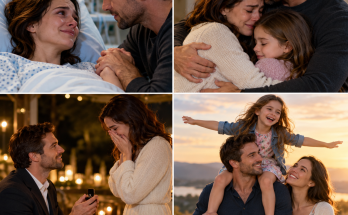
There were twelve people at our second wedding.
Margaret.
My brother.
Two close friends.
Three of Sarah’s coworkers.
Martinez and his daughter.
Reynolds, who had protested and then arrived early.
And us.
No photographers beyond phones.
No elaborate flowers.
No business associates nobody actually knew.
No strangers whose presence required explanation.
Sarah arrived exactly on time.
That alone made Martinez grin.
She wore a simple cream dress.
Nothing like the first wedding.
I wore a dark suit.
Also nothing like the first wedding.
When she saw me, she stopped.
For a second, her expression looked almost frightened.
I knew the feeling.
This was not fear of danger.
It was fear of meaning.
The clerk led us into a small ceremony room.
Wood-paneled walls.
Municipal carpet.
A window overlooking a parking lot.
Perfect.
The officiant asked whether we had written vows.
Sarah looked at me.
We had discussed this.
No.
Not because words were dangerous.
Because we had spent years talking.
We did not need performance.
The legal vows were enough.
Do you—
Yes.
Do you—
Yes.
Simple questions.
Informed answers.
When the rings came out, I looked at mine.
Gold from the first ring.
Mixed with new metal.
No hidden number.
No inscription.
Nothing inside except smooth surface.
Sarah slid it onto my finger.
Her hand trembled.
Mine did too.
The officiant smiled.
Then I put hers on.
For a brief second, I remembered the first wedding.
Flowers.
People.
Marcus somewhere unseen.
Sarah carrying secrets.
Me carrying none.
That memory did not disappear.
It stood beside the present.
The difference was choice.
I knew enough now.
Not everything.
Enough.
The officiant pronounced us married.
Margaret cried openly this time.
No denial.
Reynolds clapped.
Martinez leaned over and said something to him.
Later Reynolds told me it was:
“Hope he checked her license.”
Dinner at Margaret’s house was crowded and loud.
She insisted on hosting despite everyone’s objections.
Catered food.
No cooking.
Compromise.
The dining table where I once sat with Martinez’s note hidden in my pocket was covered in plates.
I noticed that immediately.
Sarah did too.
We exchanged a look.
No one else needed explanation.
At one point Margaret tapped her glass.
Sarah said, “Mom, no speech.”
Margaret ignored her.
Her voice remained slower after the stroke, but clear.
“I had two versions of this family.”
Everyone quieted.
“The first one looked normal and wasn’t.”
Sarah lowered her eyes.
Margaret continued.
“The second looks strange to everybody and is more honest.”
I felt Sarah’s hand find mine beneath the table.
Margaret smiled.
“That is all.”
It was the shortest wedding speech I had ever heard.
Also the best.
After dinner, Reynolds handed me an envelope.
I stared at him.
“Absolutely not.”
He laughed.
“It’s not evidence.”
“Open it yourself.”
He did.
Inside was a photocopy of his retirement identification and a note:
FOR ONCE, NOTHING URGENT.
I laughed.
Then he became serious.
“You know the original case file is finally being archived.”
“Good.”
“Route 35 stop included.”
“Everything.”
“Everything legally retained.”
I thought of the note.
The destroyed pieces.
The contractor card now gone.
“Does that bother you?”
“No.”
“You sure?”
“Yes.”
For years, records had seemed dangerous because other people used them to define reality.
Now the archive was simply record.
It did not own us.
Martinez joined us.
“I still say I should’ve written the speeding ticket.”
Sarah handed him a small envelope.
He looked suspicious.
“What’s this?”
“A check.”
“For?”
“Traffic safety charity.”
He opened it.
Seventy-eight dollars.
Martinez stared.
Then laughed harder than I had ever seen him laugh.
“Very funny.”
Sarah smiled.
“I owed somebody.”
“Technically the state.”
“This is better.”
He hugged her.
The gesture surprised both of them.
Later, after everyone left, Sarah and I helped Margaret clean.
She complained that newlyweds should not be washing dishes.
I reminded her we were middle-aged and had both washed plenty.
She told us to go.
We obeyed.
Outside, the rain had stopped.
The air smelled clean.
Sarah stood beside my car.
“You driving?”
“Yes.”
“Probably wise.”
“You still have a record.”
“Technically no moving violations from that day.”
“Martinez was generous.”
“He changed our lives.”
“Yes.”
We drove home.
Not to my apartment anymore.
Our apartment.
That word had taken time.
We had moved to a new place after deciding neither old apartment should become the default.
Neutral ground.
Two bedrooms.
Large windows.
No basement.
Sarah considered that last feature a joke.
I considered it due diligence.
At home, we changed clothes.
Put the wedding certificate on the kitchen counter.
Sarah stared at it.
“You okay?”
“Yes.”
“You?”
“Yes.”
“Any urge to flee to Canada?”
“Moderate.”
I laughed.
She smiled.
Then became quiet.
“David.”
“Yes?”
“There’s something I want to ask.”
The old reaction tried to rise.
Something else.
Another hidden fact.
Another layer.
I caught it before it took over.
“Ask.”
“Do you ever wish Martinez had never pulled us over?”
I thought.
There were years when the answer would have been complicated by fantasy.
If Martinez had not stopped us, maybe Sarah and I could have lived longer inside the illusion.
Maybe Marcus would not have accelerated.
Maybe police would have missed their window.
Maybe Montreal.
Maybe death.
Maybe escape.
Maybe eventual truth under worse circumstances.
But alternate histories do not become kinder because we cannot test them.
“No.”
Sarah looked surprised.
“Never?”
“I wish none of the things that made the stop necessary had happened.”
“Yes.”
“But once they had?”
I looked at her.
“I’m glad he pulled us over.”
Sarah nodded.
“Me too.”
“Do you wish he had told me more?”
“No.”
“Really?”
“If he had, I might have panicked.”
“You did anyway.”
“Later.”
I smiled.
Then she asked:
“Do you remember exactly what the note said?”
“Yes.”
“She isn’t who she says she is.”
“Yes.”
“That was true.”
“Yes.”
Sarah looked down at her new ring.
“Is it still?”
I understood what she was asking.
Not whether she was secretly laundering money.
Whether people ever fully become who they claim.
Whether the current Sarah was another constructed identity.
I considered giving reassurance.
Instead I gave truth.
“I think everyone is partly not who they say they are.”
She looked at me.
“That’s bleak.”
“No.”
I sat beside her.
“I think who we say we are is often what we’re trying to become.”
Sarah listened.
“You said you were a pharmaceutical marketer.”
“That was definitely a lie.”
“Yes.”
“You said you loved me.”
“I did.”
“You also used me.”
“Yes.”
“You said you wanted out.”
“Yes.”
“You also stayed for years.”
“Yes.”
“You said you wanted to protect me.”
“Yes.”
“You also endangered me.”
“Yes.”
“All true.”
Sarah nodded.
“So who are you?”
She thought for a long time.
“Someone trying not to make the next lie.”
I smiled.
“That sounds good enough.”
“What about you?”
“I’m still the boring husband.”
“Not boring.”
“Painfully, according to Ward.”
Sarah laughed.
“Good.”
We went to bed.
No special hotel.
No secret honeymoon.
We planned a trip months later after Sarah’s passport was fully regularized.
For the wedding night, home was enough.
At 2:06 a.m., I woke.
Sarah was beside me.
For once, that did not surprise me.
I lay there listening to her breathe.
Then realized I was thinking about Marcus.
Not with fear.
Almost with distance.
He had believed people did not change.
Only priorities revealed themselves.
There was truth in the second half.
Repeated choices do reveal priorities.
But he was wrong about the first.
People change precisely because repeated choices reshape them.
Sarah had changed by telling truths earlier.
By asking permission.
By staying when discomfort did not offer profit.
By accepting consequences without disappearing.
I had changed too.
I stopped treating uncertainty as emergency.
Stopped believing answers were always safer than ambiguity.
Stopped confusing vigilance with wisdom.
Stopped making Sarah prove every ordinary thing.
None of that happened in one redemptive moment.
It happened through hundreds of smaller decisions.
That morning, after breakfast, Sarah found the old framed legal page in the hallway.
FINAL BENEFICIAL OWNERSHIP STATUS.
NONE.
“You’re keeping this?”
“Absolutely.”
“It’s ugly.”
“It brings me joy.”
She laughed.
Then she brought out something from a drawer.
The Route 35 letter.
The one she had written at Margaret’s house.
If I tell you we need to leave, please trust me long enough to come with me.
I had kept it for years.
“What do you want to do with it?” she asked.
“I don’t know.”
“Burn it?”
“No.”
“Keep it?”
“Maybe.”
She unfolded it.
Read the line she had crossed out.
I love you enough to disappear.
Then the replacement.
I love you enough to want you safe, even if you hate me when this is over.
Sarah looked at me.
“I had it backward.”
“Yes.”
“Love isn’t disappearing.”
“No.”
“Or deciding what’s safe for someone.”
“No.”
“What is it?”
“That sounds like a trap.”
She smiled.
“Answer anyway.”
I thought of everything.
Route 35.
Martinez.
The note.
Reynolds.
The diner.
Cover.
The fake Denver trip.
Marcus at our wedding.
The cemetery.
Harbor.
Ward.
Ross.
Margaret.
Prison.
The market.
The second wedding.
Then I thought of toast at two in the morning.
A canceled dinner explained honestly.
Sarah telling me she was angry but not gone.
Her asking before touching parts of my life that once belonged automatically to her.
My telling her when fear returned instead of turning it into accusation.
“Enough truth for the other person to choose.”
Sarah’s eyes filled.
She nodded.
“That’s better.”
“Less poetic.”
“Much.”
We kept the letter.
Not framed.
Not hidden.
It went into a normal file box with tax records and warranty papers.
That seemed right.
Years passed.
Not many.
Enough.
Margaret eventually moved into assisted living by her own decision.
Sarah asked only twice if she was sure.
Progress.
Reynolds disappeared into retirement properly.
Martinez sent us a Christmas card every year.
The first said:
SPEED LIMITS SAVE MARRIAGES.
Sarah framed that one.
The scholarship bearing my father’s name helped students I never met.
No speeches.
No public story.
North Creek continued its work.
Harbor became something younger investigators knew only as an old case file.
The world moved.
One afternoon, years after the second wedding, Sarah and I drove Route 35 again.
Not deliberately.
Construction diverted us.
I recognized the stretch before she did.
Then she looked out.
“Oh.”
“Yeah.”
Neither of us asked to stop.
There was no need.
We drove past the shoulder.
Cars behind us.
Cars ahead.
Sarah’s hand rested near the console.
I reached over.
She took mine.
No revelation.
No warning.
No note.
The place that once divided my life into before and after became simply a mile of road behind us.
Sarah checked the speedometer.
Sixty-four.
“Look at that,” she said.
“Personal growth.”
“Don’t get excited.”
I smiled.
Then something occurred to me.
“What?”
she asked.
“I never told you one thing.”
Sarah turned.
“That sentence is unacceptable.”
I laughed.
“Not a secret.”
“What?”
“The morning after Martinez gave me the note, when you left your mother’s house for the fake client meeting…”
“Yes.”
“I almost followed you.”
Her expression changed.
“You did?”
“No. Almost.”
“Why didn’t you?”
“I didn’t know what I was doing.”
“Good instinct.”
“I thought it was cowardice.”
“It wasn’t.”
“Maybe.”
“If you followed me, Marcus might have seen.”
“I know now.”
Sarah squeezed my hand.
“So Reynolds was right.”
“About what?”
“Sometimes survival is a low bar.”
I laughed.
“Unfortunately.”
We continued driving.
A few miles later, Sarah said:
“You know what I’m glad about?”
“What?”
“You lied about the roofer.”
“That was a terrible lie.”
“It worked.”
“For ten minutes.”
“Long enough.”
“Daniel Mercer.”
“Marcus must have hated that.”
“What?”
“That his own alias became the reason I didn’t realize you knew.”
I had never thought of that.
Marcus’s business card had saved my first lie from Sarah.
One small accident inside all his planning.
I smiled.
“He would hate it.”
“Good.”
The highway opened ahead.
No police lights behind us.
No hidden route.
No destination we could not name.
Sarah asked:
“Where are we going again?”
“Your mother’s.”
“Right.”
“For dinner.”
“Right.”
“You invited Reynolds?”
“No.”
“Martinez?”
“No.”
“Any international money launderers?”
“I’m trying to cut back.”
“Good.”
We laughed.
That was the end of it.
Not because every consequence disappeared.
Not because Sarah became innocent.
Not because I forgot.
Not because love proved stronger than crime or fear or betrayal.
The truth was less dramatic.
Sarah did terrible things.
She lied to me.
Used me.
Put me in danger.
She also loved me.
Tried too late to protect me.
Accepted prison.
Helped expose the network.
Stopped running.
Learned to tell truth before being cornered.
I was deceived.
I was angry.
I stayed away.
I came back slowly.
I never recovered the years I had lost to false assumptions.
I did recover my ability to choose what happened afterward.
That was enough.
When Officer Martinez pulled us over all those years ago, I thought he was interrupting an ordinary drive.
He was not.
The ordinary life had already been interrupted.
I simply did not know it yet.
The note in my hand did not destroy my marriage.
It revealed the part of it Sarah had hidden.
Everything that followed came from what we did after the revealing.
Sarah lost twelve years of freedom, then regained some through cooperation.
Marcus lost his entire architecture of control.
Ward lost the empire she believed secrecy could preserve.
Ross lost the career he compromised one rationalization at a time.
Harbor disappeared.
The money went where courts decided.
The evidence remained.
The ring changed form.
And me?
I stopped believing safety meant knowing everything.
No one knows everything.
Safety, when it finally came, looked much simpler.
A wife who said where she was going.
A husband who admitted when he was afraid.
Separate choices made in the open.
A door neither of us had to lock from the inside.
Sarah squeezed my hand again as the road curved toward Margaret’s town.
“David.”
“Yes?”
“You’re speeding.”
I looked.
Sixty-eight in a sixty-five.
I laughed and eased off the gas.
“Better?”
“Yes.”
“You nervous?”
Sarah looked at me.
Then out at the open road.
“No.”
Neither was I.
The End
Read more original stories on Feel Every Story.