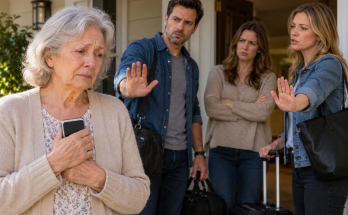
The first time I understood that my children might be happier without hearing from me, I was standing in my kitchen with a pot of soup cooling on the stove and my phone pressed against my ear.
Jessica was doing most of the talking. She had always been good at that. Even as a girl, she could turn a complaint into something that sounded almost reasonable.
“Mom, you call every day.”
“I don't call every day.”
“You called me Monday, Tuesday, Thursday, and this morning.”
It was Friday.
I stared at the steam fogging the window above the sink. Outside, the last leaves were skittering across the stone patio Robert and I had laid twenty-three years earlier.
“I wanted to know how the children were.”
“They're fine.”
“I know they're fine. I wanted to hear about them.”
Jessica exhaled. Somewhere beside her, I heard another voice.
Brandon.
That made me straighten.
“Am I on speaker?”
There was a pause long enough to answer the question.
Then Brandon said, “Mom, nobody's trying to hurt you.”
Whenever someone begins a sentence that way, I have learned to pay attention.
Jessica continued before I could respond.
“We're saying you need to stop calling us so much. We have our own lives.”
The words were not shouted.
That made them worse.
They had been discussed beforehand.
I could hear Chloe faintly in the background, which meant all three of my children were there. Whether physically together or joined on some conference call, I didn't know.
I lowered myself into the chair beside the breakfast table.
“So all three of you feel this way?”
Silence.
Then Chloe said quietly, “Maybe everybody just needs a little space.”
That was Chloe's way. Jessica delivered the verdict. Brandon enforced it. Chloe softened the language afterward and hoped softness absolved her from having agreed.
I looked toward the framed photograph on the counter.
Robert stood in the middle of us, his silver hair blown crooked by the wind, laughing because our youngest grandson had dumped half a cup of lemonade down his shirt. I remembered the exact afternoon. I remembered thinking that if happiness could be preserved, I would have kept that hour in a jar.
Robert had been dead eighteen months.
The house had become quieter afterward, but until that Friday I had not realized how much of the remaining noise I had been creating myself.
Birthday reminders. Sunday invitations. Photos of the garden. Calls to ask whether a grandchild's fever had broken. Messages telling Brandon that a storm was moving toward his neighborhood. Questions Jessica considered unnecessary. Invitations Chloe answered three days late.
Perhaps I had been trying too hard.
“All right,” I said.
Jessica sounded startled. “All right?”
“You've asked me to stop calling so often. I'll respect that.”
“Mom, don't make it dramatic.”
“I haven't.”
“You sound upset.”
“I am upset.”
Another pause.
I heard Brandon mutter something I couldn't make out.
Then Jessica said, “We aren't saying never call.”
“What are you saying?”
“That we need room.”
I ran my thumb along a scratch Robert had left in the wooden table while repairing a lamp.
“I understand.”
We ended the call without anyone saying they loved me.
For the first week, I kept reaching for my phone.
That habit surprised me more than their silence did.
I would see a recipe Chloe might like and think of sending it. A photograph of Jessica's eldest appeared on the school website after a science competition, and my finger hovered over her contact. Brandon's city had freezing rain one evening, and I nearly called to warn him.
Each time, I stopped.
They had asked for room.
I gave it to them.
Seven days became fourteen.
Fourteen became thirty.
Not one of them called.
There were no messages asking whether I was all right. No invitation to Sunday lunch. No photograph from a soccer game. No grandchild pushed onto a video call to tell me about school.
I began noticing something uncomfortable.
For years, I had believed we were maintaining a relationship.
In reality, I had been maintaining contact.
Those were not the same thing.
My phone became an object again instead of a little machine through which I measured whether my children still needed me.
I joined Margaret Hale for lunch after repeatedly refusing her invitations.
I went back to the botanical garden where Robert and I had once volunteered.
I had the piano tuned.
One Tuesday afternoon, I opened the lid, placed my fingers on the keys, and discovered I could still play the opening of a Chopin nocturne Robert used to request when he was reading.
The notes were uneven.
I played anyway.
Then, in the seventh week, something happened that should have frightened me more than it did.
I collapsed.
I had been carrying a laundry basket down the upstairs hallway when a crushing pressure spread beneath my ribs. The basket slipped from my hands. Towels tumbled across the floor.
I remember reaching for the banister.
Then nothing.
When I opened my eyes, I was in a hospital.
Margaret sat beside the bed wearing the same navy sweater she had worn at lunch the previous afternoon.
“You scared ten years off my life,” she said.
Apparently I had missed our morning walk. She called twice, drove over, and found me conscious but confused on the hallway floor.
The doctors eventually decided the episode was not a heart attack. Dehydration, an irregular heartbeat, and medication interactions had probably combined to cause the collapse.
I spent two nights under observation.
On the second evening, I looked at the empty chair beside my bed.
I had not called Jessica.
I had not called Brandon.
I had not called Chloe.
And none of them knew.
That realization should have made me reach for the phone.
Instead, I remembered their request.
Space.
Margaret noticed where I was looking.
“Want me to contact them?”
I turned toward the dark window.
“No.”
“Eleanor.”
“They asked me not to keep inserting myself into their lives.”
“This is different.”
“Is it?”
She had no answer that could make the situation less painful.
When I returned home, I made two decisions.
The first was simple.
I would stop waiting for people who had told me plainly that they wanted less of me.
The second concerned something Robert had spent forty years building.
Our estate.
Robert had been an obsessive planner. He had accumulated properties, investments, retirement accounts, and a trust large enough that I had always found the numbers faintly embarrassing.
After he died, I barely touched any of it.
David Vance, our longtime financial attorney, continued managing the structure Robert had established. Whenever he mentioned estate revisions, I waved him away.
“The children will sort it out when I'm gone.”
That sentence had once sounded practical.
After the hospital, it sounded dangerous.
I contacted Thomas Mercer, an attorney Robert had trusted independently of David.
Thomas came to the house on a gray Thursday afternoon carrying a legal pad and no assumptions.
I told him about the hospital.
Then I told him about my children.
He listened without interrupting.
When I finished, he removed his glasses.
“What do you want?”
“I want to know exactly what happens if I become incapacitated tomorrow.”
He hesitated.
“That depends on documents I haven't reviewed.”
“Then review them.”
“And the trust?”
“Everything.”
Thomas studied me for a moment.
“Eleanor, is there a reason you're worried someone might attempt to control your finances?”
I thought about Jessica's increasingly frequent questions after Robert's death.
Had Dad ever discussed selling the house?
Was the trust still with David's firm?
Did I really need this much property?
Brandon had asked for account statements twice, claiming he wanted to “help simplify things.”
Chloe once wanted photographs of documents from Robert's office because, she said, Jessica needed them for “family records.”
At the time, none of those moments had seemed important enough to connect.
Now they did.
“I don't know,” I said.
Thomas closed his notebook.
“Then until we do know, don't sign anything anyone puts in front of you.”
That evening, I changed the access code to the front gate.
I told myself it was routine security.
Two days later, I changed the alarm code.
Then the locks.
I hired a private security company to monitor the property during the holidays because I planned to travel briefly with Margaret.
The strange thing was that my children still did not call.
Thanksgiving passed.
Nothing.
My birthday passed.
Jessica sent flowers ordered through an app.
There was no personal note.
Brandon sent a text at 11:42 that night.
Happy birthday Mom. Crazy day. Hope it was good.
Chloe sent nothing until the following morning.
Sorry. Thought your birthday was today.
I stared at that message for a long time.
Then I put the phone facedown.
Three months after they asked for space, I finally understood what they had actually given me.
Information.
They had shown me what happened when I stopped carrying the entire relationship.
There was almost nothing left.
And then, six days before Christmas, Thomas called.
His voice was different.
Careful.
“Eleanor, have any of your children asked you to sign documents recently?”
“No.”
“Have they mentioned your house?”
“Not lately.”
“Your medical care?”
“No.”
He went quiet.
“What did you find?”
“I don't want to discuss this by telephone.”
My hand tightened around the receiver.
“Thomas.”
“Do not sign anything,” he said. “Not from your children. Not from David. Not from anyone until I have reviewed it.”
“What did you find?”
“I'll explain when I have everything verified.”
The line went dead a few minutes later.
I remained in the kitchen listening to the refrigerator hum.
For the first time, my children's silence no longer felt like neglect.
It felt like cover.
Click here to continue reading: PART 2: A Lawyer’s Warning Made Three Months of Silence Look Less Like Distance and More Like Preparation
Three Months After My Children Asked for Space, Their Silence Taught Me Something Their Words Never Could
Part 1 of 35