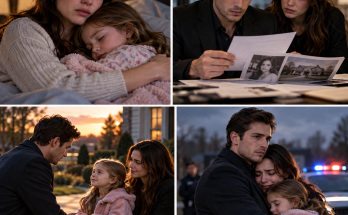
The morning after Richard’s funeral, I was still finding traces of him everywhere when the doorbell rang. His reading glasses rested beside the armchair. A half-finished chess game remained on the table near the window. One black knight stood between two of Emily’s white pawns, exactly where Richard had left it three nights before he died.
I nearly ignored the bell. Emily had finally fallen asleep upstairs after crying until dawn, and I had no strength left for condolences, casseroles, flowers, or people telling me that Richard had lived a long life as though seventy-seven years somehow made losing him painless.
The bell rang again.
When I opened the door, Richard’s estate lawyer stood on the porch with a leather briefcase in one hand. I recognized him from several formal dinners, though I had never spoken to him for more than a minute at a time.
“Mrs. Whitmore,” he said. “May I come in?”
Something about his expression tightened my stomach.
I stepped aside.
He followed me into the sitting room, glanced at Richard’s empty chair, and stopped. For an instant, the professional mask slipped from his face. He had known Richard for decades. Perhaps he was grieving too.
“Would you like coffee?” I asked automatically.
“No, thank you.”
That answer bothered me more than it should have. Everyone who came into this house drank coffee. Richard had made it almost a ritual.
I sat opposite the lawyer. “What happened?”
“Nothing happened.”
“Then why are you here the morning after I buried my husband?”
He lowered his briefcase to the floor. “Because Richard gave me instructions about when I was to speak with you.”
The room seemed suddenly too quiet.
Five years earlier, I would have laughed if someone had told me that Richard Whitmore would become my husband. He was seventy-two when we met. I was thirty-five, widowed, exhausted, and trying to keep my young daughter fed while unpaid bills accumulated faster than I could open them.
I had grown up in foster care. By adulthood, I knew how to pack a life into two bags and leave before anyone had the chance to tell me I was no longer welcome.
My first husband had understood that instinct because he had grown up without a stable family too. We had met young, when neither of us possessed much besides stubbornness and plans.
We built a modest life. He worked with engines. I took whatever jobs paid regularly. Our apartment had thin walls and unreliable heating, but when Emily was born, it felt richer to me than any mansion could have.
Then cancer arrived.
For almost a year, our lives became hospital corridors, medication schedules, insurance forms, whispered conversations with doctors, and desperate calculations at the kitchen table.
My husband died before Emily was old enough to remember his voice.
Grief did not stop the bills.
Within months, I owed money for treatment, rent, utilities, and expenses I barely understood. I worked whenever someone would hire me. Eventually I found a housekeeping position at Richard’s estate.
He was wealthy enough that his house seemed absurd to me at first. Rooms stood unused for weeks. Paintings probably cost more than every possession I owned. Yet Richard himself ate toast over the kitchen sink and complained that expensive coffee tasted burned.
He never treated me like furniture.
When Emily became ill and I arrived late one morning after spending hours at a clinic, Richard noticed immediately.
“Your daughter?” he asked.
I nodded.
“Is she all right?”
“She will be.”
He studied me long enough to know I was lying.
A week later, my landlord gave me notice. I was behind again. I pleaded for another month, then two weeks, then anything.
He refused.
I remember standing in my tiny kitchen afterward with the notice in my hand while Emily slept in the next room. The refrigerator hummed. Rain tapped against the window. I had less than forty dollars until payday.
I had survived being unwanted as a child.
What terrified me was the possibility that my daughter would learn the same fear.
Richard proposed three days later.
There was no orchestra, candlelight, or elaborate speech. I had placed his tea beside him when he asked me to sit down.
He looked unusually nervous.
“I know what this will sound like,” he said. “And I know the difference in our ages makes it stranger.”
I stared at him.
“Anna, marry me.”
I actually thought I had misheard him.
He did not smile.
“You and Emily would live here. You would never have to worry about losing a home again.”
Those words struck the weakest place in me.
I wanted to believe I considered the proposal carefully. The truth was uglier. I thought about the eviction notice. Emily’s medicine. The medical debt. The possibility of sleeping in my car with a child.
Richard was offering a locked door that nobody could order us through.
I said yes.
For months afterward, I waited for him to reveal the price.
He never did.
Richard gave me my own room until I chose otherwise. He never demanded gratitude. He never asked Emily to call him Dad. Instead, he became the man who cut her toast into triangles, taught her chess, and carried a blanket into the garden when she insisted on watching fireflies after bedtime.
Our marriage changed gradually.
I stopped thinking of the house as Richard’s.
Then I stopped thinking of him as my employer.
Eventually I stopped remembering, every morning, why I had originally said yes.
Five years passed.
His body weakened. His mind remained sharp.
When walking became difficult, I pushed his wheelchair along the garden paths. When his hands trembled, I buttoned his shirts. When he woke frightened in the night, I sat beside him until his breathing settled.
On his final evening, he asked me to open the curtains.
Snow had begun falling outside.
“Emily asleep?” he asked.
“Yes.”
“She cheats at chess.”
“She learned from you.”
That made him laugh.
He reached for my hand.
There was something he wanted to say. I could see it in his face.
Instead, he squeezed my fingers.
“I’m glad you stayed, Annie.”
He died before sunrise.
Now his lawyer sat across from me less than forty-eight hours later.
He folded his hands.
“There is something you should know about Richard’s will.”
My throat tightened. “What?”
“You receive nothing from his primary estate.”
For a moment, I thought grief had distorted the sentence.
“Nothing?”
“Nothing directly.”
I looked around the room.
“What about the house?”
He did not answer.
My pulse accelerated.
“Richard told me Emily and I would always have a home.”
“I know.”
“Then what are you telling me?”
The lawyer exhaled.
“Richard expected you to marry him.”
I frowned. “Of course he did. He proposed.”
“That isn’t what I mean.”
His next words landed harder.
“He knew the circumstances would make it almost impossible for you to refuse.”
I stood so quickly my knee struck the table.
“You think I married him for money?”
“No.”
“You just said—”
“I said Richard understood how desperate your circumstances were.”
The shame I had carried five years earlier came rushing back. The overdue rent. The pharmacy receipt. My daughter coughing beneath a borrowed blanket. Me accepting a marriage proposal from a man thirty-seven years older because I was afraid.
“Did he think I used him?”
“No.”
“Then why leave us nothing?”
The lawyer reached for his briefcase.
“There are two different questions here, Mrs. Whitmore.”
“What questions?”
“Why did you marry Richard?”
I stared at him.
“And why,” he continued, “did Richard marry you?”
My anger faltered.
“I know why.”
“Do you?”
He opened the briefcase.
From inside, he removed a thick brown envelope.
Richard’s handwriting was on the front.
ANNA.
I recognized the slope of the A immediately.
My knees weakened.
The lawyer placed the envelope between us.
“Your husband instructed me to give you this only after his funeral.”
I touched the edge but did not pick it up.
“What’s inside?”
“Something he spent years preparing you to discover.”
I looked at him.
“Preparing me?”
The lawyer’s expression became grave.
“You believed meeting Richard was an accident.”
A chill moved over my skin.
“It wasn’t?”
He pushed the envelope toward me.
“No.”
I stared at my name in Richard’s handwriting.
For the first time since his death, grief gave way to something colder.
Because if meeting Richard had not been an accident, then the most important five years of my life had begun with a secret.
And Richard had taken that secret to his grave.
Click here to continue reading: PART 2: Richard’s Last Letter Told Me Not to Leave the House, Then Revealed He Had Known Who I Was Before We Met
The Morning After Richard’s Funeral, His Lawyer Said One Sentence That Made Our Five-Year Marriage Feel Like a Lie
Part 1 of 35