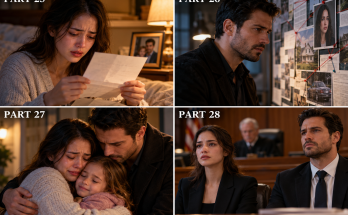
Emily read the first paragraph twice.
Then she handed the letter to me.
Her hands were shaking.
I continued aloud.
Daniel wrote that he had spent the final years of his life trying to distinguish discovery from restitution.
They were not the same.
Finding facts did not repair people.
Documenting wrongdoing did not automatically make the investigator righteous.
Emily closed her eyes.
Her father knew.
At least near the end, he understood his own contradictions.
The letter continued.
He apologized to Emily for making her childhood identity into an investigation.
He apologized for giving her truths before she had language for them.
He apologized for later withholding other truths because he had become afraid of repeating the first mistake.
“I wish he’d told me that while he was alive,” Emily whispered.
“Yes.”
Dead people had an unfair advantage.
They could finally become articulate when no one could answer back.
Daniel addressed me next.
Susan, I participated in decisions concerning your medical history without your informed permission.
My throat tightened.
He described the 2008 genetic testing.
He had justified it as necessary to evaluate hereditary danger.
He still believed the medical concern had been legitimate.
He no longer believed that legitimacy excused bypassing me once I regained capacity.
“He knew that too,” Michael said.
“Yes.”
Daniel wrote that he had intended to tell me after discharge.
Margaret stopped him.
Then Charles asked him to wait.
Then Michael’s silence convinced Daniel the family had chosen not to reopen the subject.
I looked at Michael.
His face tightened.
“That wasn’t their choice to make,” he said.
“No.”
Daniel knew that now.
The letter said so.
Then came a sentence that made me stop.
The most consequential lie was not Leonard’s.
I looked at Emily.
“What could that mean?”
“Keep reading.”
Daniel wrote:
Leonard’s violations explain what happened to Susan’s reproductive material. They do not explain why Margaret believed she possessed the moral authority to direct Susan’s reproductive life.
I read more slowly.
To understand that, you must understand what Margaret believed about Susan’s birth.
My pulse changed.
Thomas had told me Margaret used his sperm to conceive me.
Charles learned after she was pregnant.
But Daniel had found another layer.
Margaret had spent most of my life claiming privately that Charles had approved Thomas as donor.
Thomas believed she had told him Charles consented.
Charles told Daniel he had authorized Thomas only for evaluation, never actual insemination.
So far, that matched Vale’s recording.
Then Daniel found the original insemination consent.
Only one patient signature appeared.
Margaret’s.
No spouse authorization.
No donor-recipient disclosure.
No Charles.
No Thomas.
The doctor who performed the insemination was not Vale.
It was an older physician who died before my fertility treatment began.
Vale later inherited the records.
Emily whispered, “So Margaret started the pattern.”
I stared at the paper.
“Yes.”
Before Vale used me.
Before Charles funded anything dangerous.
Before Thomas stayed silent.
My mother had already decided that wanting a child gave her authority over everyone else involved.
Daniel continued.
Margaret later told Charles the insemination had occurred because of a scheduling misunderstanding.
That was false.
She had deliberately timed it while he was traveling.
When she became pregnant, she presented the pregnancy as a fact he could either accept or destroy the marriage over.
Charles stayed.
My chest hurt.
I imagined the man who raised me learning his wife had conceived using another man’s sperm without his knowledge.
Then deciding the unborn child was still his daughter.
He had failed me later.
Terribly.
But he had also made that choice.
I had been loved inside a deception.
Both facts could coexist.
Daniel’s letter explained Margaret’s obsession with genetic continuity.
She had spent decades defending her first decision.
If my life was good, she could tell herself the method had been justified.
When Michael and I struggled with infertility, she saw history repeating.
And she repeated her solution.
Thomas again.
Secretly.
“She was proving herself right,” I whispered.
Emily nodded.
“Through you.”
That was the last lie.
My mother had not simply wanted a Lawson-looking grandchild.
She wanted evidence that her original violation had produced something valuable enough to justify itself.
Me.
Then Jake.
Generations turned into arguments for previous choices.
I felt suddenly exhausted.
Not angry.
Not even surprised.
Just tired.
Daniel wrote that Charles eventually understood this.
It explained why he funded Daniel’s later investigation.
Not only guilt over Vale.
Guilt over allowing Margaret’s logic to govern the family.
He had stayed after my conception because he loved Margaret and wanted me.
But by staying silent, he allowed her to interpret acceptance as approval.
Years later, when she proposed Thomas as donor for my treatment, Charles agreed to the donor evaluation.
He did not know she and Vale had already decided to use Thomas regardless of what Michael or I understood.
That distinction did not make Charles innocent.
He still concealed Jake’s biological parentage after discovering it.
He still protected the clinic too long.
But it clarified the sequence.
Daniel’s next pages contained a formal accounting.
Nine eggs.
All nine traced as far as surviving records permitted.
Five embryos created with Thomas.
One became Jake.
One became Maya.
One became Natalie.
Two failed development before transfer.
The retained intact egg became Ethan after unauthorized fertilization using Robert Mercer’s research tissue.
X8 was fertilized with Daniel’s research sample but destroyed at Briar under Charles’s supervision.
X9 contributed to experimental research and one unauthorized pregnancy that ended early.
No evidence of surviving stored reproductive material.
No evidence of additional living children.
I read the final line twice.
That was it.
Not absolute metaphysical certainty.
But the most complete reconstruction possible.
The endless expansion stopped.
Four living people.
Jake.
Maya.
Natalie.
Ethan.
Emily took a slow breath.
“My father actually finished it.”
“Yes.”
Then she noticed a smaller envelope behind the accounting.
MARGARET LAWSON — AUDIO TRANSCRIPT.
My stomach tightened.
“When did he interview her?”
Emily checked the date.
Eight months before my mother died.
I had never known.
The transcript began politely.
Daniel asked Margaret why she had authorized decisions concerning my treatment without telling me.
Margaret answered:
Because Susan makes decisions emotionally.
I laughed bitterly.
Even on paper, I could hear her voice.
Daniel asked whether that justified deception.
She said:
A mother sometimes sees consequences her child cannot.
I stopped.
I was already in my fifties when she said that.
Still her child.
Still, in her mind, someone whose choices could be overridden.
Daniel asked about Jake’s conception.
Margaret defended it.
Susan wanted a baby.
Michael wanted a baby.
Thomas provided healthy material.
The outcome was successful.
Again.
Outcome as permission.
Daniel asked whether I had wanted Thomas specifically.
Margaret said it did not matter because I had wanted pregnancy.
My hands trembled.
Wanting a child had become consent to any method.
Daniel challenged her.
Margaret became angry.
Then he asked the question that finally cracked her certainty.
If Susan had secretly replaced your chosen donor with someone else, would you consider that acceptable because you still received a healthy grandchild?
Margaret did not answer.
The transcript marked twenty-seven seconds of silence.
Then:
No.
Daniel asked why the standard changed when she was the one making the choice.
Margaret said:
Because I knew what was best.
Daniel:
For whom?
Another silence.
Margaret:
For the family.
Daniel:
Or for you?
The interview stopped there for several minutes.
When it resumed, Margaret sounded different.
Quieter.
She admitted fearing that if she told me everything, I would hate her.
That sentence hurt more than her justifications.
Because beneath all the control was something painfully ordinary.
Fear.
Not noble.
Not sufficient.
But human.
She had known there was something to hate.
Daniel asked whether she wanted to tell me.
Margaret said:
Every year.
“Every year,” I whispered.
Michael sat beside me.
He did not speak.
Daniel asked why she never did.
Her answer:
Because every year it became harder to explain the year before.
There it was.
The architecture of long secrets.
The first silence makes the second easier.
Then the second makes confession harder.
Eventually people protect not the original wrongdoing, but all the years of deception built over it.
Michael lowered his head.
He knew that structure intimately.
So did Thomas.
Carol.
Daniel.
Perhaps everyone involved.
Daniel asked Margaret what she would say if she had one chance.
The transcript ended with her answer.
I would tell Susan that loving someone does not give you ownership of the consequences of their life.
My vision blurred.
Emily placed a hand over mine.
I let her.
My mother had understood.
Too late.
She had understood.
That did not repair anything.
But I would rather know she reached the truth than imagine she died believing herself entirely justified.
The final page was Daniel’s note.
Margaret declined permission for him to share the interview while she lived.
After her death, he had legal permission to release it to me.
But Daniel hesitated.
Then he became ill.
Then he died.
Another delay.
Another truth almost lost because someone decided later would be better.
Emily folded the transcript carefully.
“I’m angry at him.”
“You can be.”
“I’m also grateful.”
“You can be that too.”
She looked at me.
“Does that get easier?”
“What?”
“Letting contradictory things be true.”
I thought of Charles.
Michael.
My mother.
Daniel.
Thomas.
“No.”
Then I reconsidered.
“Maybe more familiar.”
That afternoon, Maya arrived at Emily’s house.
Natalie came with Diane.
Jake drove separately.
Michael and I arrived last.
Ethan joined by video because he wanted to wait for his DNA results before meeting everyone in person.
Nobody knew where to sit.
That helped.
There was no established hierarchy.
Emily brought food nobody ate.
Jake made a joke about needing name tags.
Natalie told him his jokes were already getting worse with age.
Maya laughed.
I recognized the laugh.
Not mine.
Thomas’s.
That startled me more than her face.
Maya looked at me across the room.
She was twenty-three.
A complete adult life had already begun without me.
Good.
That was how it should be.
She approached.
“Hi.”
“Hi.”
“I’m Maya.”
“I know.”
She smiled nervously.
“Right.”
I did not reach for her.
Neither did she.
Then she asked, “Can I hug you?”
The same question Natalie had asked.
“Yes.”
Her embrace was brief.
Warm.
When she stepped back, Emily watched from across the room.
I saw fear in her face.
I walked directly to her.
“She’s your daughter.”
Emily’s eyes filled.
“I know.”
“I mean it.”
She nodded.
“Thank you.”
Maya heard.
She crossed the room and took Emily’s hand.
No speech.
No grand reconciliation.
Just a daughter making a choice.
Jake stood beside Natalie.
Three full biological siblings.
Raised apart.
Now laughing over some photograph Thomas had apparently sent Natalie.
I watched them.
For years, adults had treated biology as destiny.
Standing there, I finally understood its proper size.
Biology could reveal connection.
It could reveal risk.
It could explain resemblance.
It could not dictate relationship.
That required participation.
Choice.
Time.
Maya looked toward me.
“Jake says you make terrible coffee.”
“He lies.”
Jake shouted from across the room.
“Ask Dad.”
Everyone looked at Michael.
He raised both hands.
“I am staying out of this.”
The room laughed.
Even me.
Then my phone rang.
Dr. Evans.
I stepped into the hallway.
“Susan?”
“Yes.”
“I received the final specialist review of your ultrasound and surgical history.”
My body tensed.
After everything, I had almost forgotten how this began.
An ordinary appointment.
An irregularity.
A question inside my own body.
“What does it show?”
Dr. Evans paused.
“The good news is there’s no malignancy.”
I closed my eyes.
Relief moved through me so quickly my knees weakened.
“And the irregularity?”
“Postoperative scarring consistent with the 2008 procedure.”
Nothing new.
No hidden disease.
No fresh catastrophe.
Just physical evidence of an old decision made without me.
Dr. Evans continued.
“There’s something else I think you should see in person.”
My relief tightened.
“What?”
“A surgical photograph was recovered with the archived file.”
“Of what?”
“The procedure.”
I swallowed.
“And?”
“It appears the operation performed may not match the procedure described in the consent copy you have.”
The hallway seemed to tilt.
“What do you mean?”
“I mean we may finally know exactly what was done to you.”
Click here to continue reading: PART 28: The Surgical Photograph Finally Showed What Happened to My Body in 2008, and Michael Heard the Truth Beside Me Instead of Hiding It
For Eighteen Years My Husband Slept Ten Feet Away, Until One Ordinary Appointment Made Our Silence Feel Suddenly Dangerous
Part 27 of 35