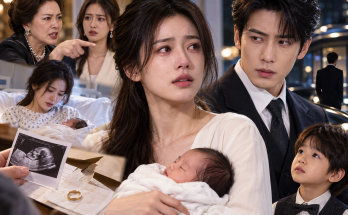
Malcolm Reed placed a second birth record on the table.
Diane did not touch it.
The document belonging to the woman I knew as Diane Mercer had been created years after her supposed birth.
There was no matching hospital registration.
No newborn file.
No early pediatric history.
Then Reed produced an older school record.
DIANA LOUISE VALE.
Born June 3, 1974.
Mother: Margaret Vale.
Diane stared at the page.
“No.”
Reed explained that Margaret had lived under several names.
Vale was one of them.
Something stirred at the edge of my memory.
Pine trees.
A green screen door.
A little girl with dark braids.
Then something vivid.
“A red coat.”
Diane looked at me sharply.
“What?”
“The girl was wearing a red coat.”
Diane began crying.
She still had one.
Margaret had kept it in a box for years, telling Diane it had belonged to a cousin who died young.
It had been hers.
Reed reconstructed what investigators believed had happened.
In 1978, my mother, Helen Harper, rented a cabin near Lake Crescent with my father and me.
Margaret Vale arrived with four-year-old Diana.
The women had known each other since high school.
Margaret was trying to escape an abusive husband, Thomas Vale.
My mother agreed to help.
The cabin fire was real.
The disappearance afterward was not entirely accidental.
Thomas was searching for Margaret and their daughter.
If he believed the child had died, he might finally stop.
My mother helped move Diana into hiding.
For nearly a year, she lived with one of Helen’s relatives in Oregon under another name.
Margaret eventually reclaimed her.
Frank did not meet Margaret until 1981.
That meant one fact could no longer be avoided.
Frank was not Diane’s biological father.
Diane seemed to fold inward.
Ross sat beside her.
“But he raised her.”
“Yes,” Aaron said.
Frank had adopted Diane.
He knew exactly who she was.
He chose to become her father.
For nineteen years, Diane had used biology like a weapon against me.
Now she was learning that the man she defended as belonging exclusively to his blood family had never required blood before offering someone his name.
Aaron had another letter.
This one was addressed to Diane.
Her hands shook too badly to read it, so Ross read aloud.
Frank told her that adoption had never made her less his daughter.
He had not rescued her.
He had wanted her.
Whatever Margaret might have told her, nothing about Diane’s biological parentage could erase that.
Diane covered her face.
Then Ross reached the warning.
If Margaret claimed that revealing Diane’s origins would cost her Frank’s love or inheritance, she was lying.
Diane slowly lowered her hands.
Margaret had told her exactly that.
Seven years earlier, when Margaret reappeared, she proved her identity using details from Diane’s childhood: the red coat, a song she used to sing, a scar behind Diane’s knee, photographs nobody else possessed.
Then came the requests.
Five thousand dollars.
Ten thousand.
Twenty.
Eventually much more.
When Diane could no longer afford them, Margaret convinced her that Frank’s money partly belonged to Margaret anyway.
Diane began rationalizing theft as repayment.
Ross had participated in some transactions without knowing Margaret was alive.
Diane told him Frank owed old debts.
It did not make Ross innocent.
But it explained why the siblings’ stories differed.
Aaron then revealed another piece Frank had concealed.
Frank and Margaret had divorced before her supposed death.
Margaret became involved in financial fraud and identity schemes.
When Frank discovered enough to understand what she was doing, he left her and gained primary custody.
Later, as investigators closed in, Margaret vanished.
Another woman died in a vehicle accident.
Margaret’s jewelry was found with the body.
The identification was accepted.
Frank eventually allowed people to believe he had been widowed because the truth embarrassed him and because he believed Margaret had truly died.
My anger rose despite everything else.
Frank had lied to me too.
Not about one small thing.
About an entire marriage.
A supposed death.
The mother of his children.
Yet the room was filled with people whose lives had been distorted by secrets someone once claimed were necessary for protection.
Margaret had not merely contacted Diane.
She had watched me.
She told Diane that my mother had stolen something from her.
The walnut clock.
On the morning of Frank’s funeral, Margaret instructed Diane to retrieve it before Aaron arrived.
So that pink label had carried a different purpose from all the others.
Diane had not wanted the clock for its value.
She had been sent to recover whatever Helen Harper hid inside.
I picked up the old envelope again.
Something crackled between my fingers.
The lining felt unusually thick.
I carefully separated one edge.
Another paper slipped out.
A hospital record.
1972.
My birth year.
Helen Harper was listed as the patient.
A live female birth had been recorded.
Then another notation appeared beneath it.
A second female infant.
Temporary guardian:
Margaret Vale.
My mouth went dry.
“Why was Margaret at my birth?”
Reed said Frank had apparently asked the same question.
Months before his death, he had rented a storage unit where he collected records concerning my mother, Margaret, the Lake Crescent fire, and decades of financial activity.
Then Joanna’s phone buzzed.
She looked at the screen.
Her expression changed.
“What?”
“Security alert.”
Frank’s storage unit had just been opened.
Unit 214.
Someone was inside.
I reached into my handbag.
Frank’s keys were still there.
Among them hung a small brass key Aaron identified as belonging to the storage unit.
“If I have his key,” I said, “how did anyone get in?”
Reed was already calling police.
I insisted on going.
Twenty-three minutes later, fluorescent lights hummed above us at Crescent Storage.
The lock on Unit 214 had been cut.
The intruder was gone.
Inside, boxes had been opened and dumped across the concrete. Papers covered the floor. A metal filing cabinet lay on its side.
Against the back wall stood a corkboard.
Frank had built a timeline.
My birth.
The Lake Crescent fire.
Diana Vale’s disappearance and return.
Frank meeting Margaret.
Ross’s birth.
Frank adopting Diane.
The divorce.
Margaret’s disappearance.
Frank meeting me.
The suspicious transfers.
My fall down the stairs.
Confirmation that Margaret was alive.
Three months before Frank died, he had added a final handwritten note.
I KNOW WHY MARGARET CHOSE EILEEN.
An arrow pointed toward an empty space.
A label remained there.
RED FOLDER.
The folder was gone.
Whoever entered the unit had known precisely what mattered.
A police officer called us into the manager’s office.
The security cameras had captured the break-in.
An older woman approached Unit 214.
Gray hair.
Dark glasses.
Baseball cap.
Diane leaned toward the monitor.
Her lips parted.
“Mom.”
Margaret cut the lock and entered.
Nine minutes later, she emerged carrying a red folder beneath one arm.
“There,” Reed said.
“Pause it.”
The image froze.
Margaret was not alone.
A man stepped from the storage unit behind her.
Tall.
Cap pulled low.
Something about his posture made my stomach tighten.
Then he walked.
I knew that walk.
I had watched it cross our kitchen every morning.
Watched it climb stairs.
Watched it slow as cancer weakened him.
“No.”
My sister grabbed my arm.
The man turned toward the camera.
For a single frame, his face appeared clearly.
Ross gripped the edge of the desk.
Diane collapsed into a chair.
I could not breathe.
Frank.
My husband.
The man whose coffin I had followed to the cemetery that morning.
The man whose forehead I had kissed goodbye.
The man whose grave was covered with fresh soil and funeral flowers.
The timestamp showed that the footage had been recorded less than thirty minutes earlier.
Reed stared at the monitor.
Then he looked at me.
“We need to contact the funeral home immediately.”
“Why?”
I already knew why.
I simply needed someone else to say it.
Reed’s answer made the floor seem to shift beneath my feet.
“We need to find out who you buried this morning.”
Click here to continue reading: PART 5: The Funeral Home Opened Frank’s Casket Before Sunset, and the Man Inside Had Been Dead Much Longer Than My Husband
An Hour After Frank’s Burial, His Children Began Marking My Possessions as Though the House Already Belonged to Them
Part 4 of 35