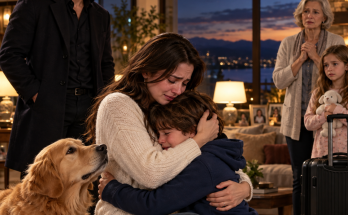
The hug at the park became important mostly because nobody treated it like a breakthrough.
Nobody called it reconciliation.
Nobody told Emily how proud they were that she had hugged her father.
Nobody suggested the next visit should happen sooner because things were “going so well.”
That restraint mattered.
For several days afterward, Emily said almost nothing about Scott.
She talked instead about the bicycle.
Her knees.
The unfairness of helmets making her hair look “flat and weird.”
The fact that Rachel had promised to buy her a bell and had somehow selected one loud enough to disturb neighboring counties.
Scott existed in the background.
Present.
Not central.
I began to understand that this was probably healthier than any dramatic emotional shift.
One evening, while I washed dishes, Emily sat on the floor beside the kitchen island arranging Margaret and Susan beneath a dish towel she had declared a picnic blanket.
“Mommy?”
“Yes?”
“Can Daddy come to my birthday if he stays far?”
My hands stopped in the sink.
Her birthday was closer now.
Weeks instead of months.
“You've been thinking about that?”
“Yes.”
“What does far mean?”
She pointed toward the living room.
“Like there.”
“That's not very far.”
She considered.
“Then like outside.”
I smiled.
“I don't think having Daddy celebrate from the parking lot would be much fun.”
“For him or me?”
Good question.
“Probably either.”
She placed Margaret beside a plastic teacup.
“Can he come but not be Dad?”
I dried my hands.
“What does that mean?”
“You know.”
I did not.
“I really don't.”
Emily frowned, frustrated by adult incompetence.
“Like he doesn't tell me what to do.”
Ah.
“More like a guest?”
“Yes.”
That distinction hit me unexpectedly.
For Emily, fatherhood was still associated with authority.
Control.
Rules.
If she wanted Scott present, she wanted him without the part of the relationship that had frightened her.
Not Daddy deciding.
Just Scott sitting.
Watching.
Maybe speaking.
No authority.
No demands.
“That's something we could talk about with your therapist.”
She sighed.
“Everything is therapist.”
“Lately, yes.”
“Does therapist decide everything?”
“No.”
“Then why ask?”
“Because she helps us think about what might feel safe before we try it.”
Emily accepted that.
Then she asked, “Does Daddy still get to be my dad if he doesn't decide?”
There it was.
The harder question.
Not where he sat.
What being a father meant.
I sat on the floor across from her.
“He is still your dad.”
“But dads make rules.”
“Sometimes.”
“You make rules.”
“Yes.”
“So if Daddy doesn't make rules, what does he do?”
I had no prepared answer.
I thought about Scott’s letter.
The visits.
The bicycle.
The way he had asked before touching the handlebars.
“He can care about you.”
Emily waited.
“He can listen.”
Still waiting.
“He can show up when it's safe.”
She touched Susan’s oversized ear.
“That's not much.”
My chest tightened.
“No. Maybe it doesn't feel like much.”
She looked at me.
“Can dads lose dad jobs?”
I chose the truth carefully.
“They can lose some responsibilities if they aren't safe with them.”
“Forever?”
“Sometimes. Sometimes things can change later.”
“Who decides?”
“Grown-ups who are responsible for keeping kids safe. And as you get older, your feelings matter more and more too.”
She absorbed this.
Then:
“Can I fire Daddy?”
I nearly smiled but did not.
“No.”
“Why?”
“Because being your father is something that happened when you were born. You can't erase that.”
Her face fell slightly.
“But you can decide what kind of relationship you want with him as you grow.”
That mattered.
She nodded.
“So he's Daddy but not boss Daddy.”
I exhaled.
“For now, that's probably a good way to think about it.”
She returned to the rabbits.
Conversation over.
I sat there another minute.
Children have a way of reducing legal and therapeutic complexity into brutal little sentences.
Daddy but not boss Daddy.
That was almost exactly where things stood.
The birthday question moved into therapy.
Emily remained interested in Scott attending under strict conditions.
She did not want a private visit.
She wanted a party.
People.
Noise.
Cake.
A setting where Scott would be part of the room rather than the entire purpose of it.
That distinction interested her therapist.
Sometimes children tolerate contact more easily when the relationship is not the sole focus.
But the risk was obvious too.
A birthday could become emotionally loaded.
Scott might arrive carrying hopes Emily did not share.
The party might turn into a test.
Did she hug him?
Sit beside him?
Open his gift first?
Call him Daddy?
That could not happen.
So the adults began designing rules.
Scott would attend only part of the party.
He would not bring an extravagant gift.
He would not ask Emily for private time.
He would not initiate physical affection.
He would not make a speech.
No comments about the family being together again.
No photos forced for sentimental reasons.
And if Emily asked him to leave, he would leave.
The final condition came from Emily herself.
“No singing loud at me.”
I stared at her.
“What?”
“At birthday song.”
“You don't want him singing?”
“Not loud.”
Apparently this had nothing to do with trauma.
Scott was simply terrible at singing.
Some things remained beautifully ordinary.
The therapist asked whether Emily wanted Scott to bring a present.
“Yes.”
“What kind?”
She shrugged.
“One present.”
No grand gesture.
No compensation.
One present.
She wanted a puzzle.
Specifically, “a hard one but not impossible.”
That phrase sounded like our entire family.
Scott was told.
He agreed.
The party would be at a community center with a small play area.
Rachel helped organize it.
By “helped,” I mean she ignored every budget conversation and purchased decorations in quantities suitable for a royal coronation.
“Why are there forty purple balloons?”
“Atmosphere.”
“There will be seven children.”
“Exactly.”
“That does not explain anything.”
“Art doesn't explain itself.”
Emily loved them.
So Rachel won.
The morning of the party, Emily was excited.
Not visibly anxious.
That concerned me because I had begun mistrusting calm.
I caught myself.
Again.
Stop turning wellness into evidence of danger.
She wore a purple dress.
Then changed into jeans.
Then changed back.
Then decided the dress was “too birthday” and wore the jeans with a glittery shirt.
At six years old, fashion already required suffering.
Before we left, she checked the plan.
“Daddy comes after cake?”
“Before cake.”
“I thought after.”
“We can change it.”
She frowned.
“Why before?”
“That's what we planned.”
“Can he come after?”
“Yes, if everyone agrees.”
“After.”
“Okay.”
I contacted the appropriate people.
The adjustment was made.
No complaint from Scott.
That mattered.
At the party, Emily forgot about him for nearly an hour.
She ran.
Ate too many cheese crackers.
Lost at a game and accused the game of cheating.
Opened presents.
Then the cake came out.
Everyone sang.
Loudly.
Rachel deliberately sang badly.
Emily laughed so hard she nearly blew out the candles too early.
After cake, I saw the supervisor enter.
Scott followed several steps behind.
Emily noticed him immediately.
Her body changed.
Not fear.
Awareness.
Like every sense became sharper.
Scott wore jeans and a plain shirt.
No suit.
No dramatic posture.
He carried a wrapped rectangular box.
One present.
He stayed near the doorway.
Did not wave.
Did not approach.
Emily looked at me.
I said nothing.
Her choice.
She walked toward him.
Slowly.
Stopped several feet away.
“Hi.”
Scott smiled.
“Hi, Emily.”
She looked at the present.
“Is that puzzle?”
“Yes.”
“What kind?”
“Animals.”
“How many pieces?”
“One hundred.”
She considered.
“Hard but not impossible.”
“That was the request.”
She smiled faintly.
Good answer.
Scott held the box but did not extend it.
He asked:
“Want it now or later?”
Emily thought.
“Now.”
He offered it.
She took it.
No touch.
“Thank you.”
“You're welcome.”
Then Emily surprised everyone.
“You can come sit.”
Scott glanced toward the supervisor before moving.
Permission.
Good.
He sat at a table near the wall.
Emily returned to her friends.
For fifteen minutes, Scott barely spoke.
A child he did not know asked him for a napkin.
He provided one.
Another spilled juice.
He moved his shoes.
Ordinary adult behavior.
No attempt to become central.
Then came presents.
Emily opened the puzzle.
She held it up.
“Daddy got this.”
The word landed in the room.
Daddy.
Scott’s face changed.
He looked down.
Good.
He did not make her manage his reaction.
Rachel squeezed my arm beneath the table.
I did not look at her.
At one point, Emily’s friend Ava asked:
“Is that your dad?”
Emily nodded.
“Why doesn't he live with you?”
The room inside me stopped.
Emily answered before any adult could intervene.
“Because grown-up rules.”
Ava accepted this instantly.
Children are sometimes better at boundaries than adults.
“Oh.”
Then she returned to a doll.
No interrogation.
No gossip.
No demand for explanation.
I wanted to hug Ava.
Scott stayed twenty-two minutes.
Then the supervisor quietly reminded him the scheduled time had ended.
Scott stood.
Emily noticed.
“You leaving?”
“Yes.”
“Because rule?”
“Yes.”
She looked at the clock.
“You can stay five more.”
Every adult froze.
Scott did not answer immediately.
He looked to the supervisor.
Correct.
The extension had been anticipated as a possibility and could be allowed if Emily initiated.
The supervisor nodded.
Scott sat again.
Exactly five minutes later, he stood.
Emily was talking to another child.
He did not interrupt her.
He waited near the door.
Eventually she noticed.
“You're going?”
“Yes.”
“Okay.”
She walked over.
Scott stayed still.
Emily hugged him.
Again, she initiated.
Again, he released immediately.
“Happy birthday.”
“Thank you.”
“I hope you like the puzzle.”
“I do.”
Then she said something that made my throat tighten.
“You did good.”
Scott’s face crumpled.
He breathed.
Looked down.
Recovered.
“Thank you.”
No tears turned toward her.
No demand for praise.
No “does this mean…”
Just thank you.
Emily ran back to her friends.
Scott left.
I watched him disappear through the doors.
Months earlier, I had feared he would use every positive interaction as evidence that Emily’s earlier fear was false.
Now he seemed to understand something important.
A child can feel safe today and still have been unsafe yesterday.
Healing does not rewrite history.
At home that evening, Emily spread the puzzle across the floor.
One hundred pieces.
Animals.
Hard but not impossible.
Rachel immediately tried to take over.
Emily slapped her hand away.
“Ask.”
Rachel froze.
Then smiled.
“May I help?”
“Yes.”
Growth everywhere.
I sat nearby while they argued about whether a zebra belonged in the upper-left corner.
After several minutes, Emily looked at me.
“Daddy was different.”
My heartbeat changed.
“How?”
“He waited.”
That was all.
He waited.
The verb captured months of work.
He waited to enter.
Waited to approach.
Waited to give the gift.
Waited to sit.
Waited to hug.
Waited to leave.
Once, Scott believed fatherhood required controlling every outcome.
Now Emily’s strongest evidence of change was that he waited.
“Did that feel okay?”
“Yes.”
“Do you want another visit?”
“Not tomorrow.”
I smiled.
“Definitely not tomorrow.”
She placed another puzzle piece.
“Maybe later.”
Maybe.
The word had become safe.
That night, after everyone slept, I opened an old folder containing photographs from Emily’s previous birthdays.
There was Scott holding her at age one.
Scott carrying a cake at age three.
Scott wearing a ridiculous paper hat at age four.
I did not delete them.
I no longer felt the need.
Those moments existed.
The later harm existed.
The present effort existed.
Truth did not require me to erase any part to preserve another.
A few days later, Scott’s therapist shared an update through proper channels.
Scott had apparently struggled after the birthday.
Not because anything went wrong.
Because it went well.
That surprised me.
He described feeling hopeful.
Then ashamed of feeling hopeful.
Then wanting to ask for more.
Then recognizing that asking for more would turn Emily’s good experience into a bargaining chip.
So he did nothing.
The therapist considered that progress.
I did too.
Not doing something had once been impossible for Scott.
He had always acted on discomfort.
Corrected.
Explained.
Pressed.
Controlled.
Now he was learning that wanting did not equal permission.
That lesson mattered more than emotional speeches.
Later that week, Emily asked a new question during dinner.
“Can Daddy ever be boss Daddy again?”
I put down my fork.
“What do you think?”
“I don't know.”
“What would have to happen?”
She counted on her fingers.
“He listens.”
“Yes.”
“He asks.”
“Yes.”
“He doesn't lock.”
My chest tightened.
“Yes.”
“He doesn't make secrets.”
“Yes.”
“He doesn't get mad when I want you.”
“Yes.”
Then:
“And I believe him.”
There.
Not Scott proving something.
Emily believing.
Trust could not be ordered from outside.
“That's a very important one.”
“How long does that take?”
“I don't know.”
She frowned.
“You never know.”
“I know many things.”
“Not useful things.”
Fair.
She ate another bite.
“Maybe when I'm seven.”
I smiled.
“Maybe.”
“Or eight.”
“Maybe.”
“Or never.”
“Yes.”
She looked surprised by the answer.
“Never is allowed?”
“Yes.”
Her face relaxed.
That mattered.
Progress remained meaningful only if never stayed possible.
If reconciliation became inevitable, then every “choice” along the way would be fake.
Emily needed to know she was not walking toward a predetermined ending.
She was deciding.
One visit at a time.
One boundary at a time.
One yes.
One no.
One maybe.
Later that evening, I received a brief message through formal channels.
Scott wished to know whether a future parenting role could ever be restored if professionals recommended it and Emily became comfortable.
For the first time, I understood the question without feeling threatened.
He was asking about possibility.
Not demanding a timetable.
The response remained cautious.
Any expansion of responsibility would require sustained change, professional assessment, and evidence that Emily trusted him enough for increased caregiving.
There were no guarantees.
Scott replied:
Understood.
That word again.
Maybe one day it would become evidence.
For now, it was only another piece of the puzzle.
One hundred pieces.
Hard but not impossible.
Click here to continue reading: PART 22: Scott Asked for Responsibility Instead of Access, and the Difference Revealed Whether His Changes Could Survive Without Immediate Reward
The First Time Emily Pulled Away From Her Father, I Told Myself There Had to Be an Innocent Explanation
Part 21 of 38