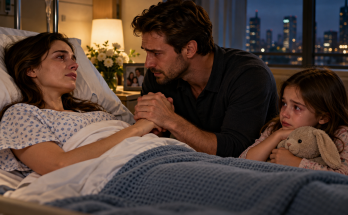
Dad died the following spring.
Not suddenly.
Not slowly enough for any of us to feel prepared.
A stroke.
Three days in the hospital.
Then a decision he had already documented years earlier became relevant.
No prolonged intervention if meaningful recovery was unlikely.
Mom struggled.
Dara struggled.
Raymond struggled most.
The neurologist explained everything twice.
Dad could not speak.
Could not decide.
For once, there was no possibility of asking him what he wanted in the moment.
We had his written directive.
That mattered.
Mom sat beside his bed holding his hand.
“What if he changed his mind?”
Nobody had an answer.
Then Dara said, “He planned this so we wouldn’t have to guess.”
Mom cried.
“Yes.”
There was no victory in respecting the choice.
Only sorrow.
Dad died just before dawn.
Mom kissed his forehead.
Raymond stood by the window.
Dara sat beside me.
Nobody said anything wise.
Thank God.
The first test came six hours later.
Funeral planning.
Everyone looked at Dara.
Habit.
She felt it.
I saw her shoulders change.
The organizer waking.
Then she closed her eyes.
Opened them.
Looked at Mom.
“What do you want?”
Mom stared.
“I don’t know.”
“That’s okay.”
Raymond said, “We should use Dad’s church.”
Dara looked at Mom.
Mom nodded.
“Yes.”
Dara wrote it down.
Not command.
Answer.
Then she asked me, “Do you want to help?”
“Yes.”
Raymond began suggesting speakers.
Alicia suggested photographs.
Ben asked about food.
The room filled with decisions.
Old Dara might have seized all of them.
This Dara said, “I’ll keep a list of what people volunteer for.”
Not assign.
Volunteer.
Dad would have approved.
Maybe.
There it was.
I smiled through tears.
“What?”
“Nothing.”
She understood anyway.
Funeral homes compress grief into forms.
Name.
Date.
Service.
Casket.
Flowers.
Obituary.
Each box felt offensive.
How do you reduce a person to data before breakfast?
Mom chose simple arrangements.
Dad had left notes.
No expensive casket.
No long eulogies.
No military-style biography of every achievement.
And, in handwriting unmistakably his:
Dara—no schedule longer than one page.
She laughed when she saw it.
Then cried so hard she had to leave the room.
I followed.
She stood outside beside the funeral home wall.
“He knew.”
“Yes.”
“He really wrote my name.”
“Yes.”
She laughed through tears.
“I’m framing that too.”
“He specifically asked not to become a project.”
“I know.”
I waited.
She took several breaths.
Then said, “One page.”
“One page.”
We created it together.
Service time.
Speakers.
Reception location.
That was it.
No minute-by-minute transitions.
No floral placement chart.
No emergency call tree.
Progress survived grief.
Not perfectly.
But enough.
Then came the horse.
Dad’s will and donation papers were clear.
After his death, Daniel’s carved horse belonged to the archive.
Raymond asked whether we could delay.
Not contest.
Delay.
“Until after the funeral.”
Mom wanted it displayed beside Dad’s photograph.
The archive agreed.
No problem.
Then Raymond asked whether he could take it to Arizona for one week afterward.
The room tightened.
I saw him notice.
He raised both hands.
“I’m asking.”
That mattered.
Mom looked at the horse.
Dara looked at Mom.
Nobody answered for her.
Finally Mom said, “No.”
Raymond’s face changed.
Pain.
Not anger.
“Okay.”
Just that.
He did not argue.
If Dad could have seen the moment, maybe he would have laughed at how much work it represented.
At the funeral, the horse sat beside a photograph of Dad holding it.
The one I had taken years earlier.
He looked annoyed in the picture.
Perfect.
Chloe gave the first eulogy.
She talked about Dad’s habit of pretending every repair required three trips to the hardware store when everybody knew he enjoyed going.
Uncle Ben talked about fishing.
Mom did not speak.
She did not need to.
Raymond stood last.
Everyone became still.
He unfolded one sheet of paper.
“I had a complicated brother.”
People laughed softly.
“He would want me to say he had a complicated brother too.”
More laughter.
Raymond looked toward the casket.
“We spent too many years arguing about our father.”
His voice broke.
“I’m grateful we spent the last ones talking about ourselves.”
That was enough.
No Laurel Bottom lecture.
No family history.
No defense.
Just brothers.
At the reception, people ate.
Children ran.
Adults told stories.
Several contradicted one another.
Dad was quiet.
Dad was loud.
Dad loved country music.
Dad hated country music.
Dad was patient.
Dad had no patience.
I remembered his request.
Let me be messy.
He was getting his wish.
Afterward, the immediate family returned to Mom’s house.
The horse sat on the dining table.
Tomorrow Laura would collect it for the archive.
Raymond stood beside it.
No one rushed him.
He picked it up.
Turned it over.
D.W.
Then handed it to Mom.
She held it against her palm.
“Your father loved this thing,” she said.
Raymond nodded.
“So did mine.”
There were two fathers in that sentence.
Dad.
Grandpa.
Different generations tied to the same child’s toy.
Mom gave it to Dara.
Dara looked startled.
“What?”
“Hold it.”
She did.
Then passed it to me.
No claim.
No symbolic designation.
Just hands.
I passed it to Eric.
Eric looked uncomfortable.
“I’m afraid I’ll drop it.”
“You won’t.”
He held it briefly.
Then gave it back to Mom.
No one became owner through contact.
That mattered.
The next morning Laura arrived.
She brought archival paperwork.
Mom signed.
Raymond witnessed.
Dara watched.
I took one photograph.
Then the horse left the house.
Mom cried after the door closed.
“So do I,” she said.
Dara hugged her.
No one told Mom it was still part of the family.
No one told her it was only an object.
Grief does not need correction.
Weeks passed.
Dad’s absence changed rooms.
His chair.
His tools.
His coffee mug.
The silent side of Mom’s bed.
Those details hurt more than the funeral.
Mom began giving away more things.
Not everything.
Some.
Dara helped.
I helped.
Raymond called weekly.
He did not try to manage.
One afternoon Mom handed me Dad’s old pocketknife.
“He wanted you to have it.”
No note.
No legal instruction.
Just Mom’s memory.
I accepted it.
That night I sharpened it.
Grandpa had taught me.
Dad had corrected my technique.
Three generations in one ordinary action.
No claim required.
Then came a complication.
Dad’s will contained a provision none of us expected.
Not secret.
We simply had not discussed it.
He left a small sum—ten thousand dollars—to the county archive.
For preservation and digitization of family and local working-class records.
Not specifically Whitmore records.
Local records.
Mill workers.
Tenant farmers.
Church relief lists.
Boarding-house registers.
The documents our family had ignored while chasing ownership.
Raymond read the provision twice.
Then smiled.
“That’s Sam.”
Mom looked proud.
Dara said, “That’s perfect.”
I agreed.
Then the attorney read another clause.
Dad left his share of Mom’s eventual estate decisions entirely to her.
No instructions.
No expectations.
No list of objects.
No family conditions.
Mom laughed.
“He escaped.”
We all did.
Dad had spent much of his life avoiding conflict.
In the end, he left fewer instructions than expected.
Only the decisions he believed were truly his.
Everything else remained with the living.
That felt right.
Months later, Mom sold the leaning-fence house and moved into a smaller condominium near Alicia.
Dara coordinated the move because Mom asked.
I handled tools.
Raymond flew in.
No one fought over Dad’s possessions.
Not because nobody wanted anything.
Because people asked.
Mom decided.
Sometimes two people wanted the same object.
Someone waited.
Someone changed their mind.
One item caused trouble.
Dad’s toolbox.
Raymond wanted it.
So did Eric.
So did I.
We stood in the garage staring at it.
Dara laughed.
“Oh, this is excellent.”
“Stay out of it,” I said.
“I absolutely will.”
Raymond opened the toolbox.
Wrenches.
Screwdrivers.
Electrical tape.
Rusty drill bits.
Nothing valuable.
Everything valuable.
Eric said, “I want Grandpa’s hammer.”
Raymond said, “Fine.”
I wanted the small socket set.
Raymond wanted the large one.
Ten minutes.
Done.
The toolbox itself?
Nobody wanted it empty.
Mom donated it to a vocational school.
Dad would have liked that.
Maybe.
I stopped myself.
I hoped he would.
Different.
The first Christmas without Dad was painful.
Mom almost canceled.
Dara said okay.
Then Mom changed her mind.
Also okay.
We gathered at Alicia’s.
Not Mom’s.
Different house.
Different seating.
Nobody sat where Dad used to sit because there was no where Dad used to sit.
That helped.
Raymond told one of Dad’s bad jokes.
Ben corrected it.
Mom laughed.
Then cried.
Both.
After dinner Chloe brought the published article.
She had added a handwritten dedication to the family copy.
For the people who taught me that history is what happened, memory is what we carry, and neither gives us ownership of one another.
Dara read it aloud.
Nobody spoke afterward.
Then Uncle Ben said, “That kid is showing off.”
Chloe threw a napkin at him.
Family restored to proper functioning.
Later that night I drove back to the cabin.
Snow had begun.
At the gate, I stopped before opening it.
Dad had never made the cabin dispute his story.
Even when he helped.
Even when he confessed his silence.
Even when Raymond dragged him into old arguments.
He remained larger than the conflict.
I had promised him that.
Let me be messy.
I whispered it into the car.
Then opened the gate.
At the porch, a package waited.
From the archive.
Inside was a small reproduction of Daniel’s wooden horse.
Not the original.
A 3D-scanned replica the archive had created for educational handling.
A note from Laura:
We made several. Thought the family might enjoy one without creating another inheritance problem.
I laughed alone on the porch.
Perfect.
The original belonged to no one in the family now.
The copy could be dropped.
Handled.
Passed around.
Lost.
Replaced.
Maybe that was the best kind of symbol.
One that could survive being ordinary.
I put it beside the fireplace.
Not on a pedestal.
Just a shelf.
A week later Dara visited.
She picked it up.
“What is this?”
I explained.
Her eyes narrowed.
“Who gets it when you die?”
I stared at her.
She lasted three seconds before laughing.
Dad would have appreciated that.
I hoped.