
Dale’s first handwritten letter arrived six months after sentencing.
Until then, communication had been short.
Approved messages.
Updates about the truck.
Questions about the archive.
Occasional remarks about the company.
The letter was different.
Four pages.
No lawyer copied.
No request for money.
I left it unopened for two days.
Not because I feared it.
Because I had learned that receiving something did not create an obligation to deal with it immediately.
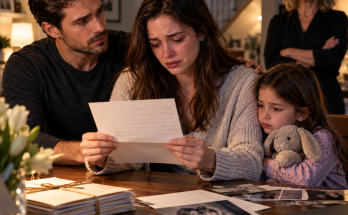
On Sunday morning, I opened it.
Nancy—
I keep thinking about the basement.
Not the bonds.
The three hundred dollars.
I almost stopped there.
Dale wrote that he had chosen the amount because it was small enough to feel insulting but large enough that he thought I would accept.
He wanted me downstairs.
That much we knew.
Grandpa had manipulated him into suggesting it.
But Dale admitted he had added his own cruelty.
He believed giving me a menial job would remind everyone of my place.
Outside the company.
Outside the inheritance.
Outside the decisions.
I read that paragraph twice.
It hurt more than some of the fraud.
Maybe because it was petty.
Large crimes can become abstract.
Humiliation stays personal.
He continued.
I told myself you were lucky because you had escaped all this. At the same time, I resented you for escaping. I wanted you to come back just enough to see that I had what Grandpa once promised me.
There it was.
Not money.
Status.
He had wanted me to witness his victory.
Then I found the bonds.
The letter said he panicked because the envelope transformed me from audience into claimant.
That was why his first instinct had been destruction.
Burn them.
Not because he knew every legal implication.
Because seeing my name on Grandpa’s hidden property felt like proof that Grandpa had chosen me over him.
Even though that was not what the bonds meant.
He had reacted to a story in his head.
We all had.
The final page changed tone.
I don’t expect forgiveness.
Good.
I don’t know if I deserve a relationship with you.
Also good.
But I want to ask one thing.
There it was.
The request.
When I get out, if I get the chance to rebuild a normal life, I want to work again.
Not run anything.
Work.
I don’t know who will hire me.
Please don’t stop them because of what I did to you.
I sat back.
That was the request.
Not recommendation.
Not endorsement.
Noninterference.
He continued.
If someone asks you what I did, tell them the truth.
If they ask whether they should trust me, tell them you can’t answer for them.
Just don’t use what you now control to make sure I never get another chance.
I folded the letter.
For several minutes I felt angry that he had put the question in my hands.
Then I realized he had not.
He was asking me not to take it.
That was different.
I wrote back three days later.
Dale—
I will not lie for you.
I will not hide what you did.
I will not recommend you for positions involving authority I do not believe you have earned.
But I will not campaign to keep you unemployed.
Your future decisions belong to you.
So do their consequences.
That is all I can promise.
Nancy.
I read it once.
Sent it.
No second draft.
No emotional conclusion.
The following week brought a problem I had not expected.
Robert disappeared.
Not dramatically.
No blood.
No overturned furniture.
He simply missed a call.
Then another.
My oldest son texted him.
Nothing.
My youngest tried.
Nothing.
By evening, every old fear had returned before evidence justified it.
I hated that.
I called Alan.
“Heard from Robert?”
“Yesterday.”
“Since?”
“No.”
Pam had not.
Thomas had not.
Robert’s apartment manager said his car was gone.
My stomach tightened.
I called Rachel.
Then stopped myself.
Robert was an adult.
Missing for several hours was not a legal emergency.
I had spent too long turning uncertainty into catastrophe.
At ten that night, he called.
“Hi.”
I nearly shouted.
“Where are you?”
Silence.
Then, “Macon.”
The farmhouse.
Of course.
“Why?”
“I needed to go back.”
“You could have told someone.”
“Yes.”
“You said you’d call.”
“Yes.”
“That was the higher bar.”
“I know.”
Anger replaced fear.
Better.
“Are you safe?”
“Yes.”
“Are you alone?”
“Yes.”
“Why are you there?”
A long pause.
“Tomorrow is the anniversary of Elaine’s death.”
Mom.
I sat down.
“I didn’t know you marked it.”
“Every year.”
At the farmhouse where Grandpa had scattered her ashes.
The place Robert hid.
The place Dale later met him.
The place where so many lies had crossed.
“Why didn’t you tell me?”
“I thought it was private.”
“It can be private without making people think you vanished.”
“I know.”
There was no defense in his voice.
“I’m sorry.”
I breathed slowly.
“Come home tomorrow.”
“To Columbia?”
“Yes.”
“I will.”
“And call my sons.”
“I will.”
“They were worried.”
“I know.”
“No. You don’t get to say that until you call them.”
“Fair.”
We hung up.
Ten minutes later my oldest texted.
HE CALLED.
My youngest:
HE’S AN IDIOT.
I replied:
GENETIC RISK.
That earned two laughing reactions.
The next afternoon Robert returned.
He came to my house without being asked.
He looked exhausted.
“I brought something.”
I stared.
“If it’s a document, leave.”
He almost smiled.
“Not a document.”
A small jar.
Soil.
From the farmhouse.
“What am I supposed to do with that?”
“Nothing.”
“Then why bring it?”
“I was going to ask whether you wanted some.”
“Mom’s ashes?”
“No. Just soil from where Henry scattered them.”
I looked at the jar.
“No.”
Robert nodded immediately.
“Okay.”
No persuasion.
No disappointment used as pressure.
He put the jar back in his coat.
That small reaction mattered.
“You can keep it,” I said.
“I will.”
We sat at the dining table.
Robert ran a hand over the wood.
“I scared them.”
“Yes.”
“And you.”
“Yes.”
“I didn’t mean to.”
“I know.”
“That doesn’t make it okay.”
“No.”
He looked toward the window.
“I lived so long believing disappearing protected people that sometimes leaving without explanation still feels normal.”
That was probably the most honest thing he had said about himself.
“Then learn a new normal.”
“I’m trying.”
“Trying includes telling people where you are.”
“Yes.”
He nodded.
“I will.”
We sat quietly.
Then he said, “Elaine would hate what we did.”
“To whom?”
“You.”
“Yes.”
“She’d also understand.”
“Yes.”
“Those are different.”
“Yes.”
He smiled faintly.
“You say yes to uncomfortable things very efficiently.”
“I’ve had practice.”
He looked at me.
“Nancy, there’s something I haven’t asked because I thought asking would be pressure.”
I waited.
“When I die, would you want to know?”
The question was so simple I almost laughed.
“Yes.”
He nodded.
“That’s all.”
“Why wouldn’t I?”
“Because sometimes I think my death was easier for you when it was already part of the past.”
I stared at him.
“It wasn’t your death.”
“I know.”
“It was a lie.”
“Yes.”
“If you die now, it will be real.”
“Yes.”
“I want to know.”
His eyes filled.
He looked down.
“Okay.”
I reached across the table.
Not dramatically.
I put my hand over his.
He went still.
For the first time, I did not think about whether touching him meant forgiveness.
It meant my father was sitting at my table.
That was enough.
The next morning, Robert sent his location before driving to a doctor’s appointment.
I texted:
THIS IS EXCESSIVE.
He replied:
LEARNING CURVE.
Good.
The company’s first annual independent audit arrived soon afterward.
Clean opinion.
Not perfect operations.
Clean reporting.
Related-party disclosures complete.
Employee fund valuation independently reviewed.
Environmental reserve adequate under current estimates.
No hidden accounts discovered.
Marcus called.
“You realize how boring this is?”
“I’m framing it.”
“You should.”
I almost did.
The archive expanded its exhibition to include the restructuring.
Helen asked me to record an oral history.
I refused.
She accepted.
Two weeks later I changed my mind.
That was allowed too.
The recording took three hours.
Helen asked about the funeral.
The basement.
The bonds.
Dale.
Grandpa.
Mom.
Robert.
My sons.
She asked what I believed when I first found the envelope.
“That I had found money.”
“And what had you actually found?”
“A question.”
“What question?”
“Why was everyone afraid of me knowing?”
She nodded.
“And now?”
“Now I think most of them were afraid of what truth would force them to admit about themselves.”
“What did it force you to admit?”
That question stopped me.
I thought about it.
“That being excluded protected me from some things and deprived me of others.”
“What else?”
“That I liked being able to say I was the only person who hadn’t participated.”
Helen waited.
“But?”
“But once I knew, I had choices too.”
“Such as?”
“Whether to punish employees.”
“Whether to destroy Dale.”
“Whether to control my sons’ inheritance.”
“Whether to turn Grandpa into a saint because he left me evidence.”
“Whether to turn him into a monster because he lied.”
“Whether to make Robert earn the right to exist near me.”
I stopped.
“Knowing made me responsible for what I did next.”
Helen let the silence sit.
Then asked, “Do you think you chose well?”
I laughed.
“Ask me in twenty years.”
That answer went into the archive.
No polished lesson.
Good.
Near the end of the session, Helen placed a photograph on the table.
Grandpa at the plant.
Dale beside him, maybe eighteen.
Robert on the other side.
Raymond behind them.
All young.
All alive.
All before the worst of it.
“What do you see?” she asked.
“People who don’t know what they’re about to do.”
“That’s interesting.”
“Why?”
“Most people say family.”
I looked again.
“It is family.”
“Anything else?”
I noticed Grandpa’s hand on Dale’s shoulder.
Dale smiling.
Raymond looking away.
Robert holding paperwork.
A worker blurred behind them.
“I see choices that haven’t happened yet.”
Helen smiled.
“That might be the title.”
“No titles.”
“Archivists need titles.”
“Use the date.”
She laughed.
We used the date.
A few months later, the education grants funded their first recipients.
One was Carl Benton’s granddaughter.
He tried to decline because he thought accepting looked improper.
The independent committee selected her without knowing the family connection.
I told him to stop being ridiculous.
“She earned it.”
He frowned.
“I don’t want anyone saying—”
“Carl.”
“What?”
“Do not make her carry your fear of appearances.”
He stopped.
Then laughed.
“You really have become Henry’s granddaughter.”
I pointed at him.
“Take that back.”
He laughed harder.
But his comment stayed with me.
Being Grandpa’s granddaughter was not a verdict.
I could inherit habits without obeying them.
Genes were not governance.
History was not instruction.
The scholarship stayed.
Carl’s granddaughter accepted.
No scandal occurred.
Imagine that.
Then the developer on the sold portion of Tract C asked permission to name the access road Harper Way.
I rejected it immediately.
Evelyn asked why.
“Because there are enough Harper things.”
The developer proposed Ellis Parkway.
“No.”
My sons agreed.
The county eventually named it Junction Commerce Drive.
Perfectly dull.
I loved it.
Construction continued.
The retained company expansion broke ground the following month.
Employees gathered.
No ceremonial Harper shovel.
The board chair spoke.
Carl spoke.
The employee representative spoke.
I stood in the back.
My youngest son nudged me.
“You could be up there.”
“I’m exactly where I want to be.”
He nodded.
Then asked, “Would Grandpa?”
“No.”
We both laughed.
Later, we drove past Grandpa’s old house.
The new owners had painted the front door blue.
A swing hung from the porch.
Bicycles lay in the yard.
My son slowed.
“Want to stop?”
“No.”
“You sure?”
“Yes.”
It was their house.
The basement belonged to someone else now.
I did not need to see it.
That night, I received another letter from Dale.
Short this time.
Nancy—
I got your answer.
It’s fair.
I’m taking a vocational maintenance course.
Turns out I’m better with machines when nobody lets me own the building.
I laughed.
Then continued.
I keep thinking about what Henry said—that he stopped trusting himself.
I used to think trust meant letting someone control things.
Now I think maybe trust is giving them information and accepting that they might choose differently.
You figured that out before I did.
I don’t need you to answer.
Dale.
I did answer.
One sentence.
I DIDN’T FIGURE IT OUT EARLY EITHER.
That mattered.
I did not want to become another person rewriting the past to make myself wiser.
Months passed.
No new conspiracy.
No hidden account.
No anonymous envelope.
The absence itself became something I had to learn to trust.
Then, one rainy Tuesday, Robert called.
His voice sounded wrong.
“Nancy.”
“What happened?”
“I’m at the hospital.”
My body went cold.
“What hospital?”
He told me.
“What happened?”
“Chest pain.”
“Are you alone?”
“Yes.”
“I’m coming.”
He started to say I did not have to.
Then stopped.
Good.
“I’ll be here,” he said.
I grabbed my coat.
My sons were already on their way after Robert called them too.
He had learned.
At the hospital, we found him sitting upright, irritated by monitoring wires.
The doctor said tests were reassuring so far.
Not a heart attack.
Likely another issue requiring follow-up.
My knees nearly gave out from relief.
Robert looked embarrassed.
“I may have overreacted.”
“No.”
He blinked.
“You called.”
“Yes.”
“You told us.”
“Yes.”
“You let us decide whether to come.”
His eyes filled.
“Oh.”
“That’s the whole thing.”
My sons arrived.
My youngest looked at the monitor.
“You almost died?”
“No.”
“Great. I skipped dinner for nothing.”
Robert laughed.
So did I.
The fear passed slowly.
But something else remained.
He had not disappeared.
He had called.
A small choice.
A completely different ending to an old pattern.
When they discharged him after midnight, he asked if someone could drive him home.
My oldest took his keys.
I rode in the passenger seat.
Robert sat in back with my youngest.
At his apartment, he stood under the entry light.
“Thank you.”
“Call tomorrow.”
“I will.”
“At a reasonable hour.”
“Nine?”
“Nine is fine.”
He smiled.
The next morning, my phone rang at nine exactly.
I answered.
“Hi, Dad.”
The word came out before I decided whether to use it.
Silence.
Not awkward silence.
Something deeper.
Then Robert said quietly:
“Hi, Nancy.”
He did not make me repeat it.
He did not celebrate.
He did not claim it.
He simply accepted what I had chosen to give.
That was why I knew I might say it again.
Click here to continue reading: PART 35: I Entered Grandpa’s Basement for Three Hundred Dollars, but the Inheritance I Kept Was the Right to Decide What Happened Next
Three Hundred Dollars for a Basement Nobody Wanted to Enter Became the Cheapest Mistake My Cousins Ever Made
Part 34 of 35

One Comment on “PART 34 – Dale’s Sentencing Letter Asked Me for Something I Could Not Give, and Robert Finally Faced the Cost of Coming Home”