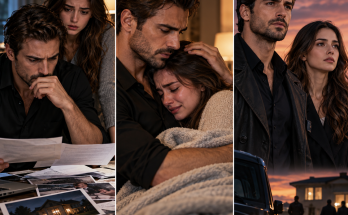
We buried Grandma on a cold Thursday morning.
She had specified no elaborate service.
Naturally, the funeral home offered one.
We declined.
She wanted music.
Two readings.
No slideshow.
“No sentimental video of me aging in chronological order,” her written instructions said.
We obeyed.
Mostly.
Rachel added one photograph near the entrance.
Grandma at twenty-eight.
Hair pinned back.
Laughing at something outside the frame.
No caption.
Perfect.
The conservatory sent Eleanor’s restored cello for the service.
Not as a display.
A faculty cellist played it.
The sound filled the chapel.
Deep.
Dark.
Scar still visible along the repaired rib.
I watched Dad when the first note began.
He closed his eyes.
No one looked away to protect him from being seen.
He cried.
So did Mom.
Denise sat several rows away from him.
They did not speak.
They did not need to.
Lucy played her own modern cello later.
Grandma’s hated piece.
Exactly as instructed.
People shifted uncomfortably.
Harvey, wrapped in two scarves despite indoor heating, whispered, “This is dreadful.”
Lucy heard.
Almost laughed mid-phrase.
Then she played the Bach Grandma loved.
No one applauded.
It was not that kind of room.
Afterward, we gathered at the old house.
The one legally held for Lucy.
The one Dad had renovated.
The one Grandma had once occupied.
The one with the pool.
The one with the music room.
History layered everywhere.
Food covered the kitchen counters.
Neighbors arrived.
Relatives I barely recognized hugged me.
Some said Grandma had lived a good long life.
True.
Not helpful.
Others said at least she had not suffered long.
Also true.
Also not helpful.
Grief had no good response because it was not a question.
Dad stayed mostly outside.
That was intentional.
Not banishment.
Space.
Denise stayed inside.
Also intentional.
People respected both.
A year earlier, someone would have insisted they should reconcile for Grandma.
Grandma would have hated that.
By late afternoon, the house emptied.
Mom left with Rachel.
Dad approached me near the front door.
“I’m going.”
“Okay.”
He looked toward the music room.
“Can I…”
He stopped.
Good.
“What?”
“Can I sit there for a minute?”
Grandma’s blue chair.
The room where Lucy’s heirloom cello once stood.
I looked at Lucy.
It was her future house.
Not yet her management responsibility, but emotionally important.
She understood.
“Okay.”
Dad entered.
Sat in Grandma’s chair.
No speech.
No touching drawers.
No searching.
He looked at the empty cello stand.
After a few minutes, he stood.
“Thank you.”
Lucy nodded.
He left.
That was all.
No reconciliation scene.
No promise.
A man sat in his mother’s chair after burying her.
Then went home.
That was enough.
Three days later, I opened Grandma’s letter.
Alone.
Not because I needed secrecy.
Because I wanted privacy.
Emily,
If you opened this immediately, I am disappointed.
I laughed out loud.
The next line:
If you waited, do not become smug. You are still you.
I cried.
Then laughed again.
Grandma wrote that she had no final revelation.
No hidden account.
No unknown heirloom.
No new betrayal.
She underlined:
THIS IS NOT ANOTHER BOX.
I could hear her voice.
She wrote about fear.
Mine.
Dad’s.
Mom’s.
Her own.
Fear had shaped more of our family than greed.
Greed was easier to condemn.
Fear looked respectable.
Protection.
Prudence.
Responsibility.
Family unity.
Sometimes those words were true.
Sometimes they were fear in good clothing.
Grandma wrote:
Your father feared being unnecessary, so he made people need him.
Your mother feared being alone, so she stayed where staying cost other people truth.
Rachel feared being less loved, so she competed for signs of preference.
You feared being selfish, so you surrendered before anyone asked.
I stopped.
Accurate.
Painful.
Then Lucy.
Lucy fears losing people she loves.
Do not turn that into obedience.
My throat closed.
Grandma had seen her too.
She continued.
Every generation believes it can spare the next one pain.
We cannot.
We can only try not to create unnecessary pain while preventing ordinary pain.
That sentence sat with me.
For years, everyone had justified deception by saying truth would hurt.
Grandma was right.
Pain itself was not proof something had gone wrong.
Sometimes grief.
Disappointment.
Regret.
Boundaries.
Consequences.
All hurt.
Trying to eliminate every hurt had created far greater harm.
Then the inheritance.
The house remained in Lucy’s trust.
Grandma asked that nobody pressure her to keep it.
Sell it if she wants.
Rent it.
Live there.
Tear down the pool.
Keep the pool.
I do not care because I will be dead.
I laughed again.
Then:
If she turns my music room into storage, I will care slightly.
Typical.
Grandma wrote about Dad last.
I love Richard.
Do not use my love as evidence that you should trust him.
I do not know what he will become after I am gone.
Neither do you.
Judge what he does next by what he does next.
Not what you hope.
Not what you fear.
Not what he once was.
That was the cleanest guidance anyone had given me.
Behavior in the present.
No forced redemption.
No permanent condemnation.
Then one final paragraph.
You spent too much of your life believing someone else would eventually certify you as good.
Your father could not do it.
I could not do it.
Harold could not do it from a box.
Lucy cannot do it by needing you.
Stop asking.
Live.
Love,
Grandma
I sat at the table for a long time.
No hidden key.
No legal instruction.
No secret.
Just Grandma.
I folded the letter.
Put it away.
Then took it out again and added one thing to my Choice account notebook.
Stop asking.
Not as an order.
A reminder.
Dad’s life after Grandma’s death did not become dramatically better or worse.
That mattered.
He continued working.
Continued therapy.
Continued restitution until the remaining obligations were satisfied.
He had setbacks.
Mom occasionally let him stay over.
Then asked him to leave again.
They never formally resumed their marriage in the old way.
They eventually described themselves as “companions.”
Rachel called that disgusting.
Mom told her to grow up.
Healthy.
Denise never reconciled with Dad.
He sent one final apology after Grandma died.
She did not answer.
He did not send another.
That restraint became the only repair available between them.
Harvey outlived Grandma by eleven months.
He complained about this because he had promised her spite would sustain him longer.
When he died, his family sent us the blue ledger.
Not because we needed it legally.
Because they thought Grandma would have wanted us to keep it.
I almost refused.
Then paused.
We donated it to a regional archive with the relevant business records.
History did not need to live in my closet.
Aaron stayed part of Lucy’s life.
Not intensely.
Birthdays.
Messages.
Occasional visits.
He went to college for engineering.
Lucy teased him for abandoning drums.
He claimed he had improved society by doing so.
Denise became someone he called sometimes when he had questions about Daniel.
She never demanded more.
Michael became more honest.
Not perfectly.
But he stopped hiding difficult information behind “later.”
Lucy loved him.
Got angry with him.
Called him Dad.
Called Daniel her biological donor when forms required it.
Called Denise Aunt Denise because that was the relationship she chose.
Labels stopped frightening us.
Lucy continued cello.
Not professionally at first.
Then maybe professionally.
At seventeen, she auditioned for conservatories.
Got into two.
Rejected one because the teacher seemed arrogant.
Grandma would have approved.
Her modern cello traveled with her everywhere.
No one knew its name.
No collectors called.
No journalists cared.
It mattered because she played it.
Dr. Marston honored every term of the heirloom cello loan.
Six months a year at the conservatory.
Lucy occasionally played it.
Not possessively.
Visiting an old friend.
When Dr. Marston died years later, her estate offered the instrument first to the conservatory.
The conservatory bought it through donors.
The cello finally became institutionally owned.
Not family property.
Not private leverage.
Music.
Grandma would have complained about the sale price.
Then approved.
The old house remained empty for several months after her death.
Eventually, the trust needed a decision.
Lucy was still a minor, but old enough to have meaningful input.
Andrew asked what she wanted.
“Rent it.”
Grandma’s wish continued accidentally.
The rental income went into the trust.
Then, when Lucy turned eighteen, control shifted to her under the trust terms.
Andrew held a formal meeting.
Documents.
Signatures.
Explanations.
I attended only because Lucy asked.
At the end, Andrew slid the ownership papers toward her.
“It’s yours to manage now.”
Lucy stared.
“The whole house?”
“Yes.”
“With the pool?”
“Yes.”
She laughed.
Dad attended no part of that meeting.
Good.
That evening, Lucy asked me to drive her there.
We entered with the old key.
The house smelled faintly of dust and paint.
The renters had moved out the month before.
Sunset reflected in the pool.
We walked through rooms slowly.
Kitchen.
Dad’s old office.
Grandma’s blue chair had moved to my house years earlier.
The music room stood nearly empty.
Only the wooden stand remained.
The same stand I had seen on the morning everything began.
Empty.
Lucy stopped.
“Do you remember?”
“Yes.”
“You were really scary that day.”
“I was?”
“Quiet scary.”
I smiled.
“You were eleven.”
“You told me I shouldn’t have to buy back something that was already mine.”
I remembered.
That sentence had changed both of us.
Lucy touched the stand.
“Do you think Grandpa ever understood?”
“Which part?”
“That taking something and replacing it isn’t the same.”
I thought.
“Yes.”
“When?”
“I don’t know.”
Maybe prison.
Maybe Grandma’s death.
Maybe never completely.
Understanding was not a finish line we could verify.
Lucy looked around.
“I don’t want the house.”
There it was.
“You’re sure?”
“No.”
We both laughed.
“Okay.”
“But I think I want to sell.”
“Why?”
“Because I don’t live here.”
“That’s reasonable.”
“And every room feels like somebody else’s memory.”
Also reasonable.
“The pool is nice.”
“Very.”
She walked to the window.
“What do you think?”
The old question.
Years ago I would have given her my answer and called it guidance.
Instead:
“I think keeping it could be financially useful.”
She nodded.
“I think selling it could free you from maintaining a property you don’t want.”
She nodded again.
“I think Grandma meant what she said.”
“What?”
“Choice.”
Lucy smiled.
She decided three months later.
Sell.
No drama.
No family war.
Dad heard.
He did not object.
That might have been one of the strongest signs of change.
He asked one question.
“Does she need help clearing the garage?”
Lucy said yes.
Dad came.
He spent two afternoons sorting tools.
Nothing disappeared.
No hidden folders.
No arguments about inheritance.
Just boxes.
At one point, I found him standing in the backyard.
Looking at the pool.
The pool that began everything.
“You okay?”
He laughed softly.
“Do you know I still think about what it cost?”
“Money?”
“No.”
Good answer.
We stood beside the water.
“I really thought I was solving something.”
“I know.”
“That almost makes it worse.”
“Sometimes.”
He looked at me.
“I don’t expect you to forgive everything.”
“Good.”
“Do you forgive anything?”
I considered.
Some of Daniel?
No.
The years of blame?
Not fully.
The inheritance?
Maybe.
The cello?
Mostly.
Control?
Parts.
There was no total.
“No single answer.”
Dad nodded.
“That’s what Mom said.”
“Yes.”
He looked toward the house.
“I miss her.”
“Me too.”
We stood quietly.
Then he said, “I’m sorry I sold the cello.”
Simple.
Years late.
No justification.
“I know.”
Not forgiveness.
Not refusal.
Recognition.
The house sold to a family with three children.
They loved the pool.
Lucy accepted the offer even though another buyer offered slightly more.
I asked why.
“The kids.”
“That is emotionally irresponsible finance.”
She grinned.
“Maybe.”
“Grandma would approve.”
“Probably.”
At closing, Lucy signed.
No one signed for her.
No guardian.
No trustee.
Her hand.
Her decision.
She used part of the proceeds to fund her music education.
Invested part.
Put some into the annual Eleanor and Daniel music award she had invented at fourteen.
By then, she finally had performance income too.
The award remained small.
One student each year.
Instrument rental.
Lessons.
No grand gala.
No family name carved in stone.
Applicants chose to apply.
Recipients owed nothing except using the support for music.
Harvey would have called the structure inefficient.
Grandma would have loved it.
Years after the first cello disappeared, I attended the award’s fifth presentation.
Lucy stood at the front of a small rehearsal hall.
Not a celebrity.
Not a millionaire.
A working musician and teacher.
She handed a twelve-year-old boy a rental certificate for a cello.
The boy stared.
“Do I have to pay it back?”
“No.”
“What if I quit?”
Lucy smiled.
“Then you quit.”
He looked suspicious.
“Really?”
“Yes.”
“What if I’m bad?”
“Most people are at first.”
His mother laughed.
The boy hugged the rental voucher.
I thought of Lucy at eleven.
Standing beside an empty cello stand.
Offering to save money to buy back what had already been hers.
The distance between those two children nearly broke me.
After the ceremony, Lucy found me.
“You’re crying.”
“No.”
“You are.”
“I’m older now.”
“That’s not how tears work.”
“Grandma used it constantly.”
“Fair.”
We walked outside.
Dad waited near the curb.
Older.
Much older.
He had come because Lucy invited him.
Denise did not attend the award ceremonies.
That boundary held.
Dad respected it.
He hugged Lucy only after she opened her arms.
Then he looked at the boy carrying the rental certificate.
“That’s the award?”
“Yes.”
“Eleanor and Daniel?”
“Yes.”
He nodded.
“Good names.”
No attempt to add his.
No money offered unless asked.
No control.
We went for coffee afterward.
Dad complained about prices.
Lucy mocked him.
I watched them.
Their relationship was not what it might have been.
It was what they had built after destruction.
Limited.
Real.
Chosen.
That mattered more.
Years earlier, Dad sold Lucy’s heirloom cello for eighty-seven thousand dollars because he believed family ownership was flexible when he had a reason.
Grandma’s response had not been screaming.
It had been records.
Boundaries.
Law.
Patience.
Consequences.
Then, over time, something harder.
Letting everyone choose what remained after the truth.
The cello came back.
Then Lucy chose to sell it herself years later.
That was not irony.
It was the entire difference.
Dad took a choice.
Lucy later made one.
Same object.
Completely different act.
Grandma had understood that before the rest of us.
Ownership was not sacred because an object stayed forever.
Ownership mattered because the owner decided.
Love worked the same way.
Family did not own access.
History did not own the future.
Guilt did not own forgiveness.
Fear did not own truth.
After coffee, Dad left first.
Lucy and I walked toward her car.
She carried her modern cello on her back.
Still the same one she bought at fourteen.
Scarred now.
Scratched.
Worth far less than the heirloom had been.
Worth more to her.
At the curb, she stopped.
“Mom.”
“What?”
“You know the story everyone tells about the old cello?”
“What story?”
“That Grandpa sold it and Great-Grandma destroyed him.”
I laughed.
“That’s dramatic.”
“It’s wrong.”
“Yes.”
“What do you say?”
I thought of Grandma.
The blue chair.
Grandpa’s boxes.
Dad’s files.
Daniel.
Mom.
Rachel.
Denise.
Michael.
Aaron.
The pool.
The empty stand.
Lucy.
All of it.
“I say Grandma stopped protecting him from the consequences.”
Lucy nodded.
“That sounds more like her.”
“It is.”
She opened her car.
Then looked back.
“Do you think she’d be proud?”
The old question.
Approval from the dead.
Certification.
I smiled.
“Probably.”
Lucy laughed.
“Wrong answer.”
She was right.
I corrected myself.
“I think she’d tell you to stop asking.”
Lucy grinned.
“There you go.”
She put the cello into the car.
I watched until she drove away.
Then I stood alone for a moment.
No one needed me to fix anything.
No crisis.
No hidden account.
No locked box.
No unanswered call.
The quiet once would have frightened me.
Now it felt ordinary.
I went home.
Grandma’s blue chair sat near the window.
My Choice account still existed.
Most of the money had become ordinary things over the years.
Mortgage.
Travel.
Retirement.
Life.
Dad’s old note had long since been shredded.
Mine had faded inside an old passport.
Emily pauses before surrendering her choices.
I did not need it anymore.
I took it out.
Read it once.
Then tore it in half.
Not because it was wrong.
Because even a good instruction could become something I obeyed without thinking.
I threw it away.
Then I sat in Grandma’s chair.
Outside, evening settled.
Somewhere across town, Lucy was probably practicing.
Or not.
Her choice.
I smiled.
And that, finally, was enough.
The End
Read more original stories on Feel Every Story.