Three years passed.
Not dramatically.
That is important.
Lives do not usually repair themselves in grand scenes.
They repair through repetition.
Vanessa kept ringing the bell.
I kept opening the door.
Sometimes we argued.
Sometimes one of us went home angry.
Sometimes weeks passed with only short messages.
None of that meant collapse.
We had finally stopped treating conflict as proof that love was disappearing.
Vanessa completed bankruptcy.
Her credit suffered.
Then slowly improved.
She left her old job.
The nonprofit position she once described half-embarrassed became real.
She began teaching financial-literacy workshops for women leaving difficult marriages and adults rebuilding after debt.
She never presented herself as an expert because of what she had done.
She presented herself as someone who had learned painfully that money, fear, status, and control can become tangled until people stop recognizing which choices belong to them.
I attended one workshop.
Only once.
She did not know I was coming.
I sat in the back.
Vanessa stood at the front beside a whiteboard.
No designer clothes.
No performance.
She told the room, “Financial independence is not about never needing people. It’s about being able to choose the help you accept.”
I wrote that sentence down.
Not because it was new.
Because it belonged to her now.
Afterward, she saw me.
Her face went red.
“You came.”
“Yes.”
“You weren’t supposed to.”
“There was no prohibition.”
“You’re impossible.”
“You were good.”
She stopped.
Then smiled.
“Thanks, Mom.”
No hunger for more praise.
No interrogation.
Just acceptance.
Caleb served his sentence and completed later supervision.
I did not track every detail.
That surprised people.
Some assumed victims must follow every consequence as proof that justice occurred.
I had already spent enough of my life measuring him.
I did not want freedom from Caleb to become another form of attention to Caleb.
He paid restitution according to the order.
The funds went where I had directed.
Over time, the elder legal-protection program expanded its emergency consultation service.
Martin complained that my donation created additional work because I joined its advisory board.
“You are incapable of simple retirement,” he told me.
“You invited me.”
“I made a mistake.”
We worked together anyway.
The program helped people review powers of attorney.
Set up independent safeguards.
Understand financial coercion.
Recognize when “family help” had stopped involving consent.
I never told clients what they should do.
That lesson had been learned too thoroughly.
I told them what choices existed.
Then I waited.
Margaret Ross became a friend.
A real one.
Not just someone bound to me by harm.
We went to lunch.
Complained about our knees.
Disagreed about books.
Her sister Doris eventually moved into memory care chosen with proper oversight and independent review.
Margaret visited twice a week.
She once told me the facility was wonderful.
Then added, “Because she actually needed it.”
We both understood the distinction.
Marianne Foster wrote me a letter.
We never became close.
She preferred distance from the entire history.
I respected that.
Her letter contained one sentence I kept:
Being believed late is still better than never being believed.
I placed it in the same file where the Silverbrook brochure once sat.
FUTURE OPTIONS.
That folder changed too.
At seventy-four, I decided the house had become more work than I wanted.
The gutters.
The stairs.
The lawn.
The room Robert used as an office that nobody had needed in sixteen years.
For three months, I considered selling.
I told no one at first.
Not Vanessa.
Not Elaine.
Not Martin.
The decision needed silence before it could tolerate other opinions.
Then I visited Silverbrook.
Alone.
I toured an independent apartment.
Bright windows.
Small kitchen.
Garden courtyard.
Library.
Transportation if I ever stopped driving.
The same place that had once represented exile now looked entirely different.
Because this time I had walked through the front door myself.
I asked about costs.
Contracts.
Medical services.
Exit policies.
Everything.
Then I went home.
Slept on it.
Went back twice.
Finally I called Vanessa.
“I’m thinking about moving.”
Silence.
Then: “Where?”
“Silverbrook.”
Another silence.
Longer.
“Are you joking?”
“No.”
“Mom.”
“What?”
“You cannot possibly expect me to react normally to that sentence.”
I laughed.
Neither of us could stop.
When we finally recovered, she asked, “Do you want me to come see it?”
“Yes.”
“Do you want my opinion?”
“Eventually.”
“Eventually?”
“First I want you to look.”
She came.
She did not criticize.
Did not praise excessively.
Did not ask about the sale price of my house.
That absence mattered more than anything she could have said.
We stood in the empty apartment.
Vanessa looked toward the courtyard.
“It’s nice.”
“It is.”
“Do you want it?”
“I think so.”
“Then I think you should take it.”
I raised an eyebrow.
She caught herself.
“I mean, I think you should do whatever you want.”
“Better.”
She grinned.
I sold the house six months later.
Not under pressure.
Not because I had become incapable.
Not because someone else wanted my equity.
I sold it because climbing stairs had become irritating and I wanted someone else to worry about roof shingles.
The sale produced more money than Caleb once estimated.
I found that funny.
I told no one the exact amount except Martin and my financial adviser.
Vanessa never asked.
That might have been the clearest proof of change.
Moving day was difficult.
The kitchen table came with me.
So did Robert’s mug.
The blue ceramic bowl.
The photograph of Vanessa at nine.
The coast photograph Elaine took.
The house emptied room by room.
At the bedroom door, I stopped.
There was no outside lock.
There had not been for years.
Still, I placed my hand against the wood.
For a second, I was seventy-one again.
Phone gone.
Keys gone.
Listening.
Waiting.
Then the memory passed.
Not disappeared.
Passed.
Vanessa stood in the hallway carrying a box.
She did not speak.
Eventually I said, “I’m ready.”
She nodded.
We walked out together.
I locked the front door one final time.
Then handed the key to the realtor.
My choice.
That mattered.
Silverbrook became home slowly.
I joined the gardening committee.
Immediately regretted it.
Older people, I discovered, can argue about tomato spacing with extraordinary intensity.
Elaine visited often.
She refused to move in because she said communal dining would destroy her personality.
I told her the damage had already occurred.
Vanessa came Sundays.
Not every Sunday.
Most.
She still rang the bell.
The apartment did not require that.
Residents could authorize family access.
I had not.
Not yet.
One winter evening, almost three years after the night she locked me in my bedroom, Vanessa arrived carrying takeout containers.
I opened the door.
Snow clung to her coat.
“Kitchen disaster,” she said.
“Yours?”
“No. Restaurant.”
“That seems safer.”
She stepped inside.
We ate at the same table.
Smaller room.
Same scratched wood.
Same two people.
Different relationship.
Vanessa had begun dating someone.
Daniel.
Not investigator Daniel.
An unfortunate coincidence that made me suspicious of the universe.
She introduced us after six months.
Not six days.
He was a high-school counselor.
Kind.
Quiet.
He asked me almost nothing about money.
A promising start.
I liked him cautiously.
Vanessa found my caution amusing.
“You don’t need to investigate him.”
“I’m not.”
“You looked up his school.”
“That is public information.”
“Mom.”
“Fine.”
She smiled.
That winter dinner, she told me Daniel had asked whether she wanted to move in together.
“What did you say?”
“Not yet.”
I nodded.
“Aren’t you going to ask why?”
“No.”
She stared.
“Who are you?”
“Retirement has softened me.”
She laughed.
Then became serious.
“I told him I want separate accounts.”
“Good.”
“I told him I need my own emergency fund.”
“Good.”
“I told him I don’t want anyone assuming access just because we’re together.”
I smiled.
“Very good.”
“He said okay.”
“That’s promising.”
“He also asked if I wanted a written cohabitation agreement.”
“Marry him immediately.”
“Mom.”
“I’m joking.”
Mostly.
We finished dinner.
Vanessa cleared the containers.
Then stood near the door.
“Can I ask you something?”
“Still capable.”
She smiled.
“Do you remember when I asked if you would ever give me a key again?”
I did.
Three years had passed.
I remembered every word.
“Yes.”
“You said you didn’t know.”
“Yes.”
She looked embarrassed.
“I’m not asking.”
“Good.”
“I just wanted you to know I don’t need one.”
I looked at her.
She continued.
“I used to think being family meant I should have access.”
“To what?”
“Everything.”
She laughed softly.
“Your house. Your money. Your decisions. Your time.”
I remained quiet.
“I understand now that being close to someone doesn’t mean owning a route into their life.”
My throat tightened.
“That is a complicated sentence.”
“Therapy.”
“Expensive?”
“Less than a million-dollar house.”
We laughed.
Then she hugged me.
When she left, I closed the door.
I did not lock it immediately.
That detail would once have terrified me.
I stood in the quiet apartment.
Looked at the kitchen table.
The photographs.
Robert’s mug.
The garden outside the window, bare under winter.
Then someone knocked.
I opened the door.
Vanessa stood there again.
“What?”
She looked embarrassed.
“I forgot my phone.”
It sat on the table.
I picked it up.
Held it out.
Then stopped.
We both noticed the symbolism immediately.
The phone.
The doorway.
Her waiting outside.
Neither of us spoke for a second.
Then I placed it in her hand.
She smiled.
“Thanks.”
“You’re welcome.”
She walked away.
I closed the door.
This time I laughed.
Life has very little respect for subtle endings.
The next spring, Vanessa and Daniel married.
Small ceremony.
Thirty people.
No country club.
No debt.
No performance.
She wore a simple dress.
Elaine cried before anyone else.
I cried eventually.
Daniel’s mother cried continuously.
At the reception, Vanessa asked me to dance.
“I don’t dance.”
“You sway.”
“That is not dancing.”
“Good enough.”
So we swayed.
Halfway through the song, she whispered, “Are you proud of me?”
The old question.
Not about money.
Not about success.
About her.
This time I did not ration the answer.
“Yes.”
She closed her eyes.
“I’m very proud of you.”
Her face crumpled.
“Okay.”
“And I love you.”
She laughed through tears.
“You’re overdoing it now.”
“I have years to compensate for.”
We kept swaying.
No one watching mattered.
Months later, Vanessa told me she was pregnant.
I sat down before she finished the sentence.
She laughed.
“You okay?”
“Yes.”
“Happy?”
“Yes.”
“Scared?”
“Yes.”
“Me too.”
I hugged her.
Then immediately began thinking about college funds.
Stopped myself.
Growth is never complete.
When my granddaughter was born, Vanessa named her Rose.
Robert’s mother’s name.
The first time I held her, she opened one eye as if already suspicious of me.
Good instincts.
Vanessa sat in the hospital bed watching.
“I want to do it differently.”
“You will.”
“How do you know?”
“You’re already asking.”
She smiled.
Then said, “I want her to know she can say no to me.”
I looked down at Rose.
Tiny hand.
Fingernails almost translucent.
“Yes.”
“And that I’ll still love her.”
“Yes.”
“Even if her no is inconvenient.”
My throat tightened.
I looked at Vanessa.
She did not look away.
That was the true ending.
Not Caleb’s sentence.
Not the recovered money.
Not the house sale.
Not forgiveness.
This.
My daughter understanding the word that had nearly destroyed us.
No.
A boundary.
Not betrayal.
Not ingratitude.
Not evidence of confusion.
Just a complete sentence spoken by one person and respected by another.
Years earlier, Vanessa locked me behind a door because I refused to sign.
She believed love meant access.
Caleb believed intelligence meant authority.
I believed independence meant never needing anyone.
All three beliefs had harmed us differently.
What returned to me was not merely control of my accounts.
I had never truly lost those.
What returned was something more ordinary and therefore more valuable.
The right to choose.
To give.
To refuse.
To move.
To stay.
To forgive.
To remain cautious.
To travel.
To sell my house.
To enter Silverbrook through the front door because I wanted to live there.
To open a door for my daughter.
Or keep it closed.
Both choices belonged to me.
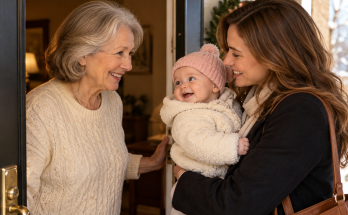
One Sunday, Vanessa arrived with Rose bundled against the cold.
She rang the bell.
I opened the door.
“Grandma,” Vanessa said, “we brought trouble.”
Rose immediately began crying.
“Accurate.”
Vanessa laughed.
I stepped aside.
“Come in.”
She entered.
Not because she had a key.
Because I invited her.
And that difference, small enough to fit inside a doorway, was everything.
The End
Read more original stories on Feel Every Story.
The Night My Daughter Took My Keys, Called Me Confused, and Turned a Family Argument Into Something I Could No Longer Ignore
Part 35 of 35