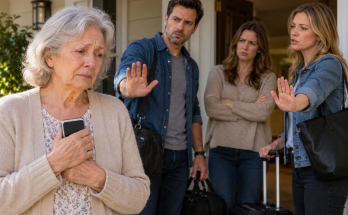
The next morning, when all twelve of them appeared… the gate was closed with a new chain.
Not with Joe’s old padlock, the one Charlie used to open with a stone because he said it “didn’t work anymore anyway.”
It was a thick chain.
Shiny.
With a large padlock that seemed to say what I still didn’t dare to shout:
“That’s enough.”
They arrived in three cars.
The first was Charlie’s, with Lauren by his side and the kids in the back, fighting over a tablet.
Then came David, my other son, with his wife Melissa, two huge suitcases, and a blue cooler full of meat.
Finally, my nephews arrived, the sons of my late sister, because for the holidays they actually remembered that I existed.
They all got out laughing.
They came with bags of charcoal, beer, ribs, speakers, towels, floaties for the creek, and that insolent confidence of those who have never asked for permission because the door was always opened for them.
Charlie went straight to the big flowerpot next to the gate.
He reached underneath.
Nothing.
He felt around again.
Nothing.
“Where is the key?” he said, annoyed.
Lauren put her sunglasses on her head.
“I’m sure your mom moved it. You know how she gets sometimes.”
I watched them from the living room window, behind the white curtain I had embroidered myself when Joe was still alive.
John was with me, looking serious, holding his hat in his hands.
“Miss Barbara, are you sure you want to do it this way?”
“No, John,” I answered. “But I’m even less sure about keeping things the same.”
Charlie then saw the sign hanging on the gate.
It was a wooden board, made by John early that morning, with large black letters:
“The Haven Farm is not a hotel.
Private property.
Entry only with the authorization of Barbara Anderson.”
Underneath, in a small plastic bag tied with string, was the brown notebook.
The same one Charlie had thrown in the trash.
Lauren was the first to laugh.
“Oh, for God’s sake. Now she’s really being dramatic.”
Charlie tore the bag from the gate, took out the notebook, and opened it in annoyance.
I saw the exact moment he stopped looking angry and started looking uncomfortable.
Because the first page didn’t say what he expected.
It wasn’t a list of recipes.
It wasn’t an old woman’s notes.
It was a letter written in my firm handwriting:
“Dear family:
Since you removed me from the group chat because it was for working adults, I decided to have my own adult meeting.
Here is the accounting of the last eleven years.
Read it before you ring the bell.
Barbara.”
David approached.
“What does it say?”
Charlie turned the page.
That’s where the accounts began.
Not just Joe’s accounts.
Mine.
“2014. Charlie and Lauren arrived with six guests. Three days. Food, gas, electricity, cleaning, repairing a broken chair: paid for by Barbara.”
“2015. David asked for money to change his car. Never paid it back. Paid for with the sale of two steers.”
“2016. Lauren organized a birthday party at the farm. Two windows were broken. Paid for by Barbara.”
“2017. Charlie asked for a loan for the kids’ school. He said it was urgent. Never paid it back.”
“2018. All twelve came for Spring Break. They left trash in the creek. John cleaned for two days. Paid for by Barbara.”
Page after page.
Year after year.
Favor after favor.
Lie after lie.
I didn’t write it to humiliate them.
I wrote it because for too long even I had forgotten how much it cost to be “the mom who always helps.”
Lauren took the notebook from Charlie.
She read a page.
Then another.
“This is absurd,” she said. “Now she’s going to charge us for visiting family?”
I opened the front door and stepped out onto the porch.
I walked slowly.
Not out of weakness.
But because I wanted them to see me arrive whole.
In my blue dress, my comfortable sandals, and my hair tied up the way I used to wear it on Sundays when Joe would tell me I looked like the owner of everything I touched.
I stood on the other side of the gate.
“I’m not charging you for the visits,” I said. “I’m showing you what you called love.”
The children went quiet.
The adults did not.
Charlie squeezed the notebook.
“Mom, open the gate.”
“No.”
He stood there as if he hadn’t heard me right.
“What do you mean, no?”
“I’m not opening it.”
David let out a nervous laugh.
“Mom, don’t start. We came with food, with the kids. We already drove three hours.”
“I also drove to the doctor alone many times, and no one ever asked if I got there safely.”
Charlie looked at John.
“You open it.”
John lifted his head.
“The owner’s orders are not to open it.”
Lauren clicked her tongue.
“The owner? Charlie, tell her something. This farm belongs to the family.”
I smiled.
Not with joy.
With an ancient tiredness.
“That was your first mistake. You confused a future inheritance with present ownership.”
Charlie lowered his voice.
“Mom, don’t embarrass us in front of the kids.”
“I’m not the one causing the embarrassment. You brought it with you in your suitcases.”
David stepped closer to the gate.
“What do you want? An apology? Fine. I’m sorry. There. Open up.”
I looked at him.
My youngest son.
The one who, as a child, used to fall asleep with his hand tucked into my pocket because he said that way he knew if I was still nearby.
“I don’t want an apology that sounds like a toll fee,” I said. “I want respect.”
Melissa intervened for the first time.
“Miss Barbara, it’s not that big of a deal. Charlie removed you from the group because we talked about money, work, practical things in there.”
“And who do you think paid for a good part of those practical things over the years?”
No one answered.
Then I held up the notebook.
“You despised this because it was old. But on these pages, Joe and I wrote down everything we built. And last night, under the floorboards in my room, I found what your father left hidden for when you forgot that this house had an owner before it had guests.”
Charlie turned pale.
“What did you find?”
“The original deed. Joe’s will. And a letter.”
I took an envelope out of my purse.
I didn’t hand it to them.
I just showed it.
“Your father left everything in my name as long as I live. The land, the house, the well, the trees. Everything. And he also left clear instructions: if any of you tries to force me to sell, put me in a home, or declare me incompetent to take the farm, you are cut out of any future benefits.”
Lauren opened her mouth.
“That can’t be legal.”
“That’s why the notary came yesterday.”
Charlie looked at me as if I had slapped him without touching him.
“You called a notary before calling us?”
“You removed me from the group before coming to my house.”
David started sweating.
“Mom, no one wants to take anything from you.”
“No?”
I opened the notebook to another page.
A new one.
Written that early morning.
“Message from Lauren: ‘Leave the keys in the usual spot. We’re coming on Friday with the kids.’ Without asking. Without inviting. Without acknowledging the owner.”
I looked up.
“Is that how you speak to a mother or an employee?”
Lauren crossed her arms.
“I just organized a family weekend.”
“No. You organized to occupy my house.”
Charlie lost his patience.
“Mom, it’s just a farm!”
The silence that followed hurt me more than his yelling.
Because that phrase confirmed everything.
To him, it was just a farm.
Not the place where Joe built walls with hands covered in blisters.
Not the yard where Charlie took his first steps.
Not the kitchen where I spent early mornings making pancakes, stew, and coffee for everyone.
Not the lemon trees we planted when my little girl died, the one they almost never mentioned because someone else’s pain makes people uncomfortable.
Just a farm.
A useful place.
A pending prize.
“To you, maybe it’s just a farm,” I said. “To me, it’s the life I have left.”
My grandchildren stood staring at me.
One of them, Matthew, Charlie’s oldest, lowered his head.
I think he understood more than his parents did.
Charlie ran his hand through his hair.
“So what do you expect? For us to turn around and go back?”
“Yes.”
Lauren let out a shout.
“With kids, with food, with everything!”
“You should have thought about that before planning a vacation in someone else’s house.”
David tried another approach.
“Mom, we love you.”
“Then do it without using my bedsheets.”
He didn’t seem to understand.
I continued:
“Loving is not arriving with coolers and leaving trash. Loving is not erasing a woman from a group chat and then asking her for keys. Loving is not throwing the notebook in the trash where your father wrote with tired hands everything he was leaving you.”
Charlie looked at the notebook.
For the first time, not with annoyance.
With fear.
“Mom, I was upset. I shouldn’t have thrown it away.”
“You didn’t throw it away because you were upset. You threw it away because, to you, what is old is no longer useful.”
He opened his mouth.
He found no defense.
Behind me, John coughed softly.
It was the signal.
Attorney Evans’ car was coming up the dirt road.
My children turned around.
Charlie frowned.
“Who is that?”
“My lawyer.”
Lauren turned pale.
“This is getting ridiculous.”
“No. Ridiculous was believing you could exclude me from my own family and walk right into my own house.”
The attorney got out of his car with a folder under his arm. He was a calm man, one of those who don’t need to raise their voices because they have their paperwork in order.
He approached the gate.
“Good morning.”
No one answered.
He continued, politely:
“On the instructions of Mrs. Barbara Anderson, you are informed that there is no authorization to enter the property. Any attempt to force entry will be reported. You are also being provided with a simple copy of the rules for the future use of the farm, in case she decides to invite you over someday.”
David blurted out:
“Rules? Now we need rules to see our mother?”
I looked at him.
“No. Not to see me. But to use my house, yes.”
The lawyer pulled out some papers.
“First: visits only with the express invitation of the owner. Second: no one shall stay without her present or without written authorization. Third: each visitor is responsible for their own food, cleaning, and any damages. Fourth: leaving keys under flowerpots is prohibited. Fifth: any disrespect towards Mrs. Barbara or the farm’s staff will result in immediate expulsion.”
Lauren laughed angrily.
“Staff? Now John is staff?”
John looked up.
“I always was, ma’am. It’s just that you treated me as if I was born to carry coolers.”
Lauren fell silent.
Good.
Sometimes a person’s dignity appears when someone else decides to name it.
Charlie looked at me with watery eyes.
“Mom, are you really going to leave us outside?”
“Yes.”
“I’m your son.”
“And I am your mother. Not your doorman.”
I saw the phrase hit him.
Maybe it was the first time he had heard those two things separated.
Mother.
Doorman.
Kitchen.
Key.
Farm.
Person.
All mixed together for years until they no longer knew how to tell me apart from them.
Matthew, my grandson, approached the gate.
“Grandma.”
Charlie tried to stop him.
I raised a hand.
“Let him be.”
The boy was fifteen and carried a shame on his face that wasn’t his own.
“I didn’t know they hadn’t told you. I thought you were expecting us.”
I swallowed hard.
“I know, sweetheart.”
“I’m sorry.”
Now that was an apology.
Not because it fixed everything.
But because it didn’t come to open a gate.
It came to acknowledge a wound.
“Thank you, Matthew.”
He looked at his dad.
“Are we leaving?”
Charlie couldn’t answer.
Lauren furiously got into the car.
“Perfect. Let’s go. Let her stay all alone with her farm and her little notebook.”
I heard her.
And for the first time in years, the word “alone” didn’t scare me.
It gave me space.
David put away the bags of charcoal.
Melissa loaded the suitcases.
The kids got in quietly.
Charlie was the last.
Before getting into the car, he held up the notebook.
“Can I take it with me to read?”
“No.”
He stood still.
“But it’s about us.”
“That’s exactly why it stays with me. You’ve already taken too many things without asking.”
He lowered his hand.
“When can I come to talk?”
“When you come without a suitcase.”
He didn’t say anything else.
The cars drove off, kicking up dust.
The meat.
The coolers.
The laughter.
The entire family returning down the same road they had come, certain they would find a docile old woman and a key under a flowerpot.
When they disappeared, I sat on the porch bench.
My hands were shaking.
John approached.
“Miss Barbara, should I make you some coffee?”
“Yes.”
“Strong?”
“Strong enough to wake the dead.”
He smiled.
I did too.
But when he went to the kitchen, I cried.
Of course I cried.
I wasn’t made of stone.
I was a mother.
And a mother can set boundaries and still feel like her heart is breaking in two.
I cried for little Charlie.
For David climbing the apple trees.
For the Christmases with Joe grilling meat while I handed out plates.
For the Sundays when my children ran around the yard and I thought that joy would protect us from everything.
It doesn’t.
Love without respect becomes a habit.
And a habit, if not stopped, ends up looking a lot like abuse.
That afternoon, I opened the notebook again.
On the last page, I glued Joe’s letter.
I had read it so many times during the early morning that I could almost recite it by heart:
“Barbara:
If someday the boys forget that you are the root and not the shade, don’t give them the land to make them remember.
The farm isn’t valuable for what it costs. It’s valuable because it was our struggle.
Don’t confuse being alone with being without love. Sometimes, for them to truly look at you again, they first need to find a closed door.
Joe.”
Wise old man.
Stubborn old man.
My old man.
For two weeks, no one came.
There were messages.
Many.
Lauren saying I was manipulative.
David saying everything had spiraled out of control.
Charlie typing and deleting.
My nephews asking if they could stop by “just to pick up a cooler” they had forgotten months ago.
I didn’t reply to everyone.
I learned late that not every message deserves to open a wound.
The first one to return was Matthew.
He took a bus to town and then walked for half an hour under the sun. John saw him from the entrance and let me know.
“The boy is coming.”
I went outside.
Matthew didn’t have a suitcase.
He brought a bag with bread and cheese.
“Grandma, can I come in?”
I felt something warm welling up in my eyes.
“Yes.”
“My dad doesn’t know I came.”
“That’s between you and him.”
He sat with me in the kitchen.
He didn’t ask for the Wi-Fi.
He didn’t turn on any speakers.
He didn’t open the fridge as if it were his.
He just looked around.
“Did Grandpa write everything in that notebook?”
“Almost everything.”
“Can I read a part of it?”
I thought about it.
Then I opened to an old page, from when Joe wrote down how much the first lemon trees cost.
Matthew read slowly.
“We bought four saplings. Barbara says someday they will provide shade for the grandkids.”
The boy swallowed hard.
“They did.”
“Yes.”
“I don’t want to be like my dad.”
That sentence hurt me and made me glad at the same time.
“Then start by not despising what others built before you.”
Matthew came back several Sundays.
He learned to prune.
To clean the irrigation ditch.
To make coffee without making it too watery.
One day he asked me if he could copy some pages from the notebook for a school project on family history.
I said yes.
When Charlie found out, he came.
Alone.
Without Lauren.
Without coolers.
Without kids.
He knocked on the gate.
He didn’t yell.
He didn’t look for a key under the flowerpot.
He just knocked.
John looked at me.
“Should I open it?”
I took a deep breath.
“Open it.”
Charlie walked in slowly.
He looked older.
Or maybe, for the first time, he came without the costume of an owner.
He stood in front of me on the porch.
“Mom.”
“Charlie.”
His eyes were red.
“I’m not here to ask for the farm.”
“Good.”
“I’m here to ask you to show me the notebook.”
I didn’t answer right away.
He continued:
“Matthew read a part of it to me. The part about the lemon trees. I… I didn’t know Dad had written so much.”
“You didn’t ask.”
He lowered his head.
“No.”
“You also didn’t ask how much it cost me to maintain this place.”
“No.”
“Or if it hurt me when you all arrived without warning.”
“No.”
“Or if I wanted to cook for twelve people.”
He closed his eyes.
“No.”
The silence filled with the sounds of birds.
Then he said:
“I’m sorry I removed you from the group chat.”
I didn’t say anything.
“I’m sorry for saying you didn’t understand. You understood more than all of us. You understood what a house, a family, and an entire life cost.”
His voice broke.
“And I’m sorry for throwing the notebook in the trash.”
That apology did touch me.
I didn’t hug him right away.
I didn’t want him to think an apology erased years.
But I put the notebook on the table.
“Read.”
He read for hours.
Some pages in silence.
Others with his hand over his mouth.
When he got to the accounts of his loans, he cried.
“I always told myself they were small favors.”
“Because you weren’t the one paying for them.”
“Why did you never confront me about it?”
“Because I confused being a mother with never asking to be paid back.”
He looked at me.
“And now?”
“Now I don’t charge you with money. I charge you with respect.”
Charlie nodded.
“I want to be back in the group chat.”
I gave a small smile.
“I already made another one.”
He took out his cell phone.
The invitation came through.
The group was called:
“The Haven Farm – with Barbara’s permission.”
Charlie laughed through his tears.
“I deserve that.”
“Yes.”
Over time, some returned.
Not all in the same way.
Lauren took months. When she arrived, it was with a homemade cake, without her sunglasses on her head, and with an apology that cost her more than any amount of money.
David also came.
He signed an agreement to slowly pay back what he could from his old debts. Not because I needed every penny, but because he needed to learn that receiving help doesn’t mean leaving the receipt buried in his mother’s memory.
Weekends changed.
Twelve people no longer arrived unannounced.
They asked me.
Sometimes I said yes.
Sometimes I said no.
The first time I said no and Charlie replied “that’s fine, Mom,” I went to my room and cried as if I had won a small war.
The key never went back under the flowerpot.
Now it hangs in my kitchen, next to the notebook.
And everyone knows it is not to be touched without asking me for permission.
Not because I’ve become mean.
But because I finally became the owner out loud.
Today, when they ask me why I put my family through that embarrassment in front of the gate, I answer that the embarrassment already existed.
I just put a sign on it.
For years, my children arrived at the farm with meat, coolers, and suitcases, convinced that a mother’s love was a hidden key to use whenever they pleased.
But that morning they found a closed gate.
A sign.
And an old notebook.
The notebook that Charlie threw in the trash because he thought it only gathered dust.
He didn’t know that written inside was everything they had forgotten.
The cost of the well.
The price of the roof tiles.
The shade of the lemon trees.
The debts never repaid.
The weekends turned into work for a widow.
Joe’s handwriting protecting me from deep within the earth.
And my own voice, finally, saying:
“This house has a memory. And memory also closes doors.”
I didn’t lose my family by closing the gate.
I lost the habit of letting them walk all over me without looking.
And that, at seventy-six years old, was the first key that truly belonged to me.