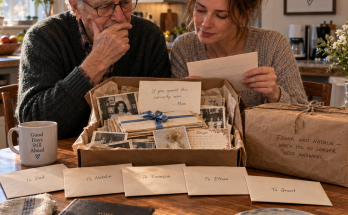
Leo decided to write Sarah six weeks after my visit.
He did not announce it dramatically.
He came into the kitchen carrying three sheets of notebook paper and asked for an envelope.
“Regular or big?”
“Regular.”
I opened the drawer.
Then I stopped.
“Is this for your mom?”
“Yes.”
“Does Dr. Patel know?”
“Yes.”
That answered the safety question.
I handed him an envelope.
He did not ask me to read the letter.
I did not ask.
That required more restraint than I expected.
He sealed it.
Then wrote Sarah’s prison mailing address carefully from the card Dr. Patel had given him.
His handwriting leaned forward.
Michael’s had too.
“Do I need a stamp?”
“Yes.”
“How many?”
“One.”
“That’s cheap.”
“Please never say that in front of the postal service.”
He rolled his eyes.
We mailed it the next morning.
For ten days, Leo said nothing.
Then every afternoon he checked the mailbox.
I noticed.
I did not comment.
On day twelve, an envelope arrived.
Sarah’s handwriting.
Addressed to Leo.
He took it to his room.
The door remained closed for almost an hour.
When he came downstairs, his face looked swollen.
“Want company?”
He nodded.
We sat on the couch.
“She answered everything.”
I waited.
“I asked if she knew Dad was going to take me from school.”
My stomach tightened.
“What did she say?”
“She knew he might.”
That was more precise than I expected.
“She said they talked about using me to scare you, but she didn’t know exactly when Dad would pick me up.”
Leo stared at the carpet.
“So she knew enough.”
“Yes.”
“She said that too.”
He unfolded the letter.
“I asked why she signed my name.”
“The blank sheet?”
He nodded.
“She said she didn’t sign it. She made me sign the blank paper and then let them use it.”
“That matches the evidence.”
“She said that doesn’t make it better.”
“No.”
Leo swallowed.
“I asked if she loved me when she did it.”
That question hurt most.
“What did she say?”
He handed me the letter.
I did not take it immediately.
“Do you want me to read it?”
“Yes.”
I read only the paragraph he indicated.
I loved you when I did it. That is one of the hardest things I have had to understand. Loving you did not automatically make my choices loving. I used to think that if I loved someone, my reasons should count more than what I actually did to them.
I stopped.
Sarah continued.
You never have to say what happened was okay in order to believe I loved you. Both things can be true, and I am sorry you have to carry that complicated truth because of me.
I gave the letter back.
“That’s a good answer,” I said.
Leo looked almost offended.
“It’s still bad.”
“The situation is bad. I mean she answered honestly.”
“Oh.”
He thought.
“Yeah.”
“What else did you ask?”
“Private.”
“Okay.”
He seemed relieved that I meant it.
Two days later, Dr. Patel called me after receiving Leo’s permission to discuss one issue.
“He wants to know whether he can eventually visit Sarah.”
My stomach tightened automatically.
“I told him it was possible.”
“He’s not ready yet.”
“Okay.”
“He wanted reassurance that waiting doesn’t mean he’s punishing her.”
I sat at the kitchen table.
“What did you tell him?”
“That boundaries are not punishment simply because someone dislikes them.”
I almost laughed.
“You people should print that on mugs.”
“We’d lose our professional dignity.”
“I doubt that.”
She continued.
“Amber, there is something else. Leo worries that if he visits his mother, he will be betraying his father.”
That surprised me.
“He doesn’t even want contact with David.”
“Children can feel loyalty toward a parent they fear or reject.”
“What should I do?”
“Nothing dramatic. If he brings it up, let him know relationships are not votes.”
Relationships are not votes.
I wrote that down.
A week later, Leo brought up David while we were grocery shopping.
Not an ideal setting.
Children rarely schedule emotional conversations properly.
“Do you think Dad knows I wrote Mom?”
“I don’t know.”
“Would he be mad?”
“I don’t know.”
“He always got mad when Mom talked to people he didn’t like.”
We moved past canned soup.
“You are allowed to write your mother whether your father likes it or not.”
“What if I write Dad someday?”
“You’re allowed to consider that too, with Dr. Patel helping make sure it’s safe.”
Leo stared at me.
“You wouldn’t be mad?”
“No.”
“After what he did to you?”
“Your relationship with him is not a reward you give me.”
He was quiet.
Then he said, “That sounds like Dr. Patel.”
“Terrible news.”
He smiled.
The restitution process continued in the background.
The SUV deficiency became part of my documented loss.
The lender released me after payment.
The title issue disappeared from my credit report.
My score, which had dropped during the fraud investigation, began recovering.
For years I had never thought about my credit except when someone else needed me to sign something.
Now it was mine again.
I froze it unless I needed access.
Elaine called that “financial adulthood.”
“I’m sixty-seven.”
“Some lessons are poorly scheduled.”
Martha had stronger opinions.
“You should tattoo NO GUARANTEES on your hand.”
“I am not tattooing financial advice on myself.”
“Fine. Put it on a bracelet.”
She brought over chicken salad and examined the new fireproof box.
“Where’s the key?”
“Not telling you.”
“Excellent.”
That was friendship too.
Not needing access.
The next major change came through family court.
Because both Sarah and David had received prison sentences, temporary custody arrangements had to become longer-term guardianship.
My attorney filed the necessary petition.
Nobody contested it.
Sarah signed consent.
David, after consulting counsel, did too.
The hearing was quieter than the earlier ones.
No accusations.
No emergency.
The judge reviewed my home, finances, Leo’s school status, therapy, and wishes.
Then she spoke privately with Leo.
I waited outside.
When he returned, he looked irritated.
“What?”
“She asked if you make me do chores.”
“I hope you told her the horrifying truth.”
“I said dishes.”
“Good.”
“And trash.”
“You poor thing.”
The guardianship order was approved.
I became Leo’s legal guardian for the foreseeable future.
Not his replacement mother.
Not owner of his future.
Guardian.
The word mattered.
I signed documents.
Then took him for burgers.
No celebration banner.
No dramatic speech.
He ordered a milkshake large enough to qualify as construction material.
Halfway through lunch he said, “So I’m staying with you.”
“Yes.”
“For years?”
“Probably.”
“What if Mom gets out?”
“We’ll decide what is safe and appropriate then, with the court if necessary.”
“So I don’t automatically go back?”
“No.”
Relief crossed his face before guilt followed it.
I recognized both.
“You’re allowed to feel relieved.”
“I still love her.”
“I know.”
“Those aren’t opposites?”
“No.”
He drank his milkshake.
“Everything is both things now.”
I smiled.
“Unfortunately.”
The guardianship changed practical matters.
School authorization.
Medical decisions.
Travel.
Savings.
I met with Elaine to update estate documents.
Again.
I had become unusually good at updating wills.
Leo’s trust remained protected.
A professional trustee would manage it if I died before he reached the designated ages.
Joanne would have a limited personal role but no unilateral financial control.
Martha agreed to serve as backup guardian if necessary.
Sarah would not automatically control inherited assets even after release.
Neither would David.
Every arrangement was designed around roles.
Not assumptions.
Not promises.
Not “family will figure it out.”
Family had demonstrated exactly why documents existed.
When I told Joanne about her limited role, she nodded.
“No offense taken.”
“You sure?”
“I hid seventy-five hundred dollars from you for six years.”
“That is a persuasive argument.”
She laughed.
Then became serious.
“I’m glad you still want me involved.”
“I do.”
“Just not with money.”
“Correct.”
“Very wise.”
Specific trust.
Specific boundaries.
It felt healthier than pretending one mistake made someone entirely unsafe or entirely safe.
Sarah’s next letter to me mentioned Leo only once.
She thanked me for caring for him.
No request for updates.
Then she wrote about prison work.
She had moved from laundry to a clerical assignment.
The pay remained tiny.
She preferred it because she liked organizing records.
That made me laugh in a dark way.
Sarah organizing records.
Perhaps life enjoyed irony.
She was also taking a bookkeeping course.
That worried me.
I called Elaine.
“Is Sarah allowed to study bookkeeping after financial fraud?”
Elaine laughed.
“Education is not a criminal instrument.”
“You know what I mean.”
“Yes. Restrictions will apply to certain financial employment after release. Learning legitimate accounting may actually help.”
I had to accept that.
Knowledge had not caused Sarah’s fraud.
Entitlement and deception had.
Proper accounting might be part of learning the opposite.
Months passed.
Leo turned eleven.
His birthday was smaller than previous years.
By choice.
Robotics friends.
Pizza.
Cake.
Martha gave him a toolkit.
Joanne gave him books.
I gave him a new bicycle helmet and money deposited directly into his protected account.
Then I gave him the one surviving savings bond Michael bought.
Not physically; the record remained secure.
I printed the documentation and placed it in a card.
Leo stared at the amount.
“Grandpa gave me this?”
“Yes.”
“And Mom didn’t cash this one?”
“No.”
“Why?”
“I don’t know.”
He held the paper carefully.
“Can I keep it until I’m old?”
“Yes.”
“How old?”
“That’s up to you when you’re legally able to decide.”
He smiled.
“Maybe a hundred.”
“Then it will be somebody else’s paperwork problem.”
That night, after everyone left, Leo brought out Michael’s brass level.
He placed it beside the bond document.
“Grandpa liked stuff that lasted.”
“Yes.”
“Do you think he knew everything would happen?”
“No.”
That answer mattered.
“He saw some problems. He did not predict our whole lives.”
“Mom said he warned her.”
“He did.”
“Then why didn’t he stop it?”
There it was.
The question I had asked privately for months.
“He tried in the ways he knew.”
“That didn’t work.”
“No.”
Leo frowned.
“Then what was the point?”
I looked at the level.
“Trying to do the right thing doesn’t guarantee you can control what other people choose.”
He considered that.
“That sucks.”
“Yes.”
“But he still tried.”
“Yes.”
Leo put the level back.
Two weeks later, Sarah sent him a birthday letter.
No gift.
Prison rules and her finances made that difficult.
Inside she had drawn a terrible robot.
Leo laughed so hard he brought it downstairs.
“She made the wheels square.”
“Maybe it’s conceptual.”
“It’s bad.”
He taped it near his desk.
Beside the old family drawing.
Past and present sharing the same wall.
Then something happened I had not expected.
A letter arrived for me from David.
The prison return address was different.
I knew immediately.
He had respected my earlier refusal for months.
Now he had written anyway through approved channels.
I did not open it.
I called Elaine.
“Do I have to keep this?”
“No.”
“Do investigators need it?”
“Not unless it contains threats or relevant undisclosed information.”
“I don’t want to read it.”
“Then don’t.”
Simple.
I shredded it unopened.
For years I believed closure required hearing every explanation.
It did not.
Sometimes the closed door was the closure.
When I told Dr. Patel—not because I needed approval, but because David remained relevant to Leo—she asked whether I would tell Leo a letter had arrived.
“No reason unless it affects him.”
“I agree.”
That was the first time in months I made a decision involving David without wondering whether I was being too harsh.
I simply did not want contact.
That was enough.
Sarah was different.
Not because she deserved more by some universal scale.
Because my relationship with her was different.
I scheduled a second visit.
This time I did not agonize for weeks.
I still felt nervous.
But fear was no longer making the decision.
When Sarah entered the visiting room, she smiled cautiously.
“Hi, Mom.”
“Hi.”
She sat.
“I wasn’t sure you’d come again.”
“Neither was I.”
“Fair.”
We talked for nearly an hour.
At the end, Sarah asked one question.
“Does Leo hate me?”
I looked at her.
“That’s his private emotional life.”
She nodded immediately.
“You’re right.”
No pressure.
No attempt to make me reassure her.
Then she said, “I hope someday he doesn’t.”
I could allow that.
Hope was not a demand.
As I drove home, I realized something had changed.
Sarah was beginning to ask questions without insisting on answers.
And I was beginning to care about her without treating care as an obligation to provide them.
Click here to continue reading: PART 27: A Year After Sarah Asked Me to Disappear, Her Old Message Returned to My Screen and Finally Looked Like Evidence Instead of a Wound
The Message That Removed Me From My Daughter’s Life Came With One Expectation She Never Thought I Would Question
Part 26 of 36