The invitation arrived from Claire, not Eleanor.
That mattered.
Ten years had passed since Thomas Montes died.
Claire wanted to hold a small memorial.
Not because the anniversary itself required ceremony.
Because she finally had access to enough of her father’s real life to remember him without her mother’s version dominating.
“He hated memorials,” Claire told me.
“Then this sounds risky.”
“He also hated catered sandwiches.”
“Now you’re disrespecting him.”
She smiled.
The gathering would be at a community room near the park.
Twenty people.
Family.
A few old colleagues.
Rachel.
Martin.
Possibly Eleanor.
“Possibly?”
“I invited her.”
“How do you feel about that?”
“Terrified.”
“Do you want me there?”
“Yes.”
That was why I agreed.
Not for Eleanor.
Not for Jason.
For Claire.
David asked whether he should come.
“No.”
“Okay.”
Again.
Simple.
The afternoon of the memorial was bright and cold.
Claire stood near the entrance wearing a navy dress and Thomas’s old watch.
I recognized Rachel immediately from photographs.
Older now.
Silver in her hair.
Steady eyes.
She hugged Claire for a long time.
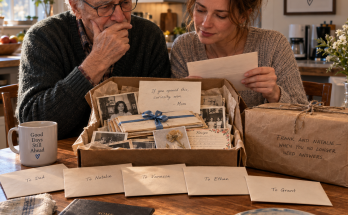
Martin arrived carrying a small wooden box.
Inside were photographs from the years before Hudson became what it became.
Thomas at a picnic.
Thomas holding baby Claire.
Jason at twelve with enormous glasses.
Eleanor laughing beside a station wagon.
I stared at that photograph.
Not because I wanted evidence.
Because Eleanor looked ordinary.
Happy.
No visible archive.
No leverage.
No warning sign.
People do not photograph their future mistakes.
Eleanor arrived alone.
The room changed slightly.
Not dramatically.
Conversation softened.
Rachel watched her.
Martin looked away.
Claire walked over.
“Hi, Mom.”
Eleanor stopped several feet from her.
“Hi.”
No hug until Claire initiated one.
Boundary.
Then Eleanor saw me.
Her face changed.
We had not stood in the same room for nearly three years.
She did not approach.
Good.
Claire came back to me later.
“She asked if she could say hello.”
I considered.
“Okay.”
Eleanor approached slowly.
“Sophia.”
“Eleanor.”
For one second, I saw the woman at the microphone again.
Perfect dress.
Champagne.
Certainty.
This Eleanor looked smaller.
Not physically.
Socially.
She no longer assumed the room belonged to her.
“I’m glad you came for Claire.”
“I came for Claire.”
“I know.”
She did not apologize.
I was grateful.
This was not the place.
Then she said:
“I heard you’re doing well.”
“I am.”
A small nod.
“I’m glad.”
“Thank you.”
That was enough.
She walked away.
My pulse remained steady.
I had once imagined seeing her again would require confrontation.
Instead, it required approximately fourteen words.
The memorial began.
Claire spoke first.
She did not turn Thomas into a saint.
“He waited too long to leave,” she said.
The room became still.
“He knew things were wrong before he acted. That matters.”
Rachel lowered her eyes.
“But he did act.”
Claire described his recordings.
Not details connected to active legal matters.
The personal part.
His effort to preserve records.
His attempt to warn people.
His failed attempts to reconnect with his children.
“I spent years angry at him for leaving.”
Her voice shook.
“Then years angry at myself for believing the wrong story.”
She paused.
“I’m trying not to spend the next years angry.”
That was the most honest memorial speech I had ever heard.
Rachel spoke next.
She told a story about Thomas ruining Thanksgiving gravy.
Martin described a business trip where Thomas refused to expense a minibar charge because he had eaten the peanuts personally.
People laughed.
Then Eleanor stood.
I felt the room tighten again.
Claire had told her she could speak if she kept it about Thomas.
No defense.
No litigation.
No correcting other people’s memories.
Eleanor held no notes.
“I loved him.”
She stopped.
For a moment I feared the sentence would become an argument.
It did not.
“I also made loving me difficult.”
Rachel looked at her.
Eleanor continued.
“Thomas used to tell me that I turned every disagreement into a problem to solve.”
A few people smiled.
“He said sometimes a person doesn’t need to be solved.”
Claire’s face tightened.
Eleanor looked at her daughter.
“I wish I had listened sooner.”
Then she told a story.
Thomas once lost his wallet during a family vacation.
Eleanor spent two hours retracing every location, questioning hotel staff, calling restaurants.
Thomas sat on the beach.
She became furious.
“How can you sit there?”
He answered:
Because you’re already worrying enough for both of us.
The room laughed softly.
Eleanor smiled.
“He was infuriating.”
Then:
“And sometimes right.”
She sat.
No grand confession.
No request for absolution.
That restraint was perhaps the strongest evidence of change I had seen from her.
Afterward, people mingled.
Rachel and Eleanor eventually stood near each other.
I did not hear the beginning.
I was not trying to.
Then Rachel’s voice rose slightly.
“You kept my file.”
The room nearby quieted.
Eleanor nodded.
“Yes.”
“For how long?”
“Years.”
“Why?”
“I thought information prevented surprises.”
Rachel stared.
“Did it?”
“No.”
One word.
No explanation.
Rachel asked:
“Did you ever intend to use my inheritance?”
Eleanor answered carefully.
“I considered whether it could help Jason.”
Rachel’s face hardened.
“That’s not what I asked.”
Eleanor inhaled.
“Yes.”
There.
No passive voice.
No:
The family considered.
No:
Circumstances required.
I intended.
Rachel nodded.
“Thank you.”
Not forgiveness.
Fact.
Then Martin approached.
He asked about records from his guarantee.
Eleanor answered.
Another former colleague asked about an old investment.
Soon she stood among people whose lives had once been reduced to folders.
No one attacked her.
That almost made the scene more difficult.
They asked questions.
She answered when she knew.
Said I don’t know when she did not.
Said I did that when she had.
I watched from across the room.
Claire came beside me.
“You okay?”
“Yes.”
“Mom looks like she’s being audited by ghosts.”
“That is an alarming phrase.”
“Accurate.”
One person did not approach Eleanor.
Me.
I had no remaining question she could answer that would change anything.
That felt like its own freedom.
Then Martin opened the wooden box of photographs.
People gathered.
One picture showed Jason around twenty, standing beside Thomas outside a small office.
On the back Thomas had written:
First day. Told him business is just promises with paperwork.
I stared at it.
Promises with paperwork.
A simple definition.
Somewhere along the way, Jason’s family learned to treat paperwork as a way around promises.
Signatures without consent.
Documents without disclosure.
Profiles without permission.
The form remained.
The promise disappeared.
Claire took the photograph.
“Can I keep this?”
Martin smiled.
“That’s why I brought it.”
Eleanor saw the picture.
Her face crumpled.
She turned away.
Claire did not chase her.
Another boundary.
People were allowed their own emotions.
Nobody had to rescue them immediately.
Later, I stepped outside for air.
Rachel followed.
We had met before only briefly.
“You’re Sophia.”
“Yes.”
She smiled.
“I’m glad you escaped the spreadsheet.”
I laughed.
“Apparently.”
She leaned against the railing.
“I almost married him.”
“Jason?”
“Yes.”
“I know.”
“Of course you do.”
Everyone’s history had become annoyingly searchable inside our circle.
Rachel looked through the window at Eleanor.
“She wasn’t always like this.”
I waited.
“I don’t mean that as defense.”
“I know.”
“She used to be fun.”
The photograph confirmed it.
“Then Peter taught her that knowing people’s weaknesses was smart business.”
“And she chose to keep doing it.”
“Yes.”
Rachel nodded.
“That distinction matters.”
We had all arrived at the same place.
Origins explain.
Choices assign responsibility.
Rachel asked:
“Do you think Jason changed?”
“I don’t know.”
“You don’t know?”
“I don’t follow him.”
She smiled.
“Good answer.”
“What about you?”
“I don’t know either.”
Then:
“I hope so.”
That surprised me.
“Why?”
“Because otherwise all that damage produces nothing except damage.”
I considered.
“I don’t think his change would redeem the damage.”
“No.”
“But it could stop more.”
“Exactly.”
That was a form of hope I could tolerate.
Not reconciliation.
Prevention.
Inside, Claire tapped a glass.
“One last thing.”
We returned.
She held Thomas’s old digital recorder.
My chest tightened.
Not the evidence recorder itself; investigators had retained the original for years and later returned a copy of the files.
Claire held a replacement device loaded with one personal recording she had never played publicly.
“I found this among Dad’s non-case files.”
She pressed play.
Thomas’s voice filled the room.
Rough.
Warm.
Alive enough to make Claire cover her mouth.
He was apparently testing the recorder.
“One, two. Claire says these things are idiot-proof, which is insulting because I have met idiots.”
People laughed through tears.
Then background noise.
Thomas calling to someone.
Eleanor, did you take my blue shirt?
A distant female voice answered:
Why would I take your shirt?
Because you steal all the good things in this house.
Eleanor laughed on the recording.
Not the controlled laugh I knew.
A real one.
Then Thomas:
Found it. Never mind. Withdraw the accusation.
The recording ended.
Silence.
Eleanor was crying openly.
Claire too.
I felt tears in my own eyes.
Not because the memory absolved anyone.
Because it preserved a family before everything hardened.
Love had existed.
So had humor.
So had ordinary mornings.
Later came fear.
Control.
Files.
Lies.
One truth did not erase another.
Claire turned off the recorder.
“That’s how I want to remember him sometimes.”
Not warning us.
Not recording evidence.
Looking for a shirt.
I understood.
The dead deserve more than their usefulness to the living.
Thomas had become the man whose recordings exposed the system.
But before that, he had been a father who lost things and made bad gravy.
We packed the room.
Eleanor carried chairs without being asked.
Rachel took photographs.
Martin left early.
When I hugged Claire goodbye, she whispered:
“Thank you for coming.”
“I’m glad I did.”
Then Eleanor approached.
She stopped at a respectful distance.
“I won’t keep you.”
I waited.
“I owe you an apology.”
My chest tightened.
She continued before I could answer.
“You don’t owe me listening to it.”
That changed everything.
She was asking permission.
Three years late.
Still.
“Okay.”
She looked at me.
“I treated your home as an answer to a problem you did not create.”
No excuses.
“I treated your marriage as access.”
Her voice shook.
“I helped Jason lie to you. I used information about you and your parents without permission. I arranged for people to enter your apartment. And at your wedding I spoke about your home as though my need gave me a claim.”
She swallowed.
“I’m sorry.”
I let the words exist.
Then:
“Thank you for saying it.”
She nodded.
No:
Do you forgive me?
No:
Can we start over?
No:
I’ve suffered too.
She stepped back.
I left.
Outside, the air was cold enough to sting.
I walked half a block before realizing something.
Eleanor’s apology had not healed me.
I had already healed enough to hear it without needing anything from it.
That difference mattered.
An apology can acknowledge harm.
It cannot become the source of recovery.
If it does, the person who hurt you still controls when healing begins.
I called Claire later.
“You okay?”
“Exhausted.”
“Your mother apologized.”
Silence.
“She did?”
“Yes.”
“Was it terrible?”
“No.”
“Did she ask for forgiveness?”
“No.”
Claire exhaled.
“She’s learning.”
“Maybe.”
I looked up at the buildings.
“But whether she keeps learning is her work.”
“Yes.”
“And whether Jason changes is his.”
“Yes.”
“And whether Peter regrets anything is definitely not my weekend problem.”
Claire laughed.
“Correct.”
I smiled.
For years, their family had moved responsibility outward.
Now I could finally leave it where it belonged.
Click here to continue reading: PART 48: When David Finally Asked Whether We Should Share a Home, I Realized the Answer Had Nothing to Do With Jason Anymore
Two Weeks Before My Wedding, My Mother Demanded My Apartment Deed and Refused to Tell Me What She Knew
Part 47 of 50